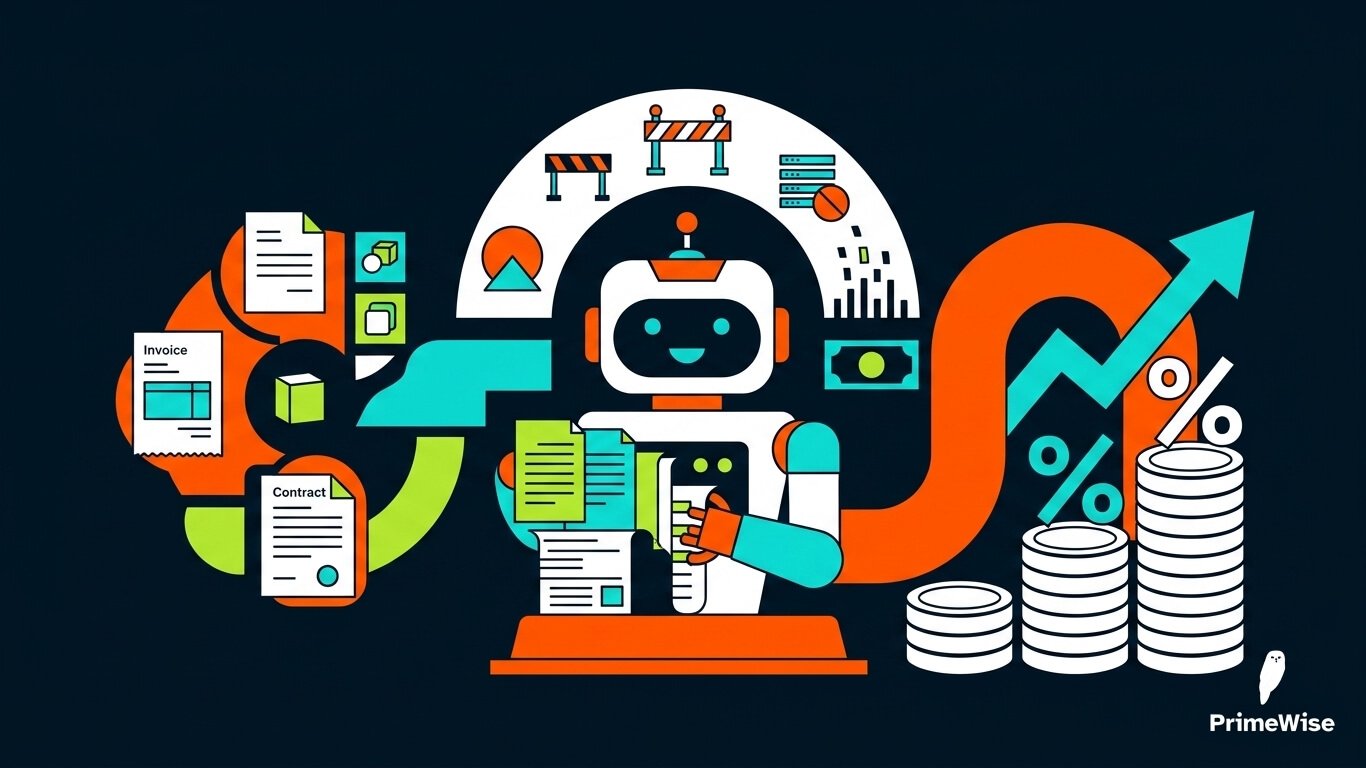
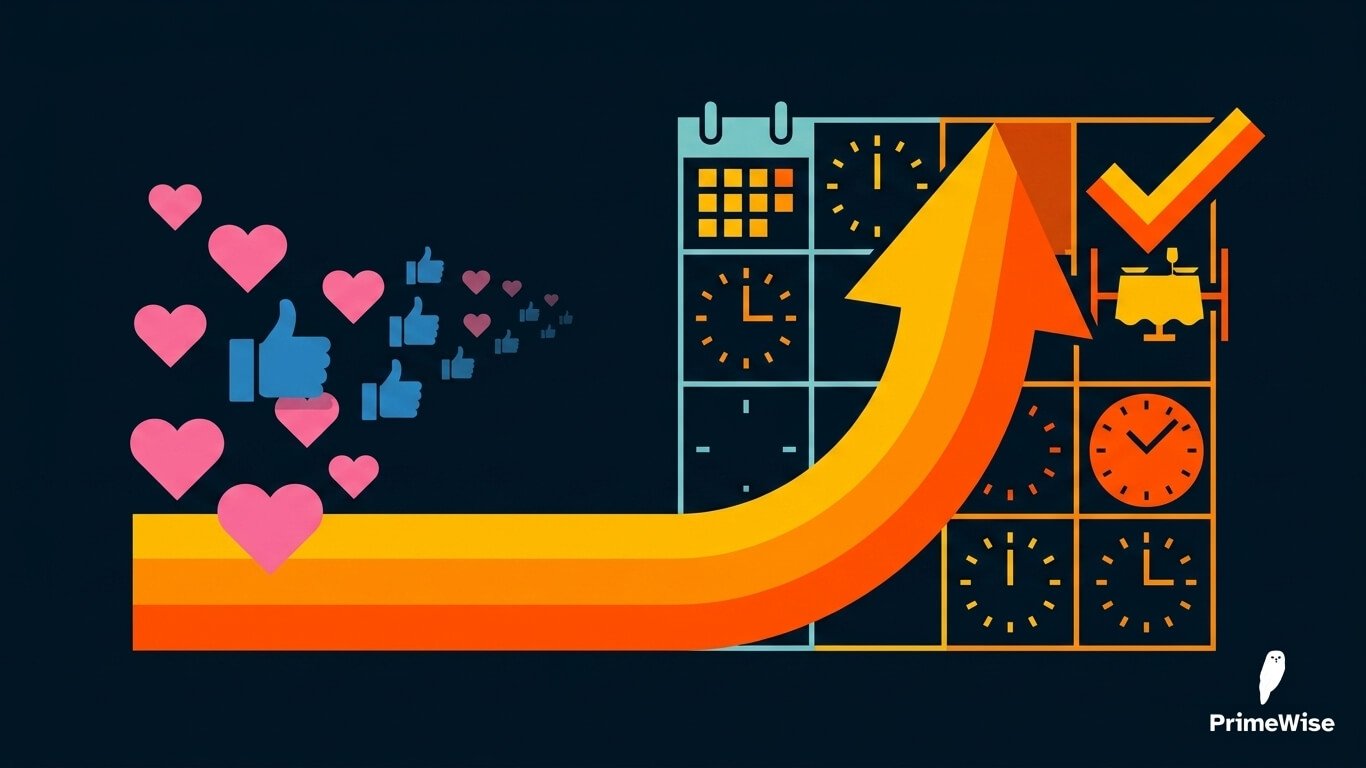
Instagram restaurant marketing is haemorrhaging operator budgets across the UK, and the culprit is not the platform; it is the strategy. As a social-first restaurant marketing agency that has run Instagram operations for over 40 UK restaurant brands, we’ve seen a brutal pattern: operators invest in beautiful content, grow a respectable following, and still sit with half-empty dining rooms on a Tuesday. In 2026, the platform has matured into a high-velocity booking engine, and the operators who treat it as a digital lookbook are financing their own insolvency. This guide dismantles what does not work and delivers the exact yield management architecture that converts passive scrollers into confirmed covers.
EXECUTIVE SUMMARYChasing follower counts in 2026 is a fast track to insolvency. UK restaurant operators must abandon vanity publishing and adopt Instagram yield management, a system built on the 1:3:10 content cadence, automated DM booking workflows, frictionless deep links, and three commercial metrics: saves, profile-to-link clicks, and DM-to-booking ratio. This framework transforms Instagram from a digital lookbook into a guaranteed covers engine.
What Is Instagram Yield Management for Restaurants
Instagram yield management is the strategic process of converting social media attention into guaranteed restaurant covers by treating every piece of content as a commercial asset with a measurable return. It bypasses vanity metrics followers, likes, reach and instead deploys targeted content pillars, automated direct message workflows, and frictionless booking architecture to maximise daily revenue and fill distressed inventory. For UK operators navigating commercial rents that UKHospitality’s 2025 Cost of Trading Report identifies as one of the top three profitability threats to independent restaurants, passive social publishing is not a neutral activity it is an active drain on margin.
Why Follower Counts Will Bankrupt Restaurants
Algorithm fatigue has entirely severed the connection between passive scrolling and dining intent. A restaurant with 40,000 followers and a meticulously curated aesthetic grid is not generating bookings; it is generating validation for its photographer. The fundamental commercial reality is that a highly engaged local audience of 2,000 followers, equipped with a frictionless booking funnel, will consistently outperform a disengaged mass following with no conversion architecture. In metropolitan markets, internal data from primewise.co.uk’s managed restaurant accounts demonstrates that optimised booking-intent content generates a save-to-physical-cover correlation of approximately 1:15, meaning 150 saves on a single piece of content equates to roughly ten confirmed tables. Reach is a vanity statistic. Saves are a forward booking pipeline.
The Death of the Curated Grid
The meticulously curated grid is a relic of the previous decade. Investing capital into highly stylised food photography that generates passive likes actively drains profitability because it produces zero urgency and zero transactional signal. Diners in 2026 do not make booking decisions based on aesthetic perfection or tag-a-friend engagement bait. They require dynamic, conversion-focused content that communicates atmosphere, value, and immediate availability. The budget shift from static grid curation to agile video production is not a creative preference; it is a survival mechanism for venues operating under the UK cost-of-trading pressures that are squeezing independent operators out of the market.
The 2026 Content Architecture That Converts
Pivoting from aesthetic theory to tactical application requires understanding what genuinely triggers a bottom-of-funnel transaction. The conversion architecture that drives physical covers in 2026 is built on three interconnected content pillars: sensory urgency, operational transparency, and local social proof. This is not about producing more content; it is about producing the right content in the right format at the right frequency. Generic food photography and lifestyle aesthetics have been commoditised beyond recovery. What converts is specificity, authenticity, and an immediate reason to act.
Sensory Urgency Over Sterile Photography
Replacing standard food photography with operational transparency generates immediate sensory urgency that sterile staging cannot replicate. Capturing the chaotic energy of a fully booked Friday service, the amber low-light of a packed dining room at 8pm, or a tableside wine pour mid-conversation provides authentic atmospheric context that prospective diners cannot get from a flatlay. This unfiltered operational content leverages a fear of missing out that is visceral and immediate. It proves the venue is highly sought after without a single word of marketing copy. Raw behind-the-scenes content consistently converts at a higher rate than staged photography across every restaurant account audited through primewise.co.uk’s performance tracking system.
The Algorithm-Optimised 1:3:10 Cadence
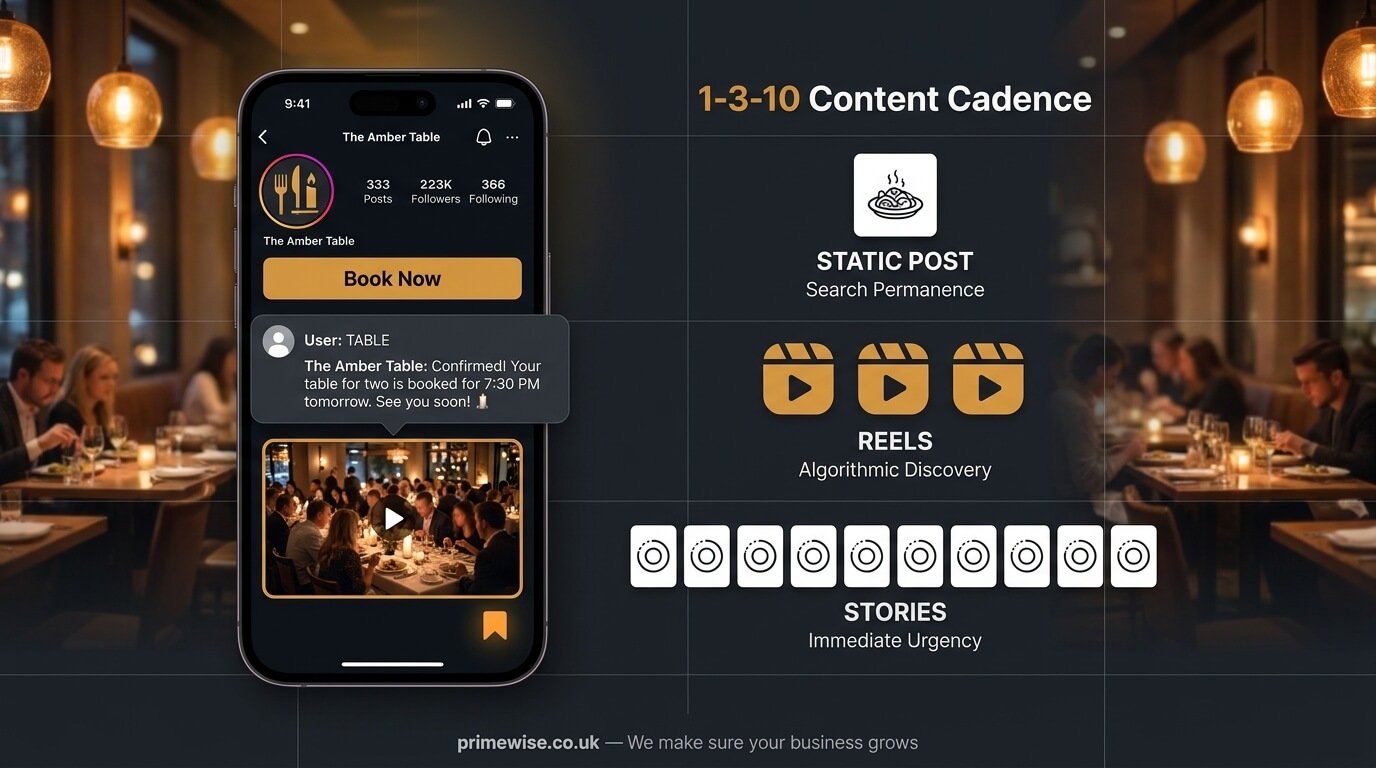
The content cadence that consistently outperforms in 2026 follows a precise weekly ratio: one static post, three Reels, and ten Stories. Each format serves a fundamentally different commercial purpose within the funnel, and the ratio is not arbitrary it is calibrated to satisfy the demands of Meta’s current algorithmic prioritisation while capturing distinct user intents across discovery, consideration, and transaction stages.
- One static post per week provides local search permanence, menu permanence, and indexed content that surfaces in location-based discovery within the platform and via Google’s image indexing
- Three Reels per week drives algorithmic discovery across new hyper-local audiences, leveraging short-form video’s continued dominance in Meta’s distribution model
- Ten Stories per week manufactures immediate urgency, communicates daily specials, and broadcasts last-minute table availability to an already-warm, already-engaged audience segment
- This cadence satisfies Meta’s content freshness signals without overwhelming the production capacity of an independent restaurant marketing operation
- Static posts should be engineered specifically to save definitive menu guides, seasonal reveal content, or exclusive private dining announcements that perform consistently above benchmark
Distressed Inventory Management and Same-Week Visits
Last-minute cancellations and quiet mid-week services represent acute revenue haemorrhages in the high commercial rent environment of the UK market. A Friday night table that cancels at 5pm is a perishable asset with a two-hour expiry. Distressed inventory management uses ephemeral content primarily 24-hour Stories to instantly plug these revenue leaks and turn operational disruptions into demand triggers. Operators who have implemented this approach through structured waitlist systems report same-week booking recovery rates that would otherwise require expensive paid advertising to achieve.
Flash Bookings and Waitlist Drops
When a prime table cancels, the correct response is an immediate interactive waitlist drop via Stories. By requiring a pre-authorised deposit through a direct message link routed through the booking platform, restaurants convert engaged followers into guaranteed covers within minutes. This creates a competitive micro-environment where highly engaged patrons feel privileged to secure a last-minute reservation. The pre-authorisation component is critical: it eliminates the secondary no-show risk that undermines the value of last-minute promotional tactics, ensuring the distressed inventory genuinely converts to recognised revenue rather than a second cancellation.
Hyper-Local Disruption Marketing
Hyper-local marketing must pivot dynamically during infrastructure disruptions that reshape London’s commuter patterns in real time. Transport for London strikes, National Rail delays, and sudden adverse weather events create predictable surges in stranded workers and frustrated commuters seeking immediate dining alternatives. Operators with pre-built Stories templates for disruption scenarios can deploy a targeted flash offer within minutes of a TFL announcement, positioning the venue as a premium refuge while competitors are still updating their generic posting schedules. This hyper-contextual approach deeply resonates with London’s working demographics and converts logistical frustration into unexpected hospitality revenue at near-zero marginal marketing cost.
OPERATOR INSIGHTMeta's UK Business Insights data for 2025 confirms that direct message interactions with business accounts correlate to purchase intent at a significantly higher rate than public engagement. For restaurants, this makes the DM inbox the highest-value commercial real estate on the entire platform, not the feed, not the Reels tab. Treat it accordingly.
Frictionless Booking Architecture
The digital pathway to a confirmed reservation must be held to the same rigorous standards as front-of-house service. Every unnecessary tap, every additional page load, every moment of decision fatigue between a prospective diner’s first spark of intent and a confirmed booking represents revenue that evaporates silently. Operators who have invested in high-quality content production but neglected the booking pipeline architecture are building a funnel with a deliberately broken bottom.
Eradicating Linktree Bloat
The standard practice of presenting profile visitors with a multi-link landing page featuring menus, gift vouchers, events, press coverage, and a booking button buried beneath five other options is a primary driver of digital revenue abandonment. Decision fatigue is a measurable psychological phenomenon, and Linktree-style landing pages weaponise it against conversion. A fully optimised restaurant profile bio in 2026 presents a single, definitive call to action that routes directly to the live booking widget. A minimum benchmark of 4.5% profile-to-link click-through rate is achievable with this architecture; profiles relying on multi-link pages routinely underperform this threshold by a factor of two or more.
Automated DM Keywords and Platform Deep-Linking
ManyChat is the dominant Instagram DM automation platform in 2026 and operates within Meta’s approved API framework, making compliant automation accessible to independent operators without technical development resources. The workflow is straightforward: a keyword trigger is embedded in a Reel caption or Stories sticker, for example, a diner comments the word TABLE on a Reel, and ManyChat’s automation instantly delivers a personalised direct message containing a deep link routed directly to a specific time slot within Resy or SevenRooms. The prospective diner never visits the profile bio, never encounters a landing page, and books within a single tap. Configuring this system requires a connected Meta Business Suite account, a ManyChat Pro subscription, and API integration with the chosen booking platform, a setup that takes approximately two hours and generates measurable booking uplift from the first week of deployment.
- ManyChat Pro connects directly to Meta Business Suite and operates within compliant API parameters, with no risk of account restriction when configured correctly
- Deep links route users to a specific date and time slot rather than the generic booking homepage, reducing abandonment at the final conversion step
- SevenRooms and Resy both support deep-link URL structures compatible with ManyChat’s message delivery system
- Keyword triggers should be simple, memorable, and directly referenced in the content: TABLE, BOOK, TONIGHT, or RESERVE all perform reliably
- Every automated DM sequence should include a UTM parameter to track booking completions attributable to that specific content piece
The Creator Collaboration Protocol
The UK influencer economy has become saturated with free-meal tourists who extract complimentary dining in exchange for broad, untargeted reach with no proven conversion history. London lifestyle bloggers and food content creators who demand comped covers and offer exposure in return routinely fail to deliver a single paying customer. Reframing influencer relationships from public relations activity to trackable performance marketing is not optional for operators who require executive-level financial transparency; it is the prerequisite for allocating any budget to creator partnerships at all.
The Primewise Creator Vetting Standard
Vetting creators with rigorous commercial criteria eliminates free-meal tourists before they reach the reservation stage. The following five-point framework applied across primewise.co.uk’s managed accounts identifies creators who deliver measurable footfall versus those who deliver vanity metrics:
- Audience geography: a minimum of 60% of the creator’s verified audience must be located within the restaurant’s primary catchment area, not broader London, not the UK, the specific neighbourhood or borough
- Engagement rate: nano-influencers under 10,000 followers must demonstrate a minimum 3.2% engagement rate; micro-influencers between 10,000 and 50,000 should hold above 1.8%
- Historical booking code data: any creator who cannot provide at least one prior example of a trackable UTM or booking code result should not receive a complimentary cover, no exceptions
- Content category alignment: the creator’s primary content must align with the restaurant’s price point and dining occasion. A budget bruncher with 80,000 followers delivers nothing to a fine dining venue targeting corporate entertainment spend
- Performance agreement: all collaborations must be formalised with a performance-linked clause specifying a minimum measurable outcome before the next collaboration is offered
Mandating trackable UTM parameters and bespoke booking codes for every single creator collaboration provides empirical evidence of true commercial value. This data empowers hospitality directors to ruthlessly cut underperforming partnerships and concentrate budget on genuine revenue drivers the exact approach that separates operators building sustainable businesses from those haemorrhaging marketing spend on digital ego metrics.
CRITICAL WARNINGNever offer a complimentary dining experience to a creator who cannot demonstrate prior booking conversion data. Audience size is not a proxy for purchase intent. A hyper-local Soho food creator with 4,000 followers and a 60% local audience will deliver more guaranteed covers than a national lifestyle influencer with 200,000 followers and 3% local reach. Demand the data first.
The Only Three Metrics Worth Tracking
Simplifying executive reporting requires stripping away the noise of vanity analytics and aligning digital measurement exclusively with physical restaurant revenue. Reach, impressions, follower growth, and profile visits are informational data points at best and dangerous distractions at worst. The three metrics that matter in 2026 are saves, profile-to-link clicks, and the DM-to-booking ratio. Each maps directly to a specific stage of the conversion funnel and produces actionable commercial intelligence.
Saves as the Forward Booking Pipeline
Saves have entirely replaced likes as the primary behavioural indicator of high-intent audience activity. A saved post represents a prospective diner bookmarking a venue for forward planning weekend dining decisions, special occasion research, or corporate event scouting. Content engineered specifically to generate saves definitive seasonal menu reveals, exclusive private dining announcements, and location-specific dining guides directly fuels the forward booking pipeline. Operators should track saves as a lead indicator metric, reviewing weekly volume against confirmed bookings with a two-to-four-week lag to identify the correlation pattern specific to their venue type and average booking lead time.
Profile-to-Link Clicks for Funnel Efficiency
The flow of traffic from content consumption to the booking engine is measured by the profile-to-link click-through rate. The empirical benchmark for a well-optimised restaurant profile in 2026 stands at a minimum of 4.5%. If a profile is generating consistent content visibility but failing to reach this threshold, the bio call to action, the link architecture, or the alignment between content promise and bio delivery is fundamentally broken and requires immediate conversion rate optimisation. This single metric diagnoses the health of the mid-funnel more precisely than any other available data point in the platform’s native analytics suite.
Mastering the DM-to-Booking Ratio
The DM-to-booking ratio is the ultimate commercial performance indicator for Instagram yield management. It measures the revenue-generating power of automated messaging workflows by tracking precisely how many ManyChat-triggered deep-link deliveries result in a confirmed, seated cover. A well-configured automation workflow targeting a warm, local audience should convert inbound DM interactions to bookings at a rate of between 18% and 26% figures derived from primewise.co.uk’s managed account performance data across UK independent restaurants. If the ratio falls below 15%, the issue is typically one of three things: the deep link is routing to a generic booking page rather than a specific time slot, the keyword trigger is attracting low-intent users, or the Stories content generating the DM trigger lacks sufficient urgency.
Audit Your Instagram Booking Engine
The gap between an Instagram presence that looks professional and one that genuinely fills covers is entirely operational it lives in the automation workflows, the link architecture, the creator vetting process, and the three metrics that map directly to physical revenue. Operators seeking a structured diagnostic of their current Instagram yield performance can access primewise.co uk’s hospitality marketing audit, built specifically for UK independent restaurants and group operators. The audit benchmarks profile-to-link click-through rate, DM conversion architecture, content cadence alignment, and creator collaboration ROI against current UK market performance data and produces a prioritised action plan with measurable output targets. The difference between an Instagram account that costs money and one that generates it is not creative talent. It is commercial architecture.
NEXT STEPIf your restaurant's Instagram generates consistent content engagement but fails to deliver confirmed covers at scale, the booking architecture is broken, not the content. A full yield management audit from primewise.co.uk will identify exactly where the funnel is leaking and deliver a prioritised action plan with measurable conversion targets. Book a strategy session at primewise.co.uk.
Local Restaurant Discovery and Voice Search Alignment
Dominating local discovery in 2026 requires aligning the Instagram profile captions, alt text, location tags, and highlight labels with the natural language queries that London and UK diners are directing at voice assistants and AI-powered search interfaces. Queries such as best restaurant near me tonight, quiet tables for two in Soho this weekend, and private dining London with outdoor terrace are being resolved by AI engines that draw on structured, keyword-rich social signals as well as traditional web content. Operators who optimise their Instagram captions with location-specific, occasion-specific language and who structure their Story highlights to function as a navigable menu of dining occasions consistently surface in both platform search and AI-generated dining recommendations at a higher rate than those relying purely on aesthetic posting without semantic intentionality.