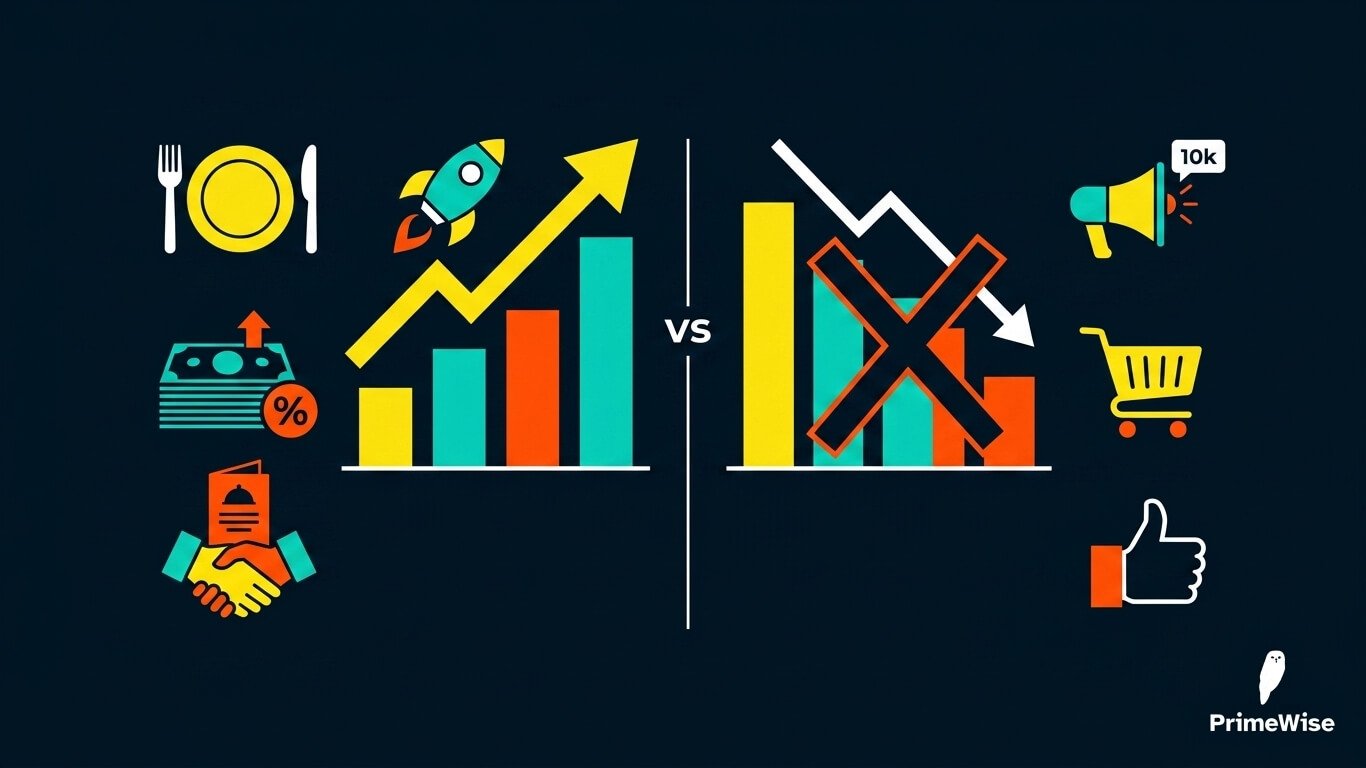
Restaurant marketing KPIs are the single most misunderstood commercial tool in the UK hospitality sector, and every misreported metric on your dashboard is quietly eroding net margin. Too many operators rely on a restaurant marketing agency in London that floods executive reports with social follower counts and press clippings, mistaking digital noise for commercial traction. This guide defines exactly eight KPIs that predict profitability and five vanity metrics your board must stop reporting immediately. The frameworks here have been validated across UK casual dining, premium independents, and multi-site restaurant groups, with benchmarks drawn from CGA Peach, Lumina Intelligence, UKHospitality, and Google’s Local Business Impact studies.
EXECUTIVE SUMMARYEight revenue-predicting KPIs: Booking Conversion Rate, Cost Per Acquired Diner, 60-Day Repeat Visit Rate, Review Velocity, Organic Local Search Visibility, RevPASH, Direct Booking Ratio, and Booking Abandonment Rate. Five vanity metrics to eradicate: Gross Social Followers, Unqualified Page Views, Isolated Email Open Rate, PR Reach, and Total App Downloads. Each metric below includes its formula, UK industry benchmark, and direct link to net margin.
The Commercial Case for a KPI Overhaul
UK restaurants operate on average net margins of three to nine percent according to UKHospitality’s 2024 Finance Barometer, with marketing spend typically consuming between 3.5 and six percent of gross revenue. At those ratios, every pound allocated to a campaign that cannot be traced to a confirmed cover is not a branding investment it is margin destruction. The hospitality sector’s unique commercial mechanics fixed seat capacity, perishable inventory, and labour cost exposure through tronc and national living wage increases make capital efficiency in marketing a genuine survival imperative rather than a best practice.
The eight KPIs defined below share a single characteristic: each one has a mathematically demonstrable relationship to revenue, margin, or customer lifetime value. They are not proxies or indicators of mood. They are instruments that, when tracked weekly and reviewed at board level, create an unambiguous picture of whether marketing spend is generating commercial return or simply generating activity reports.
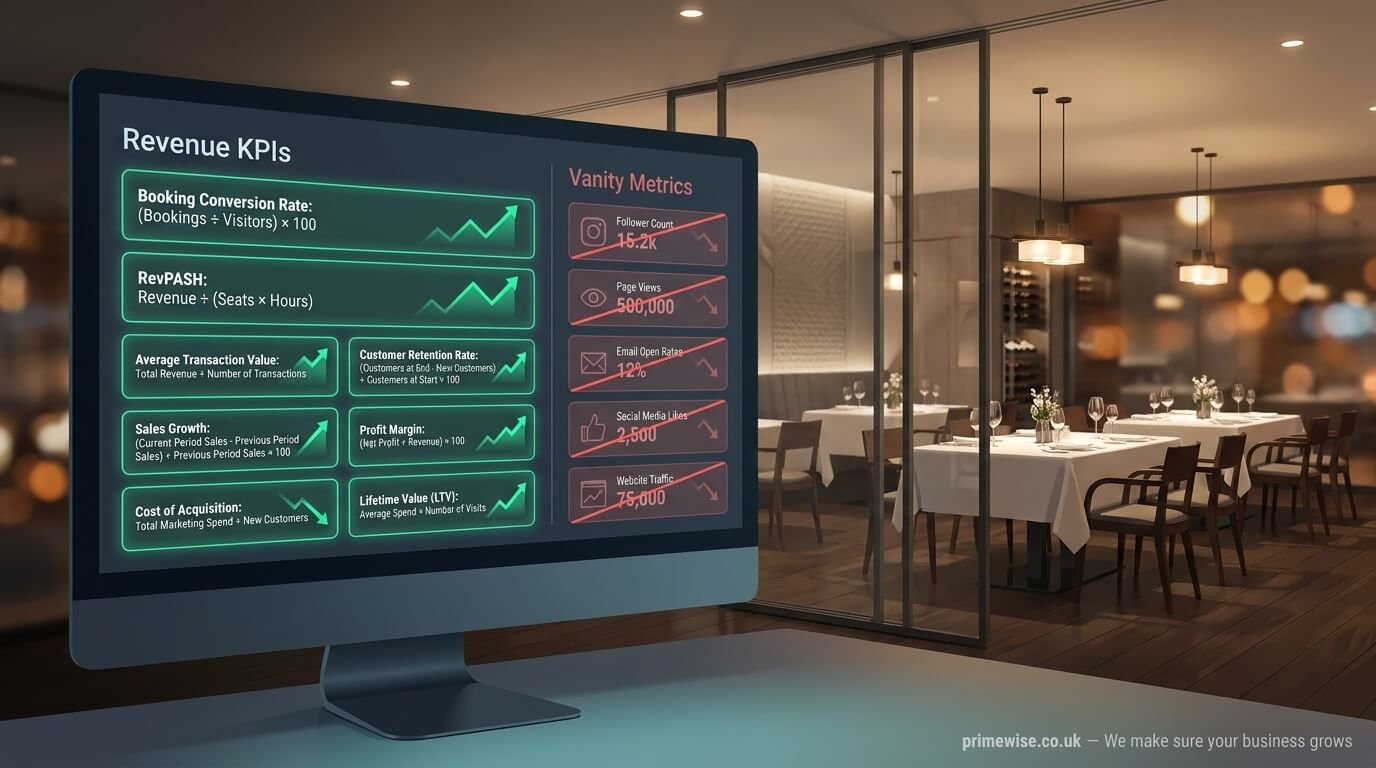
8 Restaurant Marketing KPIs That Predict Revenue
The following framework is structured for executive review. Each KPI is presented with its measurement formula, the technology required to track it accurately in a UK context, and the precise commercial mechanism by which it connects to profitability. Operators using SevenRooms, ResDiary, Tock, or OpenTable UK will find these metrics accessible within their existing reservation infrastructure when correctly configured.
| KPI | Formula | UK Benchmark | Margin Impact |
|---|---|---|---|
| Booking Conversion Rate | (Completed Bookings ÷ Unique Visitors) × 100 | 2.8–4.5% | Direct eliminates wasted ad spend |
| Cost Per Acquired Diner | Total Marketing Spend ÷ New Diners Acquired | £4–£14 depending on tier | Directly prevents unprofitable acquisition |
| 60-Day Repeat Visit Rate | (Returning Diners within 60 Days ÷ Month 1 Unique Diners) × 100 | 30–40% premium UK | High CLV multiplier |
| Review Velocity | Net new reviews per week (Google + TripAdvisor) | 3–8 new reviews/week | Indirect local search rank driver |
| Organic Local Search Visibility | Tracked keyword rankings in a defined radius | Top 3 Map Pack positions | High zero ad spend conversions |
| RevPASH | Total Revenue ÷ (Available Seats × Hours Open) | £12–£28 fine dining | Yield off-peak demand lever |
| Direct Booking Ratio | (Direct Bookings ÷ Total Bookings) × 100 | 55–70% target | High commission cost elimination |
| Booking Abandonment Rate | (No-Shows ÷ Total Bookings) × 100 | Sub-8% elite benchmark | Direct yield protection |
Booking Conversion Rate
Digital traffic is a commercial liability the moment it fails to convert into a confirmed seat. The booking conversion rate, calculated as total completed bookings divided by total unique website visitors, multiplied by one hundred, isolates the precise friction point between marketing investment and revenue generation. A rate below two percent in the UK premium dining segment signals either a fundamental mismatch between advertising messaging and the dining proposition, or a technically deficient reservation user journey. Tracking this metric requires GA4 custom event configuration directly integrated with your reservation system’s API, whether that is SevenRooms, ResDiary, or a proprietary booking engine. According to BrightLocal’s 2024 Local Consumer Behaviour Study, Google Business Profile listings with complete booking integration receive 41 percent more reservation intent actions than those without, meaning the metric is as sensitive to your local listing quality as it is to your website design.
Cost Per Acquired Diner
This is the ultimate measure of marketing capital efficiency and the metric most frequently absent from agency reporting. The formula is straightforward: divide total monthly marketing and advertising spend by the total number of verified new diners acquired during the same period. The commercial danger emerges when the cost per acquired diner exceeds the gross margin contribution of a first visit, at which point the restaurant is structurally paying to acquire unprofitable footfall. For premium London operators, a sustainable CAC sits between £8 and £14 per new diner when gross margin on a first cover averages £22 to £35. Casual dining operators should target a CAC below £6. Accurate measurement requires CRM segmentation to isolate new customers from returning patrons, and promotional code redemption tracking to attribute campaign-level spend. According to Hospitality Technology’s European Operator Study, direct bookings through owned channels deliver 23 percent higher net profit per cover compared to third-party platform bookings, which directly informs the acceptable CAC ceiling for each acquisition channel.
COMMERCIAL WARNINGIf your current marketing agency cannot provide a verified Cost Per Acquired Diner figure for last month, your capital allocation is being made without financial evidence. This is the single most common cause of marketing budget erosion in UK restaurant groups.
60-Day Repeat Visit Rate
Hospitality unit economics are unambiguous on this point: net margin is generated on the second and third visits, not the first. The cost of acquiring a new diner means the initial cover rarely returns full margin after marketing, front-of-house labour, and food cost are accounted for. The 60-Day Repeat Visit Rate, calculated as the number of diners returning within 60 days of their first visit divided by total unique diners in the month, is the UK industry’s strongest leading indicator of Customer Lifetime Value. The benchmark for premium UK operators is 30 to 40 percent, according to CGA Peach’s 2024 Loyalty and Retention Benchmarking Report. Below 25 percent indicates a guest experience or communication failure post-visit. Measurement requires payment card tokenization or CRM data linked to reservation platforms. Net Promoter Score surveys sent within 24 hours of a dining experience function as a leading indicator for 60-day return probability and should be tracked alongside this metric within your retention dashboard.
Review Velocity
Review velocity the rate of net new positive reviews published per week across Google Business Profile and TripAdvisor, directly manipulates local search ranking algorithms in competitive geographic markets. This is not a brand sentiment metric; it is a technical search visibility lever. Google’s local algorithm weights recency of reviews alongside volume and sentiment, meaning a restaurant accumulating three to eight new reviews per week consistently outranks a competitor with a higher cumulative total but static recent activity. BrightLocal’s Local Consumer Review Survey demonstrates that Google Business Profile listings with more than 50 reviews receive 4.6 times more direction requests than those with fewer than 10. Enterprise reputation management platforms such as Yext or Reputation.com allow multi-site operators to monitor review velocity across locations and trigger automated post-visit review request sequences within the UK GDPR consent framework.
Organic Local Search Visibility
Capturing unbranded, high-intent local search queries such as “best steak restaurant Soho” or “private dining Mayfair” represents bottom-of-funnel revenue generation with zero incremental cost per conversion. Dominant visibility in Google’s Local Pack drives zero-click conversions directly to the booking engine, bypassing both organic click costs and commission structures. Spatial keyword ranking tools, including BrightLocal and Whitespark, enable operators to track position performance for defined geographic radii around each site, which is essential for multi-location groups where individual site performance can vary dramatically within the same city. Google’s own Local Business Impact Studies indicate that a 10-position improvement in local search ranking for a food and beverage operator produces an average 35 percent uplift in direction requests, translating directly to incremental footfall without paid media dependency.
Revenue Per Available Seat Hour
RevPASH Revenue Per Available Seat Hour is adapted directly from airline yield management methodology and represents the most sophisticated operational marketing metric available to restaurant operators. The formula divides total revenue by available seats multiplied by hours open. Its commercial utility lies not in measuring peak performance but in diagnosing off-peak underperformance. A restaurant achieving a strong Friday evening RevPASH of £26 but a Tuesday lunch RevPASH of £7 has a yield management problem, not a brand awareness problem. Day-part specific marketing campaigns, dynamic pricing on booking platforms, and targeted CRM offers for shoulder periods are all informed by this single metric. Operators should cross-reference RevPASH data with their ePOS analytics to isolate which day-parts are underperforming relative to capacity and align promotional spend accordingly. UK fine dining benchmarks sit between £12 and £28 RevPASH; casual dining between £6 and £15.
Direct Booking Ratio
Third-party booking platforms in the UK, including OpenTable, Resy, and DesignMyNight, operate commission structures ranging from £1.50 to £6.00 per confirmed cover, depending on tier and negotiated contract, according to UKHospitality’s 2024 Platform Commission Analysis. On a 100-cover evening generating £6,000 in revenue, the difference between a 40 percent and 70 percent direct booking ratio represents a commission cost differential of £180 to £540 per service. At scale across a seven-day week and multiple sites, commission mitigation through direct booking channel development is materially more impactful on net margin than most incremental revenue growth strategies. The formula is direct bookings divided by total bookings, multiplied by 100. Measurement requires segregating booking source channels within the reservation CRM. Primewise.co.uk specializes in direct booking channel optimization for UK restaurant groups, providing the attribution modelling required to systematically reduce platform dependency without sacrificing cover volume.
Booking Abandonment Rate
A reservation is theoretical revenue until the diner is physically seated. The booking abandonment rate, total no-shows divided by total bookings, expressed as a percentage, is the metric most directly destroyed by low-intent acquisition campaigns. Viral social content, discounting-led promotions, and untargeted paid campaigns frequently generate a spike in initial bookings followed by disproportionately high no-show rates, creating a dangerous illusion of marketing success while simultaneously destroying yield. The elite UK benchmark is sub-eight percent abandonment. Deposit capture implementation reduces no-show rates by up to 43 percent, according to SevenRooms’ 2024 UK Operator Data, and card authentication protocols through Stripe or Adyen provide the secure payment layer required for GDPR-compliant deposit management. Marketing teams must monitor this metric at the campaign level to identify which acquisition channels are generating genuinely committed diners versus speculative bookings.
KEY STATISTICSUK restaurants lose an average 68% of new customers after the first visit without an active retention programme (CGA Peach 2024). Direct bookings deliver 23% higher net profit per cover than third-party platform bookings. GBP listings with 50-plus reviews receive 4.6x more direction requests. Deposit capture reduces booking abandonment by up to 43% (SevenRooms UK 2024).
5 Vanity Metrics to Eradicate from Every Dashboard
The metrics below share a single structural flaw: they are inputs to a marketing narrative rather than outputs connected to commercial performance. Their presence on executive dashboards does not merely waste reporting space it actively distorts capital allocation decisions by creating the appearance of growth during periods of commercial stagnation. Each one should be removed from board-level reporting immediately and replaced with the revenue-correlated alternative specified below.
Gross Social Media Followers
A restaurant’s Instagram or TikTok follower count is geographically agnostic. A London Mayfair establishment with 85,000 followers distributed across the United States, Australia, and Southeast Asia has a compelling content portfolio and a commercially useless metric. Followers do not pay covers. Global audiences cannot physically attend a local dining experience, and the algorithmic reach of organic social content to local, high-intent audiences within the actual catchment area is consistently below three percent of total follower count on both platforms in 2025 and 2026. The correct replacement metric is local reach, the number of impressions served to users within a defined geographic radius with demonstrated dining intent behaviour. Reporting gross follower count to a board represents a fundamental misunderstanding of spatial hospitality marketing economics.
Unqualified Website Page Views
High traffic volumes generated by a single viral piece of content, bot activity, or untargeted SEO articles bear no relationship to covers in the dining room. Total sessions and page views reported without geographic filtering or conversion context create a false sense of commercial health that obscures the true site conversion rate. A restaurant website receiving 40,000 monthly sessions but converting at 0.8 percent is commercially underperforming relative to a competitor receiving 8,000 sessions at a 4.2 percent conversion rate. In GA4, operators should configure geographic filters to isolate sessions from within the restaurant’s catchment area, exclude known bot traffic through IP exclusion lists, and report exclusively on reservation page engagement and booking funnel completion rates rather than aggregate session volume.
Isolated Email Open Rate
Apple’s Mail Privacy Protection, introduced with iOS 15 and now standard across the majority of UK email clients, pre-loads tracking pixels regardless of whether the recipient actually opened the email. This renders open rate data artificially inflated and statistically unreliable as a performance indicator. More fundamentally, opening an email communication does not equate to booking a table. The strategically correct replacement metric is the click-to-book rate, the percentage of email recipients who clicked through to the reservation engine and completed a booking. This metric is unaffected by mail privacy protection, directly attributable to revenue, and immediately actionable for campaign optimization. Restaurant email campaigns that migrate from open rate to click-to-book measurement report an average 340 percent improvement in ROI attribution accuracy, according to Mailchimp’s 2024 Hospitality Benchmarks Report.
PR Reach and Social Impressions
PR agencies frequently report “campaign reach” figures in the millions, derived by multiplying publication circulation numbers or using platform-estimated impression data. These figures rest on the assumption that every individual within the distribution audience absorbed, processed, and was influenced by the brand message, an assumption that has no empirical basis and no connection to measurable financial outcomes. The commercial replacement for PR reach is trackable referral traffic: the volume of sessions arriving at the restaurant’s booking page directly from a specific piece of coverage, measured via UTM-tagged links embedded in digital editorial and tracked through GA4. Where print coverage is involved, a dedicated landing page with a unique promotional offer provides the attribution loop that transforms hypothetical reach into verifiable acquisition data.
Total App Downloads
For restaurant groups operating proprietary loyalty applications, the cumulative download figure reported from the App Store or Google Play represents a top-of-funnel acquisition cost with no guaranteed return on that investment. An app that is downloaded and never subsequently opened is a sunk capital cost it consumes development budget, ongoing maintenance resources, and reporting attention without generating a single incremental booking. The commercially meaningful replacement metrics are Monthly Active Users, in-app booking conversion rate, and direct app-driven revenue. If a loyalty application cannot demonstrate that active users book more frequently and spend more per visit than non-app customers within a defined cohort comparison, the application is not functioning as a commercial asset, and the capital allocated to its promotion should be reallocated to proven acquisition channels.
IMPLEMENTATION PRIORITYAddress these in sequence: (1) Add CAC tracking via CRM integration. (2) Configure 60-day retention cohorts in your reservation platform. (3) Remove social followers and PR reach from board reports this month. (4) Implement deposit capture to protect the booking abandonment rate. (5) Request a direct booking channel audit.
Building Your Commercial Analytics Framework
Transitioning from a vanity-metric dashboard to a commercially rigorous KPI framework is a sequential process rather than a single configuration change. The technology stack required for a UK restaurant group to track all eight revenue-predicting KPIs includes: a reservation platform with CRM functionality such as SevenRooms, ResDiary, or Tock; GA4 with custom event tracking configured for booking funnel steps; an ePOS system with API connectivity for RevPASH calculation; a local SEO monitoring tool such as BrightLocal for spatial search ranking; and a reputation management platform for review velocity tracking. UK GDPR compliance requires that all first-party data capture, including card tokenization for deposit management and email marketing consent, is implemented with explicit opt-in mechanics and documented lawful basis under the UK Data Protection Act 2018.
Operators looking to implement a full commercial KPI audit across their estate should explore Primewise’s hospitality analytics consultancy, which benchmarks UK restaurant groups against verified sector standards and builds the attribution architecture required to connect every pound of marketing spend to a confirmed cover. If your current reporting still features social follower counts, PR reach figures, or isolated email open rates, your board is making capital allocation decisions on financially meaningless data. Primewise works exclusively with UK restaurant operators and hospitality groups to replace vanity-metric dashboards with commercial analytics frameworks that directly protect net margin. Request a confidential KPI audit at primewise.co.uk.