What is four wall restaurant marketing? It is the strategic practice of using every element within a restaurant’s physical premises from server scripts to receipt design to acquire, retain, and monetise guests without relying on external digital advertising spend. While most operators haemorrhage margin to aggregator commissions and paid social campaigns, the smartest hospitality businesses in the UK are turning inward. Working with a specialist restaurant marketing agency that understands this framework is one of the most commercially significant decisions an operator can make in 2026.
What Four Wall Restaurant Marketing Actually Means
Four wall restaurant marketing treats your physical dining room as the highest-yield acquisition channel your business owns. Rather than renting audiences from Meta, Deliveroo, or Just Eat, it systematises the guest experience from arrival to exit into a self-reinforcing marketing engine. Every server interaction, table-side moment, and bill presentation becomes a deliberately engineered conversion touchpoint designed to maximise guest lifetime value, capture first-party data, and generate organic advocacy all at near-zero marginal cost.
The framework inverts the conventional marketing logic. Instead of spending to bring strangers in, it invests in converting the guests already seated in front of you into returning patrons and active brand advocates. In a market where UK restaurant digital customer acquisition costs are estimated between £8 and £22 per new diner, the yield of optimising the physical room is mathematically staggering by comparison.
The Financial Case Your Spreadsheet Is Missing
The aggregator tax is not metaphorical it is a documented structural margin drain. Deliveroo, Just Eat, and Uber Eats charge UK operators between 25% and 35% commission on every order processed through their platforms. For a £40 average cover, that means between £10 and £14 leaves the business before a single operational cost is accounted for. In high-rent London zones such as Soho or Mayfair, where commercial rates already compress profitability to single-digit margins, this commission structure is arithmetically unsustainable.
The alternative calculus is compelling. Industry data suggests the average UK restaurant converts approximately 60 to 70 percent of seated guests into one-time visitors, but fewer than 15 percent return within 90 days. A 5 percent improvement in that repeat visit rate, achieved through systematic four wall marketing, generates net profit growth that no paid social campaign operating at prevailing UK CPMs can match. Top-performing London casual dining operators achieve £800 to £1,200 in annual revenue per square foot, against the UK sector average of £350 to £500. The gap between those two figures is largely an operational and in-house marketing problem, not an advertising spend problem.
THE AGGREGATOR MATHSUK delivery platforms charge 25–35% commission per order. On a £40 cover, you are surrendering up to £14 before fixed costs. Four wall marketing recovers margin from guests already in your seats.
The Four Wall Flywheel Explained
The Four Wall Flywheel is a closed-loop model in which each in-house touchpoint feeds the next, compounding retention and advocacy without incremental ad spend. A guest arrives, is immersed in a brand narrative through server storytelling, witnesses a theatrical table-side moment, captures and shares content organically, exchanges data for a tangible incentive, and departs with a receipt that functions as a retargeting device for their next visit. Each rotation of this flywheel increases guest lifetime value (GLTV), reduces net customer acquisition cost, and diminishes the restaurant’s structural dependency on third-party platforms.
Understanding this flywheel reframes how operators should think about RevPASH Revenue Per Available Seat Hour the hospitality industry’s primary yield management metric. Most operators measure RevPASH in terms of throughput and cover price alone. Four wall marketing expands that metric to include the downstream value of each seated guest: the social impressions generated, the data captured, the return visits triggered, and the word-of-mouth referrals initiated. When RevPASH is understood in full, the in-room experience becomes the most valuable asset on the balance sheet.
Five High ROI Four Wall Tactics
Each of the following tactics requires no new technology investment and no expansion of your existing digital stack. They require operational discipline, training investment, and creative intent resources every operator already possesses.
Server Scripts as a Human Algorithm
Your front-of-house team is your most powerful sales algorithm, and in the context of the post-Brexit hospitality staffing crisis, systematising their performance is not optional it is a survival mechanism. Structured server scripts remove the dependency on individual charisma or tenure. A server at week two of employment, equipped with the right narrative framework, can outperform a veteran who freestyles without strategic intent.
Effective scripts are not robotic recitals. They are engineered brand storytelling tools. Training a server to mention that the chef sourced a specific regenerative beef from a named Yorkshire farm does several things simultaneously: it elevates perceived dish value, justifies premium pricing, builds emotional brand connection, and creates a story the guest will repeat to others. This is front-of-house training as a profit centre, not a cost line. Independent operators who implement structured service scripts consistently report average cover value uplifts of 10 to 15 percent within the first eight weeks without altering the menu or pricing.
Table Side Moments and Experiential Virality
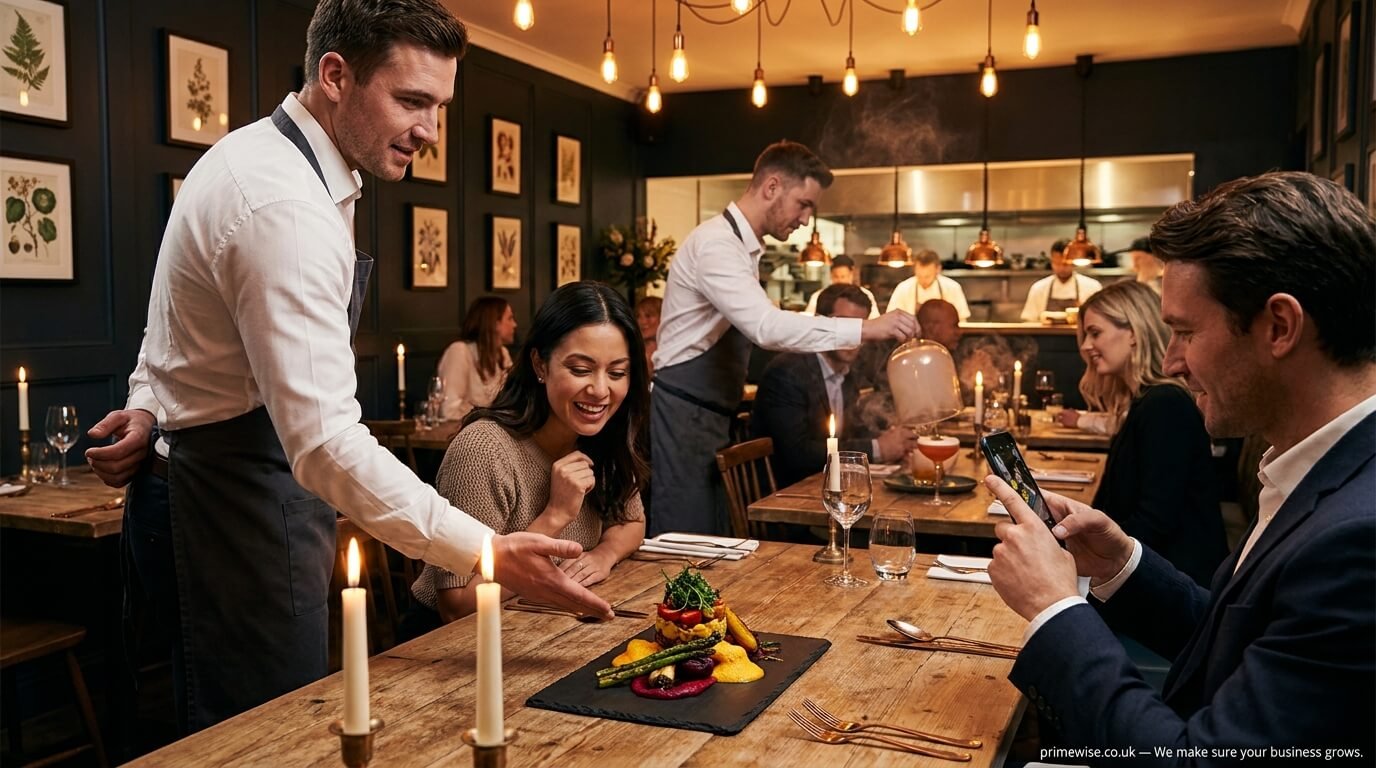
Digital advertising charges you for impressions. Table-side moments force your guests to generate impressions for you at zero additional cost. Theatrical service a flambéed dessert, a cocktail smoked under a cloche, a sauce poured tableside from a miniature copper jug is not nostalgic showmanship. It is a precision word-of-mouth marketing mechanism engineered for 2026 social behaviour.
When a dish requires kinetic presentation, every phone at the table emerges. Frequently, adjacent tables respond identically. The restaurant becomes a content production studio where the guests are the crew, the dishes are the talent, and the output is authentic, geo-tagged, highly credible micro-influencer content posted entirely without a media budget. This is experiential virality the conversion of a physical dining event into compounding organic digital reach through nothing more than deliberate theatrical design.
KEY INSIGHTOne well-engineered table-side moment can generate more authentic local social proof in a single service than a week of paid Instagram content. The guests become the content team.
The Receipt as an Analogue Retargeting Pixel
The bill presentation is routinely treated as the end of the transaction. In four wall marketing, it is the beginning of the next one. Printing a high-visibility QR code on the physical receipt linking to a bounce-back offer valid exclusively on your quietest trading day, a secret menu accessible only to returning guests, or a VIP loyalty programme sign-up transforms a dead piece of paper into a trackable, measurable analogue retargeting device.
The mechanics mirror digital retargeting precisely. A guest who has already demonstrated purchase intent by dining with you is served a targeted incentive at the moment of highest receptivity the post-meal satisfaction window. Unlike a Meta retargeting pixel that requires the guest to have visited your website, the physical receipt reaches one hundred percent of your seated audience with zero platform dependency, zero algorithmic decay, and zero commission cost. Operators who implement QR receipt bounce-back programmes consistently report measurable increases in mid-week covers within the first 30 days of deployment.
Zero Party Data Capture at the Table
Aggregator platforms retain your customer data as a deliberate commercial strategy. When a guest orders through Deliveroo or Just Eat, that guest belongs to the platform you receive the order, they retain the relationship. Four wall marketing reverses this dynamic by capturing zero-party data directly, at the table, through a frictionless value exchange.
The mechanism is straightforward: offer a complimentary digestif, an immediate discount on the current bill, or access to an exclusive future event in exchange for joining your direct email or SMS list. This is not cold acquisition it is warm conversion of a guest who has already experienced your product and has a demonstrated propensity to return. The resulting database is a sovereign commercial asset, insulated from platform algorithm changes and free from third-party commission structures.
A critical compliance note for UK operators: any data captured at the table must be handled in accordance with the UK GDPR and the Data Protection Act 2018. Consent must be freely given, specific, and informed. The value exchange offer must be genuinely optional with no negative consequence for refusal. Any loyalty programme or email list must include a clear unsubscribe mechanism and a transparent privacy statement. Operators implementing data capture programmes should ensure their hospitality CRM system is configured for UK GDPR compliance from day one.
UK GDPR COMPLIANCEZero-party data capture at the table is legal and highly effective but consent must be freely given, specific, and documented. Ensure your hospitality CRM is configured for UK GDPR and Data Protection Act 2018 compliance before deployment.
Menu Engineering for User Generated Content
Menu engineering is the formal discipline of designing dishes to maximise both profitability and guest response. In the context of four wall marketing, it extends to designing at least one signature item explicitly to be photographed, shared, and discussed. This is not a superficial aesthetic exercise it is a structured approach to generating a continuous stream of authentic, local social proof through the quality and visual design of the physical product.
A dish engineered for user-generated content (UGC) typically features contrasting colours, structural height, an interactive element, or a uniquely identifiable presentation that is immediately recognisable in a social media feed. When guests post this content organically, the restaurant benefits from geo-tagged endorsements that carry substantially more credibility than any paid influencer campaign. The investment is in the kitchen in sourcing, plating philosophy, and creative direction not in a media budget. Integrating this discipline into your culinary development process turns every plate leaving the pass into a potential word-of-mouth marketing asset.
Implementation Complexity vs Revenue Impact
The following framework allows operators to sequence their four wall investment by balancing the operational effort required against the commercial return expected. Directional timeframes and impact ranges are based on reported operator outcomes across UK casual and fine dining segments.
| Tactic | Implementation Difficulty | Estimated Revenue Impact | Time to Results |
|---|---|---|---|
| Server Scripts | Low training investment only | 10–15% uplift in average cover value | 4–8 weeks |
| Table-Side Moments | Medium menu and service redesign | High UGC volume, measurable repeat intent increase | 2–4 weeks post-launch |
| Receipt QR Bounce-Back | Low print design and offer creation | Measurable mid-week cover increase within 30 days | 30 days |
| Zero-Party Data Capture | Medium CRM setup and GDPR compliance | Reduction in aggregator dependency over 90 days | 60–90 days |
| Menu Engineering for UGC | Medium-High culinary development required | Sustained organic social reach, reduced paid content cost | Ongoing from launch |
The Agency Litmus Test
The restaurant marketing ecosystem has a structural problem. Too many agencies enter client engagements asking for access to Meta Business Manager, Google Ads accounts, and monthly retainer agreements before they have ever eaten in the dining room. This is the wrong sequence, and it is commercially dangerous for the operator who agrees to it.
The most effective hospitality marketing consultants operate from the inside out. They audit the ambient lighting quality. They taste the signature dishes. They observe server scripts in live service conditions. They analyse the receipt presentation and the data capture mechanism before they consider a single paid placement. The reasoning is straightforward: digital advertising amplifies what already exists in the physical product. If what exists is undifferentiated, amplifying it at scale accelerates commoditisation rather than growth.
Operators seeking a marketing partner that applies this exact diagnostic framework auditing the physical dining room before proposing any digital spend can explore the hospitality growth consultancy model at PrimeWise.co.uk, where the four wall audit precedes every client engagement as a non-negotiable first step.
THE LITMUS TESTIf a marketing agency asks for your Meta Business Manager access before asking to eat in your dining room, that is a disqualifying signal. The best operators work with partners who audit the room first and the algorithms second.
If a prospective agency cannot articulate how your receipt design, server script structure, or table-side service mechanics affect your customer acquisition cost, they are not equipped to manage your marketing budget. The four walls come first. The algorithms come after.