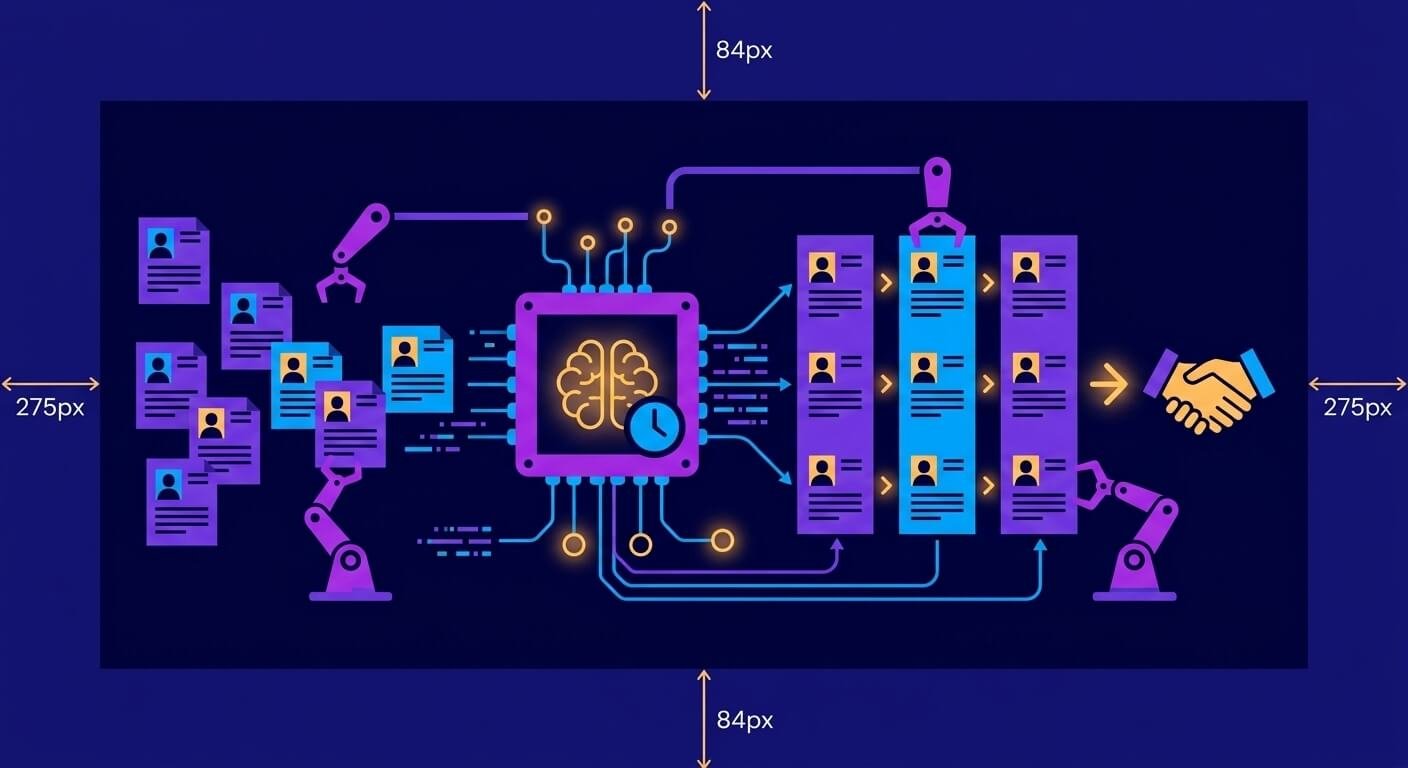

Knowing exactly when to hire a fractional CMO can be the single most consequential commercial decision a UK scale-up makes between £1M and £5M ARR. If you are considering whether to hire a fractional CMO in London, the answer almost never comes down to company size alone it comes down to operational readiness, funding stage, and the specific structural gaps inside your current go-to-market engine. This article gives you a precise, revenue-stage diagnostic to determine whether your business is at the inflection point that demands executive marketing leadership, without the £175,000 to £235,000 all-in cost of a full-time hire.
At Primewise, we have worked with UK scale-ups at exactly this crossroads. The founders we speak with are not confused about what a fractional CMO is. They are trying to answer one harder question: is right now the right moment to make the move? The seven triggers below are drawn from direct commercial experience, not theory. If two or more apply to your business today, the answer is almost certainly yes.
What a Fractional CMO Actually Is
A fractional CMO is a senior, C-suite marketing executive who integrates into your leadership team on a part-time or project basis, typically two to four days per week. They take structural ownership of your go-to-market strategy, align marketing spend directly to revenue targets, and build the commercial architecture that institutional investors and enterprise buyers expect to see. They are not a consultant who delivers a report and disappears. They sit in your leadership meetings, manage your agencies, mentor your junior team, and are accountable to pipeline metrics on the same basis as your Head of Sales.
The distinction matters because the fractional model is frequently confused with advisory or consultancy engagements. An advisor provides perspective. A fractional CMO provides execution accountability. For UK scale-ups preparing for Series A or navigating international expansion, that difference between insight and implementation is worth every penny of the monthly engagement fee.
Three Questions to Diagnose Your Readiness Now
Before examining the seven triggers in depth, run this rapid self-assessment. These three questions reflect the most statistically common early warning indicators we observe across early-stage UK commercial teams.
- Is your MRR growth flat or declining despite sustained or increased marketing spend over the last two quarters?
- Are you personally, as founder or CEO, still directly responsible for closing more than 40 percent of enterprise deals?
- Has your customer acquisition cost increased by more than 20 percent over the last six months while lifetime value has remained flat or deteriorated?
If two or more of those apply to your business right now, your commercial engine has a structural fault that additional junior headcount or agency retainers will not fix. What follows is the complete diagnostic framework built around seven concrete operational triggers that clarifies exactly when fractional executive leadership delivers its maximum commercial return.
EXECUTIVE INSIGHTA UK scale-up should hire a fractional CMO when it reaches £1M ARR, faces at least two of the seven operational triggers below, and requires C-suite commercial leadership that its current cash runway cannot sustain on a full-time basis. This is the clearest, most direct answer we can give and it is the benchmark we use internally at Primewise.
Why Founder-Led Growth Hits a Hard Ceiling
Reaching initial product-market fit is a genuine commercial achievement. It also creates a deceptively dangerous illusion of momentum. Once your founding network and early-adopter cohort are exhausted, top-line growth frequently stalls not because the product has failed, but because the acquisition engine was never systematically built. According to Tech Nation’s Scale-Up Intelligence Report, commercial leadership gaps are cited as a primary growth inhibitor in over 60 percent of UK scale-ups that plateau below £10M ARR.
The structural problem is this: founders who drive revenue generation become the bottleneck at the precise moment the business needs to accelerate. Closing enterprise deals, managing investor relationships, building product, and maintaining culture cannot coexist in a single calendar. Junior marketing hires are brought in to fill the gap, but without a senior commercial framework to operate within, their activity generates noise rather than pipeline. Escaping this ceiling requires a fundamental redesign of how the business acquires, retains, and monetises customers and that redesign demands executive-level commercial thinking.
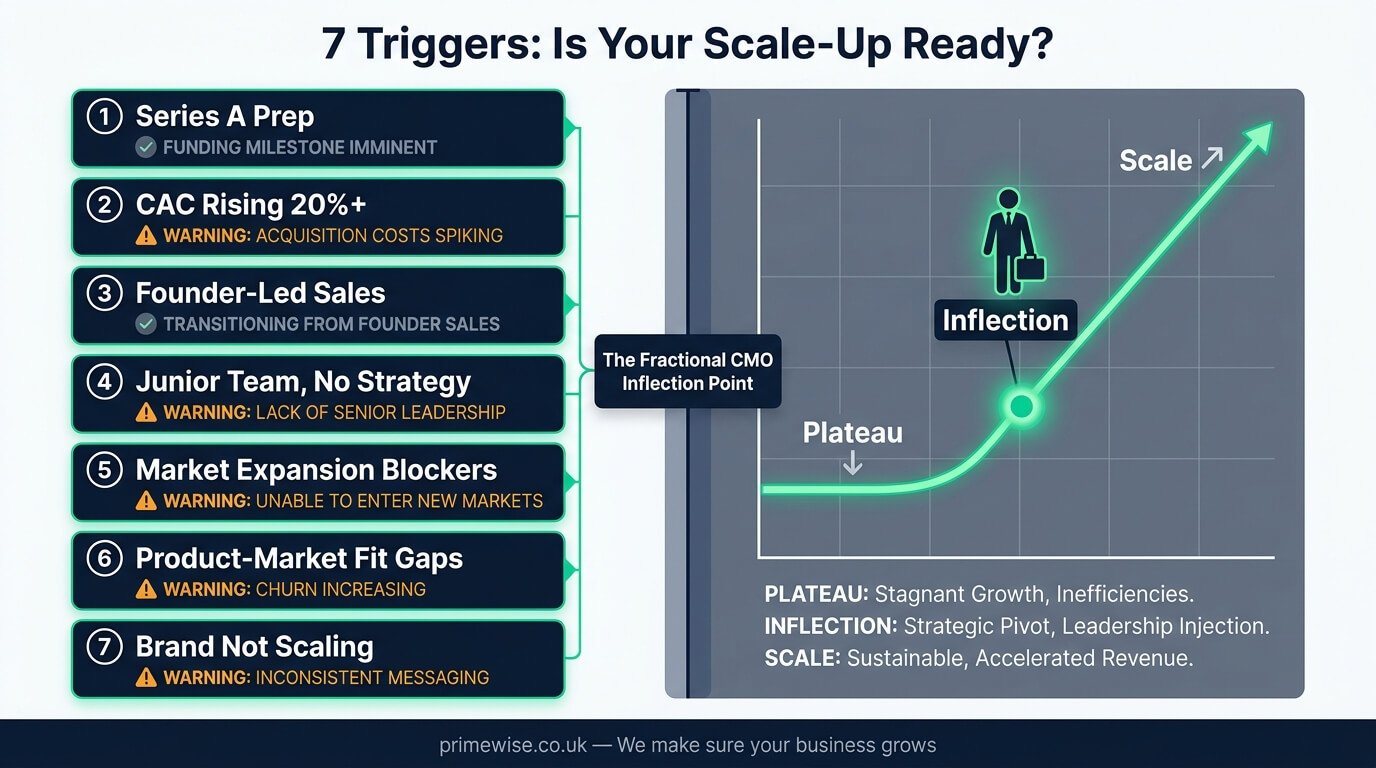
The Seven Triggers That Signal You Are Ready
Each trigger below represents a specific, measurable operational condition. These are not vague aspirations or soft signals. They are revenue-stage diagnostics that, when two or more are present simultaneously, consistently indicate a business that will generate a measurable positive return on fractional executive investment within 90 days.
Trigger 1 You Are Raising Series A or B Within 12 Months
Institutional investors operating in the London VC ecosystem from Balderton and Octopus Ventures to Notion Capital and the British Patient Capital network conduct rigorous commercial due diligence before deploying Series A or B capital. They are not evaluating your technology in isolation. They are evaluating the predictability of your revenue engine: your LTV to CAC ratio (the institutional minimum threshold is 3:1 for B2B SaaS), your pipeline coverage ratio, your payback period, and the coherence of your go-to-market narrative. Post-EIS and SEIS scaling phases place even greater pressure on demonstrating that early traction can be systematically replicated at scale.
A fractional CMO constructs the precise commercial architecture that satisfies this diligence process. They translate scattered marketing activities into a documented, data-backed acquisition model that demonstrates exactly how the capital being raised will multiply revenue. Without this architecture in place before the fundraising process begins, valuations suffer and cap table negotiations become significantly more difficult. Scale-ups that enter institutional fundraising with a fractional CMO-built GTM model consistently present stronger commercial narratives and close rounds faster than those relying on founder-assembled marketing decks.
Trigger 2 Your Junior Marketing Team Is Executing Without Strategic Alignment
Many UK scale-ups invest early in enthusiastic junior marketers who are competent at tactical execution content calendars, social publishing, email sequences, and basic paid campaigns. The problem emerges when these activities operate in a strategic vacuum, entirely disconnected from board-level revenue targets. Content is produced because it fills a schedule, not because it is engineered to move enterprise prospects through a defined buying journey. This pattern what experienced commercial leaders call random acts of marketing generates vanity metrics while the pipeline remains stubbornly empty.
A fractional CMO provides the critical translation layer between board-level OKRs and daily marketing execution. They implement attribution frameworks that connect every pound of marketing spend to a specific pipeline outcome, create ICP-aligned messaging hierarchies that junior teams can execute with precision, and establish weekly commercial reviews that hold marketing accountable to the same revenue metrics as the sales function. At Primewise, we have found that junior teams respond exceptionally well to this structure they become dramatically more effective, not redundant, once the strategic framework is in place.
Trigger 3 Your Customer Acquisition Cost Has Increased by More Than 20 Percent
Deteriorating unit economics are the clearest quantitative signal that your commercial model needs structural intervention, not additional spend. When CAC rises while LTV remains flat, the business is effectively paying more to acquire customers who generate the same or diminishing revenue. A CAC increase of 20 percent or more over two consecutive quarters, absent a deliberate market expansion strategy, indicates a leaking funnel, a positioning misalignment, or an audience saturation problem that increased ad spend will only compound.
Strategic executive intervention at this stage focuses on four operational layers: funnel attribution analysis to identify where qualified leads are dropping out, ICP refinement to ensure spend is targeting the highest-value accounts, channel mix restructuring to reduce cost-per-qualified-lead, and commercial positioning review to assess whether the core value proposition resonates with the segment being targeted. This is precisely the forensic commercial work that a fractional CMO owns and that no junior marketer or generalist agency is structurally positioned to execute.
UK COST BENCHMARKThe true all-in employment cost of a full-time CMO in London including base salary, employer National Insurance contributions at 13.8%, auto-enrolment pension, and standard benefits ranges from £175,000 to £235,000 per annum. A fractional CMO engagement typically ranges from £3,000 to £8,000 per month, delivering C-suite strategic leadership at a fraction of the total employment cost with zero equity dilution.
Trigger 4 You Are Still the Primary Revenue Driver in Your Business
When a business depends entirely on the founder for revenue generation, it possesses a structural vulnerability that becomes more dangerous with every month of growth. Complex B2B sales cycles require consistent, undivided attention. When the founder is simultaneously managing investor relations, product development, team building, and enterprise deal closing, something fractures usually the pipeline. The volume of concurrent deals the company can process is artificially capped by the available hours and personal network of one individual.
Transitioning away from founder-led sales requires more than hiring a Head of Sales. It requires building the marketing infrastructure that generates qualified pipeline autonomously content-driven inbound systems, account-based marketing programmes, sales enablement frameworks, and a commercial narrative that resonates without the founder in the room. A fractional CMO builds these systems from the ground up, separating the company’s growth trajectory from the personal bandwidth of its founding team and creating the institutionalised revenue architecture that investors and acquirers expect to see.
Trigger 5 You Are Entering a New International Market
Post-Brexit international expansion particularly into the United States or the European Union introduces a level of strategic complexity that domestic marketing experience rarely prepares a team to navigate. UK firms attempting cross-border market penetration consistently underestimate how differently enterprise buyers in New York, Berlin, or Amsterdam evaluate commercial propositions. Applying a domestically successful positioning framework to a culturally distinct market without deliberate localisation is one of the most expensive and preventable commercial mistakes a scale-up can make.
A fractional CMO with international GTM experience can test and adapt your go-to-market strategy for new regional markets without requiring the business to commit to expensive, unproven full-time international hires from day one. They establish the channel strategy, localise the messaging architecture, identify the right regional partners and media environments, and define the validation metrics that determine whether full-scale market entry is commercially justified. For UK financial services and technology firms, this capability is particularly valuable given the regulatory and commercial divergence that has accelerated since 2020.
Trigger 6 You Are Managing Multiple Agencies Without a Unifying Commercial Strategy
Outsourcing growth to multiple disconnected agencies a separate SEO retainer, a PR firm, a paid media specialist, and perhaps a content studio is a common and understandable response to the talent scarcity challenge at the scale-up stage. The problem is structural. These agencies optimise for their own deliverables, not for a unified commercial outcome. The SEO agency measures keyword rankings. The PR firm measures coverage volume. The paid media agency measures ROAS. None of them are accountable to pipeline velocity or CAC, and none of them are talking to each other.
The result is a heavily fragmented brand experience, dangerous budget overlap, and an extraordinary waste of founder time spent managing vendor relationships that should be managed by a senior commercial leader. A fractional CMO assumes complete ownership of the agency ecosystem, restructures vendor briefs around shared commercial KPIs, eliminates redundant spend, and ensures that SEO, paid, PR, and content are operating as a single integrated acquisition system. At Primewise, we typically find that this consolidation alone recovers 15 to 25 percent of total marketing spend within the first 60 days of an engagement.
Trigger 7 You Need C-Suite Firepower but Cannot Justify the Full-Time Cost
This is the trigger that most directly frames the financial logic of the fractional model. The total all-in employment cost of a senior marketing executive in London base salary between £130,000 and £180,000, employer NIC at 13.8%, pension auto-enrolment, private healthcare, and equity expectations routinely exceeds £200,000 per annum before a single strategic decision has been made. For a scale-up managing cash runway carefully against the next funding milestone, that commitment is often commercially unjustifiable.
The fractional model resolves this dilemma cleanly. A structured monthly engagement delivers C-suite strategic leadership, direct accountability to commercial KPIs, and hands-on execution oversight at a cost that preserves runway without compromising strategic ambition. There is no long recruitment process, no garden leave, no equity negotiation, and no six-month ramp period before value is delivered. For UK scale-ups in the £1M to £5M ARR range, the fractional model is not a compromise it is the structurally superior commercial decision for this stage of growth.
The Fractional ROI Equation
Evaluating the true commercial value of fractional executive leadership requires moving beyond salary comparisons to examine total impact on pipeline velocity, CAC, and funding outcomes. The table below provides a direct structural comparison across three common resource models for scale-up commercial leadership.
| Resource Model | Typical Monthly Cost | Strategic Accountability | Time to Commercial Impact | Equity Dilution |
|---|---|---|---|---|
| Full-Time CMO (London) | £14,500 to £18,500 plus benefits and equity | Full ownership, long ramp period | Six to nine months | Significant, typically 0.5% to 1.5% |
| Marketing Agency | £4,000 to £12,000 retainer | Output-based, no P&L accountability | Three to six months | None |
| Fractional CMO | £3,000 to £8,000 fixed fee | Revenue and pipeline accountability | Thirty to ninety days | None |
Scale-ups that deploy fractional GTM leadership in the twelve months before a Series A raise consistently demonstrate stronger unit economics, more coherent commercial narratives, and shorter fundraising timelines than comparably staged businesses relying on agency-only or junior-led marketing structures. The capital efficiency advantage is structural, not incidental the fractional model is specifically engineered for the constraints and ambitions of the scale-up phase.
PRIMEWISE BENCHMARKAcross fractional CMO engagements managed through Primewise with UK scale-ups between £1M and £5M ARR, businesses that enter engagements exhibiting four or more of the seven triggers above achieve an average CAC reduction of 30 to 40 percent within 90 days, alongside a measurable acceleration in pipeline velocity. These outcomes are driven by commercial architecture, not increased spend.
How a UK FinTech Used Fractional Leadership to Close a £10M Series A
A B2B payments infrastructure company operating in the UK market approached Primewise at a critical commercial juncture in Q3 2024. The business had strong core technology and a credible enterprise customer base, but its marketing function consisted entirely of two junior executives running disconnected campaigns across five separate agency relationships. Pipeline generation was inconsistent, CAC had increased by 28 percent over two quarters, and the founding team was carrying the weight of investor conversations without a coherent GTM narrative to support the fundraising process.
Within a structured 90-day engagement, the fractional CMO embedded by Primewise executed across four operational layers. Agency relationships were consolidated from five vendors to two, eliminating £18,000 per month in overlapping spend. The ICP was refined from a broad SME definition to a specific segment of regulated financial institutions with 50 to 500 employees, immediately improving lead quality. The pipeline attribution model was rebuilt from first-touch to full multi-touch, revealing that 60 percent of converted enterprise accounts had engaged with a specific category of technical content that was being systematically underfunded. The investor narrative was restructured around predictable revenue metrics rather than product features, directly addressing the diligence criteria of the target VC cohort.
The outcome: CAC reduced by 35 percent over the 90-day period. Pipeline coverage ratio improved from 1.8x to 3.2x. The business closed a £10M Series A within eight months of the fractional engagement commencing. If your scale-up is approaching a similar funding inflection point, Primewise can model the specific commercial impact of fractional leadership for your ARR stage at primewise.co.uk.
Entry and Exit Criteria for a Fractional Engagement
A fractional CMO engagement is designed as a high-impact transitional mechanism, not a permanent structural fixture. The most effective engagements begin with a rigorously structured 90-day GTM turnaround plan that establishes baseline metrics, defines clear deliverables, and builds the accountability frameworks that will govern the entire partnership. Typical engagement durations range from nine to eighteen months sufficient runway to audit existing commercial systems, implement scalable revenue infrastructure, guide the business through a major funding or growth milestone, and prepare the succession plan for a permanent internal executive.
Understanding when to exit the fractional model is as important as knowing when to enter it. The transition to a full-time CMO is typically justified when the business has achieved consistent, predictable revenue velocity above £8M to £10M ARR, has secured institutional capital that funds a permanent C-suite headcount, and requires full-time internal oversight of a growing international commercial team. At that point, the fractional CMO’s final deliverable is managing the recruitment, briefing, and onboarding of their permanent successor ensuring continuity of the commercial architecture that has been built during the engagement.
Is Your Scale-Up Ready to Take the Next Step
If you have read this far and two or more of the seven triggers resonate with your current commercial reality, your business is structurally ready for fractional executive marketing leadership. The question is no longer whether you need it. The question is how quickly you move.
Primewise works exclusively with UK scale-ups at this precise inflection point businesses with real commercial momentum, genuine funding ambitions, and marketing functions that are not yet performing at the level the next growth stage demands. If that describes your business, the most productive next step is a 30-minute no-obligation commercial diagnostic call where we map your specific operational triggers against a fractional engagement model calibrated to your ARR stage and runway. Book directly at primewise.co.uk.