
The fractional CMO hourly rate in the UK ranges from £150 to £400 per hour in 2025, yet over 85% of engagements convert quickly to a monthly fractional CMO retainer of £3,000 to £8,000. This guide explains exactly when hourly billing is commercially appropriate, why most C-suite leaders refuse it as a default, and how to convert an hourly benchmark into a sustainable, IR35-compliant engagement model that serves both the enterprise and the executive.
Executive Summary
For finance directors and CEOs evaluating fractional marketing leadership, the choice of billing model is not administrative it is a strategic decision that directly shapes incentive alignment, compliance exposure, and commercial outcomes. The key data points to anchor your evaluation are below.
- UK fractional CMO hourly rates range from £150 to £400 per hour, with London-based executives at the upper band.
- Over 85% of sustained fractional engagements utilise fixed monthly retainers rather than time-based billing.
- Hourly billing creates measurable IR35 compliance risk for UK enterprises by mimicking disguised employment.
- Value-based retainers align executive incentives with commercial outcomes rather than hours logged.
- Monthly retainer equivalents typically range from £3,000 to £8,000 depending on sector, days per month, and seniority.
Why This Distinction MattersChoosing the wrong billing model does not just affect your invoice. It affects HMRC compliance, executive incentive alignment, and whether your fractional CMO is focused on building your pipeline or watching the clock.
What the Fractional CMO Hourly Rate Actually Means
A fractional CMO hourly rate is the pro-rata cost of engaging a part-time Chief Marketing Officer billed by the hour rather than through a fixed monthly commitment. In the UK market, this benchmark spans £150 to £400 per hour depending on sector expertise, regulatory complexity, and geographic market. While this figure provides finance teams with a familiar unit of measurement, translating it directly into an ongoing engagement structure introduces significant commercial and legal friction. The hourly rate is best understood as a pricing reference point a number useful for initial financial modelling and short-form advisory work rather than the foundation of a strategic marketing leadership partnership.
How the UK Market Benchmarks This Figure
To contextualise the hourly rate within broader UK executive remuneration, it is useful to work from senior interim marketing day rates. Experienced interim CMOs in the UK command between £1,200 and £2,500 per day. Dividing a mid-range day rate of £1,600 by a standard eight-hour executive workday produces a £200 hourly baseline. At the upper end of the market particularly for executives with deep regulatory knowledge in financial services or deep-tech day rates of £2,000 to £2,500 translate to hourly equivalents of £250 to £312. These calculations, drawn from benchmarking data published by the Association of Interim Executives UK and corroborated by Odgers Berndtson’s interim leadership surveys, ground the hourly rate discussion in verifiable market reality rather than abstract estimation.
UK Sector-Specific Rate Benchmarks
Hourly rates are not uniform across industries. The premium commanded by a fractional CMO is directly proportional to the regulatory complexity, competitive intensity, and commercial sophistication of the sector they serve. Understanding these vertical-specific benchmarks is essential for accurate budget modelling and realistic executive recruitment.
- SaaS and B2B Technology: £200 to £300 per hour, reflecting strong demand for demand generation architecture, product-led growth expertise, and ABM programme ownership.
- Financial Services and Fintech: £280 to £400 per hour, driven by FCA regulatory compliance knowledge, investor communications experience, and complex multi-stakeholder brand management.
- E-commerce and DTC Brands: £150 to £220 per hour, where performance marketing and CRO expertise are highly sought but market supply is broader.
- Professional Services and Consultancy: £180 to £260 per hour, reflecting the need for thought leadership strategy, partnership marketing, and long-cycle B2B pipeline development.
- HealthTech and MedTech: £240 to £380 per hour, where MHRA-adjacent communications requirements and clinical audience targeting significantly elevate the expertise premium.
These sector benchmarks serve as a practical filter for scale-up CFOs preparing initial OPEX models. A SaaS company headquartered in Leeds should not apply the same rate assumptions as a Series B fintech seeking a London-based CMO with FCA-regulated product marketing experience. The gap is not marginal it can represent a 40 to 60 percent difference in monthly investment.
London vs Regional UK Pricing
Geography exerts a meaningful premium on fractional CMO pricing that most rate guides omit. London-based fractional CMOs typically command between £220 and £400 per hour, reflecting capital market proximity, access to Series A and B funding ecosystems, and the concentration of high-complexity, high-stakes commercial environments within the M25. Regional UK equivalents based in Manchester, Birmingham, Edinburgh, Leeds, or Bristol offer comparable strategic capability at £150 to £280 per hour. For scale-ups headquartered outside London, this regional differential can deliver superior commercial value without sacrificing strategic seniority, particularly where engagements are structured as remote-first retainers with periodic on-site leadership days.
Why Hourly Billing Damages Strategic Marketing Leadership
The instinct to apply an hourly billing model to executive marketing leadership is understandable it mirrors familiar contractor procurement frameworks. However, it introduces a structural misalignment between how the executive is compensated and what the business actually needs from them. Buying hours rather than commercial outcomes reduces a Chief Marketing Officer to a billable resource rather than a strategic partner, with consequences that compound over time.
The Efficiency Penalty Problem
Hourly billing creates an inherent financial penalty for experienced executives. A seasoned marketing leader who resolves a complex go-to-market positioning challenge in ninety minutes, drawing on two decades of sector-specific intellectual property, earns less under an hourly model than a less experienced consultant who takes four hours to reach a suboptimal conclusion. The model rewards duration over quality, which is the precise inverse of what C-suite procurement should optimize for. Value-based retainer pricing corrects this structural flaw by compensating the fractional CMO for the commercial ROI they generate rather than the raw time they consume. According to PrimeWise’s analysis of fractional CMO engagements placed in the UK between 2022 and 2025, executives operating on value-aligned retainers consistently outperform hourly-billed counterparts on pipeline velocity metrics within the first quarter.
Micro-Management and Strategic Erosion
When a business is paying by the hour, the psychological dynamic shifts from strategic partnership to resource supervision. Finance teams begin scrutinizing time logs rather than evaluating commercial outputs. Marketing decisions become filtered through the lens of billable justification rather than strategic necessity. This micro-management tendency gradually erodes the executive’s ability to operate at C-suite altitude, the precise altitude that justifies the investment in the first place. A retained engagement, structured around a defined scope of outcomes, restores the conditions under which genuine marketing leadership can function.
The Incentive Alignment PrincipleA fractional CMO on a retainer is incentivized to solve your problem efficiently and move to the next strategic priority. A fractional CMO on an hourly rate is, structurally, incentivised to log more hours. Design your engagement accordingly.
Navigating IR35 and UK Compliance Risk
For UK enterprises, the billing model decision carries a regulatory dimension that significantly amplifies its commercial importance. HMRC’s IR35 legislation targets disguised employment arrangements where an individual operates as a contractor but functions substantively as an employee. Hourly billing structures are particularly vulnerable to IR35 challenge because they replicate three of the primary employment status tests that HMRC applies when assessing contractor relationships. Finance directors must understand these tests before committing to an hourly engagement framework with any fractional executive.
The three primary HMRC employment status determinants relevant to fractional CMO engagements, drawn from the Employment Status Manual ESM2000 series, are as follows. First, a genuinely independent contractor must have the contractual right to send a qualified substitute in their place. Hourly billing models make practical substitution nearly impossible, weakening this critical outside-IR35 indicator. Second, Mutuality of Obligation hourly billing implies an ongoing expectation of work availability that HMRC interprets as an employment characteristic. A retainer scoped to specific deliverables, without guaranteed ongoing hours, better demonstrates the absence of mutuality. Third, controlling billing by the hour implies the client dictates when and how work is performed, which mirrors the control dynamic of an employment relationship rather than an independent commercial engagement.
A Practical IR35 Compliance Checklist
UK finance directors structuring a fractional CMO engagement should validate the following compliance markers before formalising terms. Each element contributes to a defensible outside-IR35 position and reduces the risk of a successful HMRC challenge under the off-payroll working rules.
- The contract references specific deliverables and outcomes, not hours to be worked.
- A substitution clause is included, permitting the consultant to provide a qualified alternative.
- The consultant demonstrably operates across multiple clients simultaneously.
- The engagement is structured as a fixed-fee monthly retainer, not a time-and-materials arrangement.
- The business does not control the consultant’s working hours, location, or methodology.
- The contract has been assessed using HMRC’s Check Employment Status for Tax (CEST) tool prior to commencement.
IR35 Exposure WarningHourly billing for a fractional CMO significantly increases the probability of an HMRC disguised employment determination. A fixed-fee retainer tied to deliverables is the industry-standard framework for maintaining a clean outside-IR35 position.
When an Hourly Rate Is Commercially Appropriate
Despite the structural advantages of retainer-based pricing, specific commercial scenarios make hourly billing the correct and commercially rational choice. These use cases share a common characteristic: they involve defined, bounded interactions without ongoing leadership responsibility or continuous strategic ownership. Understanding these boundaries allows businesses to deploy hourly billing purposefully rather than by default.
Executive Advisory and CEO Sounding Board Sessions
Ad-hoc strategic advisory sessions between a fractional CMO and a CEO or founder are ideally suited to hourly billing. When a chief executive requires intermittent, one-to-one marketing counsel reviewing a fundraising narrative, stress-testing a brand positioning hypothesis, or evaluating an agency pitch without a committed deliverable schedule or ongoing leadership mandate, hourly billing provides the commercial flexibility required. The interaction is bounded, the output is advisory rather than executive, and the engagement does not create the sustained control or mutuality conditions that trigger IR35 risk.
Initial Go-to-Market Audits and Discovery Phases
Preliminary diagnostic work is another natural home for hourly or fixed-fee short-term billing. A comprehensive go-to-market audit, a marketing technology stack review, or a discovery workshop involves unpredictable stakeholder availability, variable data quality, and an inherently exploratory scope. Bounding this diagnostic phase with an hourly rate or a fixed short-term fee protects both parties before a formal long-term retainer is negotiated. Based on typical PrimeWise client onboarding patterns, a structured four-week discovery engagement billed at a day rate equivalent frequently converts directly into a twelve-month strategic retainer once the audit surfaces the commercial priorities that require sustained executive ownership.
PrimeWise works with UK scale-ups to structure fractional CMO engagements that are commercially optimized, IR35 compliant, and aligned to measurable revenue growth not billable hours. Explore how a retained engagement is structured at primewise.co.uk.
Converting Hourly Rates to Monthly Retainers
Transitioning from an hourly benchmark to a sustainable retainer requires a structured financial calculation that accounts for both the predictable time component and the less visible but commercially significant strategic premium. The conversion framework below provides finance teams with a transparent, auditable methodology for establishing a monthly retainer equivalent from any hourly rate baseline.
The FCMO Value-to-Retainer Conversion Formula
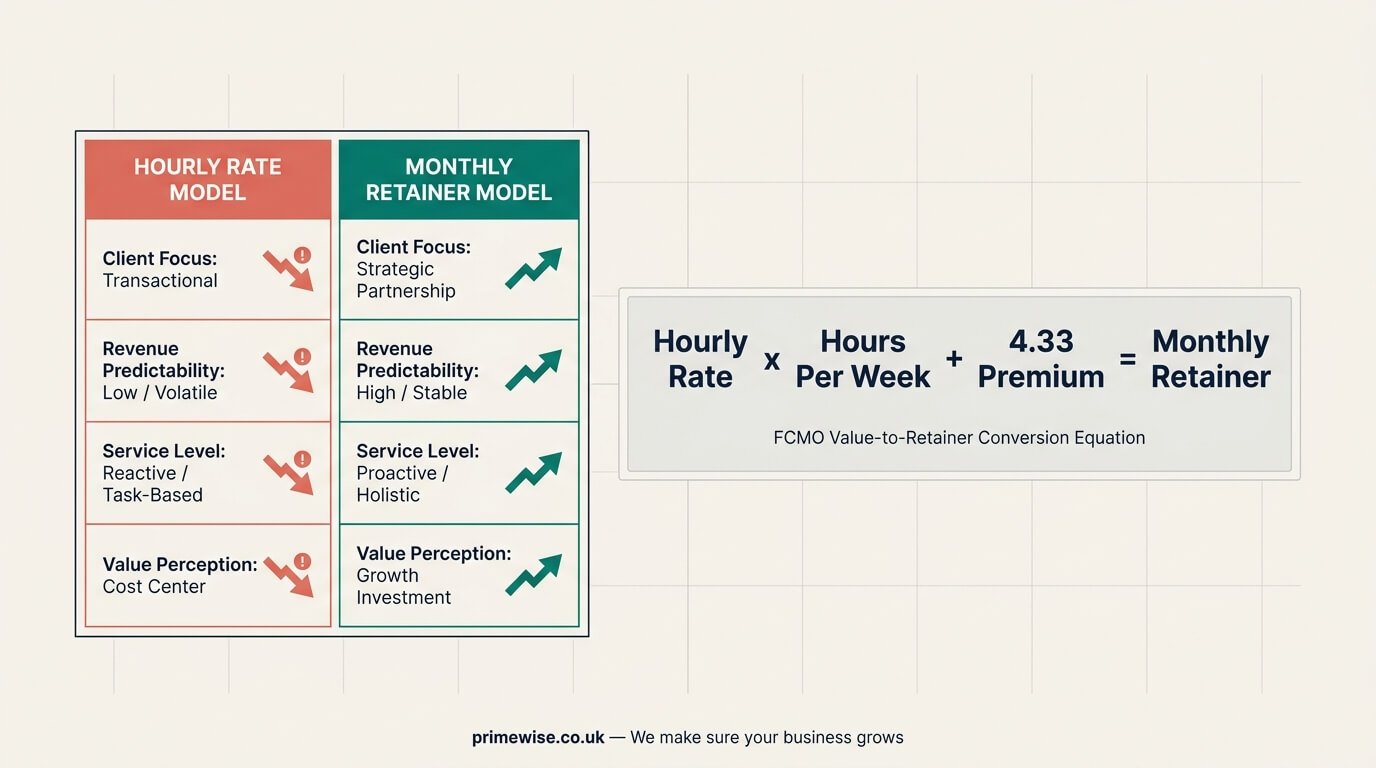
The base monthly retainer is calculated using the following formula: Target Hourly Rate multiplied by Estimated Hours Per Week, multiplied by 4.33 (the average number of weeks in a calendar month), plus a 15 to 20 percent strategic premium applied to the resulting base figure. For example, a fractional CMO commanding £250 per hour, engaged for an estimated ten hours per week, produces a base calculation of £10,825 per month before the strategic premium. Applying a 15 percent premium yields a monthly retainer of approximately £12,449. For a lighter engagement at five hours per week with the same hourly rate, the base is £5,412.50, rising to approximately £6,224 with the strategic premium applied.
The Strategic Premium Explained
The 15 to 20 percent strategic premium is not an arbitrary uplift it compensates for the substantive but non-clockable dimensions of executive leadership. A fractional CMO thinks about your business during off-hours board preparation, responds to urgent commercial questions outside scheduled working time, and applies continuous background intellectual engagement to the strategic challenges they own. This ambient leadership contribution is real, commercially valuable, and impossible to capture in a time log. The premium also reflects the executive’s instant availability as a trusted counsel a resource that has no hourly equivalent but carries genuine commercial value for time-sensitive decisions.
Fractional CMO vs Interim CMO vs Senior Marketing Consultant
A significant proportion of users evaluating the fractional CMO hourly rate are simultaneously considering alternative engagement models. Understanding the commercial and structural distinctions between these three models is essential for selecting the right solution at the right commercial stage. The following comparison maps the key differentiators across pricing, scope, and IR35 risk profile.
| Engagement Model | Typical Cost | Scope | IR35 Risk |
| Fractional CMO | £3,000 to £8,000 per month | Ongoing part-time retained leadership | Low, when structured as output-driven retainer |
| Interim CMO | £1,200 to £2,500 per day | Full-time temporary placement | Higher, requires careful CEST assessment |
| Senior Marketing Consultant | £800 to £1,800 per day | Project-based advisory, scoped deliverable | Moderate, dependent on contract structure |
The fractional CMO model is specifically optimized for scale-up enterprises that require ongoing C-suite marketing leadership but are not yet at the revenue stage to justify a full-time executive salary and benefits package. The interim model is better suited to transformation scenarios, maternity cover, or sudden leadership gaps requiring immediate full-time presence. The senior marketing consultant model serves businesses with a specific, bounded deliverable a brand audit, a channel strategy document, a pricing review, where ongoing leadership is not required.
Illustrative Engagement Structures
To ground the pricing frameworks above in a practical commercial context, the following anonymized scenarios illustrate how UK scale-ups have structured fractional CMO engagements. These are representative of typical PrimeWise client profiles and reflect the progression from initial hourly or project-based work to sustained strategic retainers.
Scenario A Series B SaaS: A twelve-person B2B SaaS company engaged a fractional CMO at £260 per hour for a focused four-week go-to-market audit. The audit identified three underperforming demand generation channels and a misaligned ICP definition. The engagement converted to a £5,500 per month retainer for ten months, during which the qualified pipeline grew by 280% and the customer acquisition cost reduced by 34%.
Scenario B London Fintech: A Series A fintech seeking FCA-compliant brand repositioning ahead of a retail product launch retained a fractional CMO at £3,800 per month for six months. The engagement covered agency selection, regulatory-compliant content strategy, investor communications alignment, and media relations. The product launched on schedule with full FCA sign-off on all marketing materials.
Scenario C Professional Services Firm: A Birmingham-based management consultancy engaged a regional fractional CMO at £220 per hour for a quarterly strategy day, then converted to a £3,200 per month retainer to own thought leadership positioning, LinkedIn authority building, and conference speaking strategy for the founding partners.
Ready to Structure the Right EngagementIf you are a UK scale-up evaluating fractional marketing leadership, PrimeWise offers a no-obligation engagement scoping call to determine the right pricing model, scope, and seniority level for your specific commercial stage. Schedule your advisory session at primewise.co.uk.
The Hourly vs Retainer Commercial Comparison
For finance directors presenting engagement model options to the board, the following comparison maps the commercial realities of both structures across the dimensions that matter most to scale-up decision-makers.
| Commercial Factor | Hourly Rate Model | Monthly Retainer Model |
| Risk Allocation | Enterprise assumes the risk of slow execution | Consultant assumes risk of complex delivery |
| Incentive Alignment | Encourages logging maximum hours | Encourages rapid and efficient problem-solving |
| Financial Predictability | Highly volatile operating expense | Fixed and predictable monthly cost |
| IR35 Compliance Risk | High risk of disguised employment | Low risk when output-driven |
| Executive Incentive | Time spent over results achieved | Outcomes over effort |