

A monthly performance marketing retainer is the contractual backbone of every high-performing digital acquisition programme, yet most UK procurement teams sign agreements riddled with ambiguity, costing them six figures in scope creep, misaligned incentives, and IR35 exposure. This definitive guide breaks down every component of a properly scoped performance marketing consultant retainer from remuneration model selection to copy-paste contract clauses, equipping finance and procurement directors with the frameworks to structure, negotiate, and protect a commercially robust Statement of Work in 2026.
EXECUTIVE SUMMARYA performance marketing consultant retainer is a deliverable-based commercial agreement that exchanges a recurring fee for defined performance outputs such as ROAS improvement or CAC reduction. The optimal UK structure in 2026 is a hybrid model pairing a base fee with a 5–8% commission on ROAS above a pre-agreed baseline, drafted explicitly outside IR35 parameters. This article covers retainer models, scope definitions, contract clauses, IR35 compliance, KPI frameworks, and a three-tier pricing comparison.
What Is a Performance Marketing Consultant Retainer
A performance marketing consultant retainer is a legally binding Statement of Work in which a client pays a recurring fee in exchange for specific, pre-defined deliverables engineered to drive scalable commercial outcomes typically measured through return on ad spend, customer acquisition cost, or qualified lead volume. Unlike a project fee or a time-and-materials arrangement, the retainer creates a structured, ongoing commercial relationship with clear accountability benchmarks on both sides. In the UK market, this distinction is not merely semantic: the deliverable-based nature of the agreement is the primary mechanism through which the engagement falls legitimately outside IR35 off-payroll working rules enforced by HMRC.
The modern retainer operates as a strategic commercial framework rather than a simple service subscription. It delineates the boundary between high-level strategic auditing and daily tactical execution, preventing the consultant from becoming a de facto employee while ensuring the procurement team retains full visibility over the activities directly driving digital revenue. For regulated financial services and investment firms operating in the UK, this clarity is not optional it is a fiduciary and operational necessity.
How Much Does a UK Performance Marketing Retainer Cost
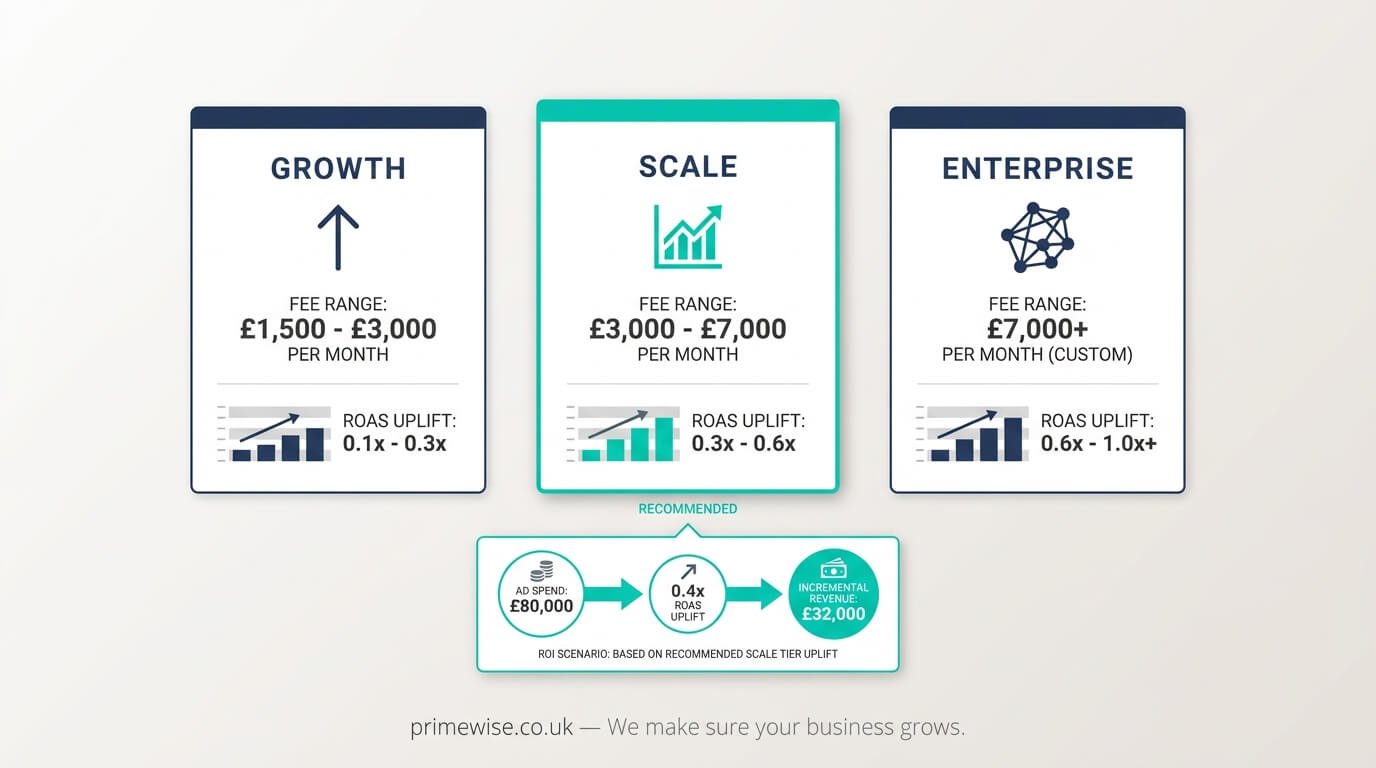
UK performance marketing consultant retainer fees in 2026 vary significantly based on sector complexity, platform scope, and remuneration model. Based on current London market engagement data and DMA UK contractor day-rate surveys, independent senior performance marketing consultants in the UK financial services sector command the following approximate monthly retainer ranges across three commercial tiers.
| Retainer Tier | Monthly Fee Range | Typical Deliverable Scope | Expected ROAS Uplift | Typical CAC Reduction |
|---|---|---|---|---|
| Growth Retainer | £6,000 – £8,500 | 2 platforms, weekly reporting, bid management, and monthly audit | 0.2 – 0.4x | 8% – 15% |
| Scale Retainer | £9,000 – £12,500 | 3–4 platforms, CRO integration, attribution modelling, fortnightly strategy calls | 0.4 – 0.8x | 15% – 28% |
| Enterprise Retainer | £13,500+ | Full-funnel management, MMM inputs, server-side tagging, C-suite dashboards | 0.8x+ | 28% – 40%+ |
To contextualise the commercial case: a financial services client investing £80,000 per month in Google Ads, who achieves a modest 0.4x ROAS improvement through a properly scoped Scale Retainer, generates approximately £32,000 in incremental monthly revenue against a £10,000 consultancy fee. That represents a 3.2x return on the consultancy investment alone, entirely separate from the underlying media spend. For a procurement director seeking sign-off from a CFO, this worked model collapses the consideration phase and transforms an abstract vendor selection into a concrete P&L decision.
PROCUREMENT INSIGHTIndependent senior consultants in the UK routinely deliver 20–35% stronger ROAS outcomes than equivalent agency retainers at the same fee level, primarily because overhead structures at agencies dilute the hours of senior talent applied to the account. Validate this by requesting a named lead consultant and a guaranteed minimum senior-hours allocation in your SOW.
Comparing Performance Marketing Retainer Models
Procurement teams must rigorously evaluate remuneration structures before executing any Statement of Work. Each model carries distinct incentive profiles, forecasting implications, and commercial risk exposures. Selecting the wrong model for your firm’s growth stage is one of the most common and most costly contracting errors in UK digital marketing procurement.
Flat Monthly Retainers
The fixed-fee model delivers maximum budget predictability, enabling finance departments to allocate annual marketing expenditure without variance risk. For early-stage firms with constrained forecasting horizons, this structure provides a clean cost baseline. However, the flat retainer creates a structural incentive vacuum that becomes progressively more damaging as the engagement matures. Once a consultant reaches target efficiency thresholds, there is no financial mechanism motivating them to aggressively scale the account, identify new revenue channels, or absorb additional platform complexity. Over a 12-month engagement, this incentive stagnation typically manifests as plateauing campaign performance, under-exploration of emerging ad formats such as Google Demand Gen or LinkedIn Thought Leader Ads, and reduced proactive strategic recommendations all of which represent a compounding opportunity cost for high-growth financial firms.
Capped Hours Retainers
A time-and-materials approach introduces transparency through timesheet accountability but fundamentally penalises consultant efficiency a critical flaw in a 2026 landscape defined by AI-driven campaign automation. A senior consultant operating Google Ads Performance Max campaigns, deploying smart bidding algorithms, and running server-side GA4 event configurations can execute optimisations in two hours that would have required two days under legacy manual management structures. Billing by the hour in this environment directly rewards slow execution over commercial impact. Beyond the incentive misalignment, capped-hours retainers introduce IR35 risk: HMRC inspectors specifically flag time-based billing and supervision of work hours as hallmarks of disguised employment. For UK enterprises, this model should be considered structurally obsolete for senior performance marketing engagements.
Hybrid and Outcome-Based Retainers
The hybrid outcome-based model has become the dominant structure among forward-thinking UK financial institutions and investment firms in 2026, precisely because it resolves the core incentive misalignment of both predecessor models. The architecture pairs a foundational base fee typically covering 60% of anticipated resource time based on agreed deliverables with a performance commission structured as a percentage of ROAS generated above a mutually agreed historical baseline. Standard London market hybrid retainers in the regulated financial sector currently feature a base fee component alongside a 5–8% commission on incremental ROAS above baseline, a benchmark aligned with DMA UK performance marketing contractor surveys for the 2025–2026 period. The commission structure ensures the consultant is financially motivated to scale aggressively, while the base fee guarantees the foundational technical and strategic work receives proper resourcing regardless of early-engagement performance volatility.
Setting the baseline correctly is the most commercially sensitive element of hybrid retainer negotiation. The baseline should be calculated from a rolling 90-day ROAS average prior to engagement commencement, adjusted for seasonal indexing where applicable. Both parties must agree in writing on the attribution model governing the baseline calculation, last-click, data-driven, or media mix modelling to prevent post-engagement disputes over commission calculations.
Performance Marketing Retainer vs Agency vs In-House
A sophisticated procurement director evaluating a performance marketing consultant retainer is invariably simultaneously weighing two competing alternatives: commissioning a full-service digital agency or building an in-house performance team. Each model carries fundamentally different cost profiles, flexibility characteristics, IR35 risk exposures, and institutional knowledge implications. Making this decision on intuition rather than structured criteria is a governance failure at the procurement level.
| Evaluation Criterion | Independent Consultant Retainer | Full-Service Agency | In-House Team |
|---|---|---|---|
| Monthly Cost (Mid-Market) | £8,000 – £12,500 | £12,000 – £25,000+ | £15,000 – £30,000+ (inc. NI, benefits) |
| IR35 Risk | Low (if SOW is correctly structured) | None | N/A (PAYE) |
| Senior Talent Access | Direct, named consultant | Variable (account managers) | Difficult to retain at senior level |
| Flexibility to Scale | High (scope amendments) | Medium (contract renegotiation) | Low (headcount constraints) |
| Institutional Knowledge | Portable on exit if SOW mandates it | Retained by the agency | Full internal retention |
| Performance Accountability | Direct, outcome-based clauses | Diffused across the team | Managed via internal KPIs |
For UK financial services firms operating in regulated environments, the independent consultant retainer model consistently outperforms the alternatives at the mid-market tier for three structural reasons. First, the direct access to named senior talent eliminates the agency model’s endemic junior-team-on-senior-fee problem. Second, a correctly drafted outcome-based SOW creates sharper performance accountability than any agency SLA. Third, the flexibility to amend scope via addendum without full contract renegotiation makes the model far more responsive to the rapid market changes characterising the 2026 paid search and paid social landscape.
Defining Retainer Scope and Deliverables
A commercially robust performance marketing consultant retainer lives or dies by the precision of its deliverable definitions. Vague scope language is the single most reliable predictor of engagement failure, generating disputes over responsibility, eroding consultant-client trust, and ultimately degrading campaign performance as energy is diverted from execution into contractual arguments. The deliverable structure should be segmented by engagement phase, with each phase carrying explicit timelines, named outputs, and defined acceptance criteria.
Month One Setup and Technical Foundations
The initial engagement phase demands intensive technical work that rarely generates immediate front-end revenue but is architecturally critical to every subsequent performance benchmark. Clients and procurement teams must recognise that month one fees fund foundational infrastructure, not vanity metrics. A well-scoped month one deliverable schedule for a financial services performance marketing retainer typically includes the following outputs.
- Comprehensive historical account audit covering the prior 12 months of campaign data across all active platforms
- Establishment of a verified ROAS and CAC baseline using an agreed attribution methodology
- Server-side GA4 event configuration and conversion pixel implementation across all target landing pages
- Google Tag Manager container audit and restructuring for first-party data capture compliance
- API integrations between CRM systems and ad platforms for offline conversion import
- Audience segmentation architecture built, including custom intent, in-market, and remarketing layers
- Competitive intelligence audit covering share of voice, auction insights, and keyword gap analysis
- Documented performance marketing strategy brief aligned to the firm’s specific CAC targets and revenue goals
Ongoing Execution and Optimisation
From month two onwards, the retainer transitions into recurring daily and weekly execution cycles. These ongoing deliverables form the operational core of the agreement and must be enumerated with equal precision to prevent scope creep from eroding execution quality. The following represents a standard ongoing deliverable schedule for a Scale Retainer engagement in the UK financial sector.
- Daily bid management and algorithmic performance monitoring across all active paid search and paid social campaigns
- Weekly revenue pacing analysis with variance-to-target commentary delivered via a shared live dashboard
- Fortnightly conversion rate optimisation testing, including landing page A/B test design, launch, and analysis
- Monthly Performance Max and Demand Gen campaign structure reviews aligned to Google’s latest algorithm update cycles
- Quarterly attribution model review incorporating GA4 data-driven attribution and any available MMM inputs
- Ad copy and creative brief generation aligned to FCA financial promotion compliance requirements
- Ongoing negative keyword management and search term query analysis to suppress irrelevant spend
- Monthly executive performance report, including ROAS, CAC, impression share, and incremental revenue calculation
SCOPE PROTECTIONAny deliverable not explicitly listed in the signed SOW schedule must be treated as out-of-scope by default. Ad hoc requests including bespoke creative production, competitor research reports, or new platform onboarding must trigger a formal Scope Change Request with agreed fee and timeline before work commences.
Performance Marketing KPIs and Attribution Frameworks
One of the most underscoped areas in UK performance marketing retainer agreements is the explicit definition of measurement methodology. In the post-cookie, first-party data landscape of 2026, ROAS figures can vary by 40–60% depending on which attribution model is applied to the same underlying campaign data. A retainer that specifies a ROAS target without defining the attribution model governing that measurement is, in commercial terms, an open-ended liability for both parties.
The Statement of Work must explicitly confirm the primary attribution model whether last-click, data-driven GA4 attribution, or a blended media mix modelling approach and must specify whether offline conversion imports from the client’s CRM are included in the ROAS calculation. For UK financial services firms where the customer journey frequently spans multiple weeks and touchpoints, data-driven attribution within GA4, supplemented by quarterly MMM model inputs, represents the current industry standard for fair performance measurement. Incrementality testing, deploying geo-based holdout experiments to isolate the true causal impact of paid media, should be specified as a quarterly deliverable on Scale and Enterprise retainer tiers to provide a statistically defensible performance narrative for C-suite reporting.
Scoping for AI-Driven Campaign Environments
The widespread adoption of Google’s Performance Max, Demand Gen, and Smart Bidding ecosystems has fundamentally altered the deliverable structure of a performance marketing consultant retainer in 2026. Legacy retainers were scoped around manual keyword bid adjustments, ad group restructuring, and match-type management activities that AI-driven campaign architectures have largely automated. Procurement teams drafting retainer scopes based on 2019-era deliverable frameworks are systematically overpaying for obsolete work while underfunding the strategic activities that now drive performance differentiation.
In an AI-driven campaign environment, the highest-value consultant activities have shifted upstream to audience signal architecture, first-party data feed quality management, creative testing velocity, and algorithm training period management. A properly scoped 2026 retainer should explicitly include Performance Max asset group strategy, audience signal configuration using first-party CRM data segments, creative rotation and performance scoring frameworks, and a documented protocol for managing the learning phase restrictions that govern smart bidding ramp-up periods. LinkedIn’s Predictive Audiences feature and Meta’s Advantage+ Shopping Campaigns introduce equivalent algorithmic complexity on paid social channels, each requiring specific scope definitions to ensure the consultant is accountable for signal quality inputs, not just surface-level bid adjustments.
Essential Contract Clauses for a Performance Marketing SOW
The gap between a generic service agreement and a genuinely protective Statement of Work is defined by the specificity and enforceability of its contractual clauses. The following clauses represent the minimum legal architecture required for a performance marketing consultant retainer in the UK-regulated financial sector. Each clause addresses a real-world procurement headache before it manifests as a commercial dispute.
Scope Boundaries and Overage Approvals
A well-drafted scope boundary clause is the most effective single mechanism for preventing engagement value erosion. The clause should read: any deliverables or services requested by the client that fall outside the defined schedules attached to this Statement of Work, including but not limited to bespoke creative asset production, third-party platform onboarding, competitor mystery shopping, or executive presentation preparation, shall be deemed out-of-scope services. Out-of-scope services are subject to a separate Scope Change Request document, which must be authorised in writing by the client’s designated procurement contact before any work commences, and shall be invoiced at the agreed overage day rate of [£X] plus applicable VAT.
Media Spend Handling and VAT
For UK operations, correctly structuring platform payment responsibilities is not merely administrative, it directly prevents a VAT cascade that can add 20% to the effective cost of media spend. The clause must state that the client shall maintain direct billing relationships with all media platforms, including but not limited to Google Ads, Microsoft Advertising, LinkedIn Campaign Manager, and Meta Business Manager. The consultant’s management fee, as defined in Schedule A of this agreement, is exclusive of direct media spend and exclusive of VAT, which shall be applied at the standard UK rate. The client is solely responsible for platform billing, media spend budget management, and any applicable platform-level taxes.
Termination and Bottleneck Protections
A balanced termination clause protects both parties against genuine performance failure without creating an instrument for bad-faith contract exit. The clause should specify that either party may terminate this agreement on 60 days’ written notice if performance metrics fall below [X]% of the agreed baseline ROAS for three consecutive calendar months, providing that the underperformance has not been caused by documented client-side bottlenecks. Bottleneck events, defined as the client’s failure to provide approved creative assets, legal compliance sign-offs, or platform billing continuity within the response times defined in Schedule B, shall suspend the performance accountability clock for the equivalent duration of the delay, and shall be logged in the monthly performance report.
Algorithmic Tool and IP Ownership
As proprietary scripts, bidding algorithms, and custom API integrations become central to competitive performance differentiation, the intellectual property clause in a retainer agreement carries growing commercial weight. The SOW must explicitly state whether custom scripts, GTM container configurations, audience segment architectures, and API integration tools built during the engagement remain the intellectual property of the consultant’s limited company upon contract termination, or are fully transferred to the client as work-for-hire deliverables. Standard market practice in UK performance marketing engagements assigns platform account ownership, including all campaign data, audience lists, and conversion history to the client absolutely, while retaining consultant IP over proprietary methodology frameworks, custom scripts, and algorithmic bidding models unless a specific IP transfer fee has been agreed and invoiced.
IP PROTECTION ALERTNever sign a retainer that is silent on IP ownership. If the SOW does not explicitly address who owns custom scripts, audience architectures, and algorithmic tools built during the engagement, default UK contract law may assign ownership to the commissioning client stripping the consultant of proprietary assets they depend on for future engagements.
What IR35 Clauses Must a Performance Marketing SOW Contain
For UK enterprise procurement teams, IR35 compliance is not a contractual nicety; it is a statutory obligation under the Off-Payroll Working Rules enforced by HMRC since April 2021, with significantly tightened enforcement activity observed through 2024 and 2025. A performance marketing consultant retainer that inadvertently displays the hallmarks of disguised employment exposes the client to back-payment of PAYE tax, National Insurance contributions, and interest penalties, a liability that can reach six figures on a rolling three-year engagement.
Five specific contractual mechanisms must be embedded in every UK performance marketing SOW to demonstrate a genuine business-to-business relationship outside IR35.
- Right of Substitution: the consultant’s limited company must retain the contractual right to provide an alternative specialist of equal or greater competence to fulfil any specific deliverable, without requiring client approval of the named substitute
- Absence of Mutuality of Obligation: the agreement must explicitly state that the client is under no obligation to offer ongoing work after the defined SOW period, and the consultant is under no obligation to accept work beyond the agreed deliverable schedule
- Method Autonomy: the SOW must confirm that the consultant retains total autonomy over the method, tools, location, and sequencing of execution, with the client’s contractual interest limited strictly to the quality of defined outputs
- No Direct Supervision or Control: the agreement must state that the consultant is not subject to the client’s management hierarchy, disciplinary procedures, or operational direction. Any quality concerns must be addressed through the deliverable acceptance procedure defined in Schedule C
- Business-to-Business Commercial Terms: payment terms, invoicing structure, and termination provisions must reflect a commercial relationship between two independent business entities, not an employer-employee dynamic
Procurement teams should instruct a qualified UK employment solicitor or HMRC-registered contractor specialist to review the final SOW before execution. HMRC’s Check Employment Status for Tax (CEST) tool provides a preliminary assessment but is not a substitute for professional legal review on engagements exceeding £50,000 in total contract value.
The Next Step for UK Financial Firms
For UK financial and investment firms ready to implement a commercially structured performance marketing consultant retainer, PrimeWise.co.uk provides specialist consultancy with engagements scoped specifically for regulated financial services environments. Retainer agreements are drafted to satisfy IR35 compliance requirements and are structured around outcome-based deliverables aligned to your specific customer acquisition cost targets, ROAS baselines, and FCA financial promotion obligations. Every engagement begins with a documented baseline audit and a custom SOW before any monthly fees are invoiced, ensuring that both commercial alignment and legal protection are established from day one.