The AI maturity model uk you choose will determine whether artificial intelligence becomes a genuine commercial engine or an expensive distraction. If you are a managing director, operations director, or founder of a UK business with 20 to 250 employees, this guide delivers a structured AI readiness audit you can complete in under thirty minutes, no data science team required. According to the UK Department for Science, Innovation and Technology’s 2024 AI Activity in UK Businesses survey, only 15% of UK SMEs have adopted at least one AI technology. That gap represents both a competitive risk and a significant first-mover opportunity for mid-market firms willing to act with clarity and structure.
Who This Guide Is ForThis framework is designed exclusively for UK managing directors, founders, and operations leaders at businesses with 20–250 employees who want a practical, governance-compliant AI roadmap without hiring expensive data scientists.
What Is the AI Maturity Model for UK SMEs
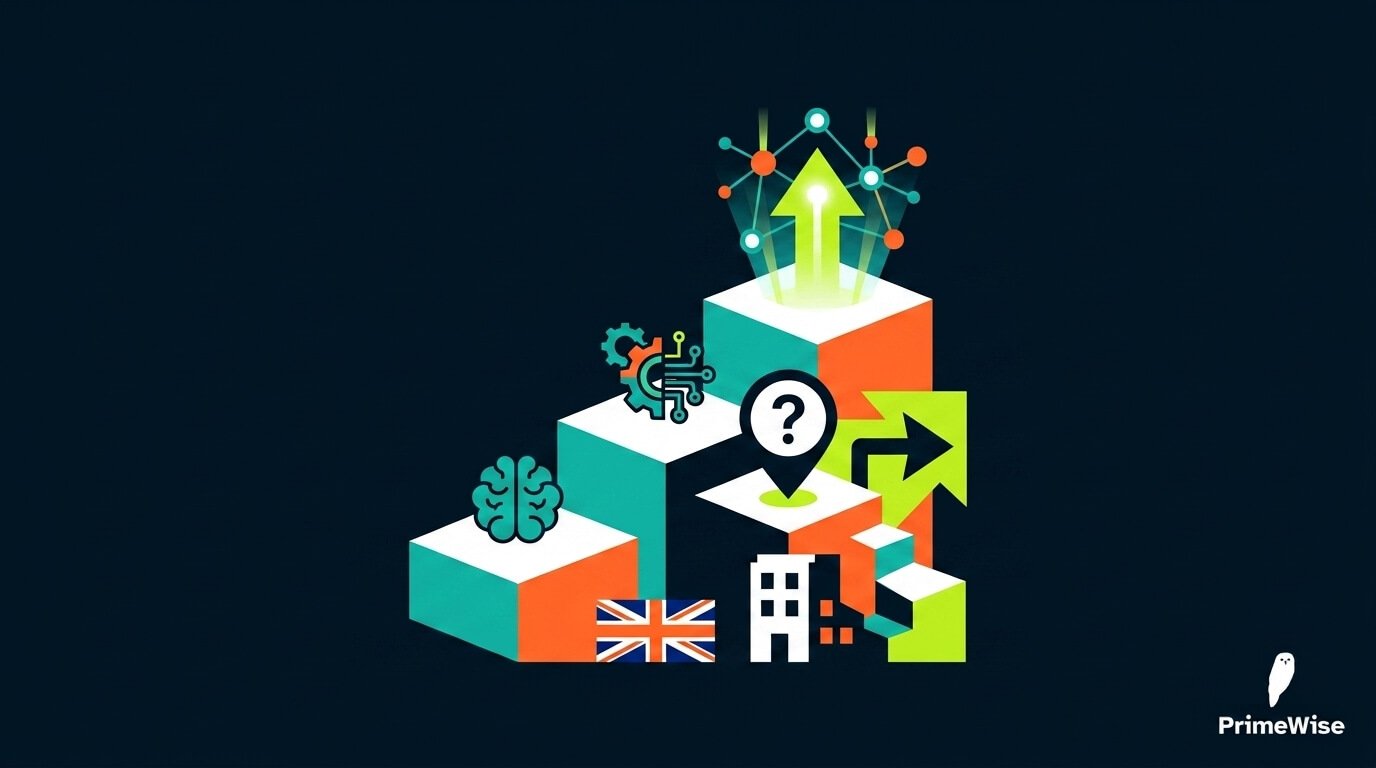
The AI Maturity Model for UK SMEs is a four-stage strategic framework that allows business leaders to benchmark their current artificial intelligence capability, identify their precise position in the adoption lifecycle, and build a funded, governance-compliant roadmap toward AI-first operations. Unlike enterprise-grade models, it is calibrated specifically for businesses operating with limited internal technical resource, legacy infrastructure, and the distinct regulatory obligations of the post-Brexit UK market.
Why Enterprise Frameworks Fail Mid-Market Firms
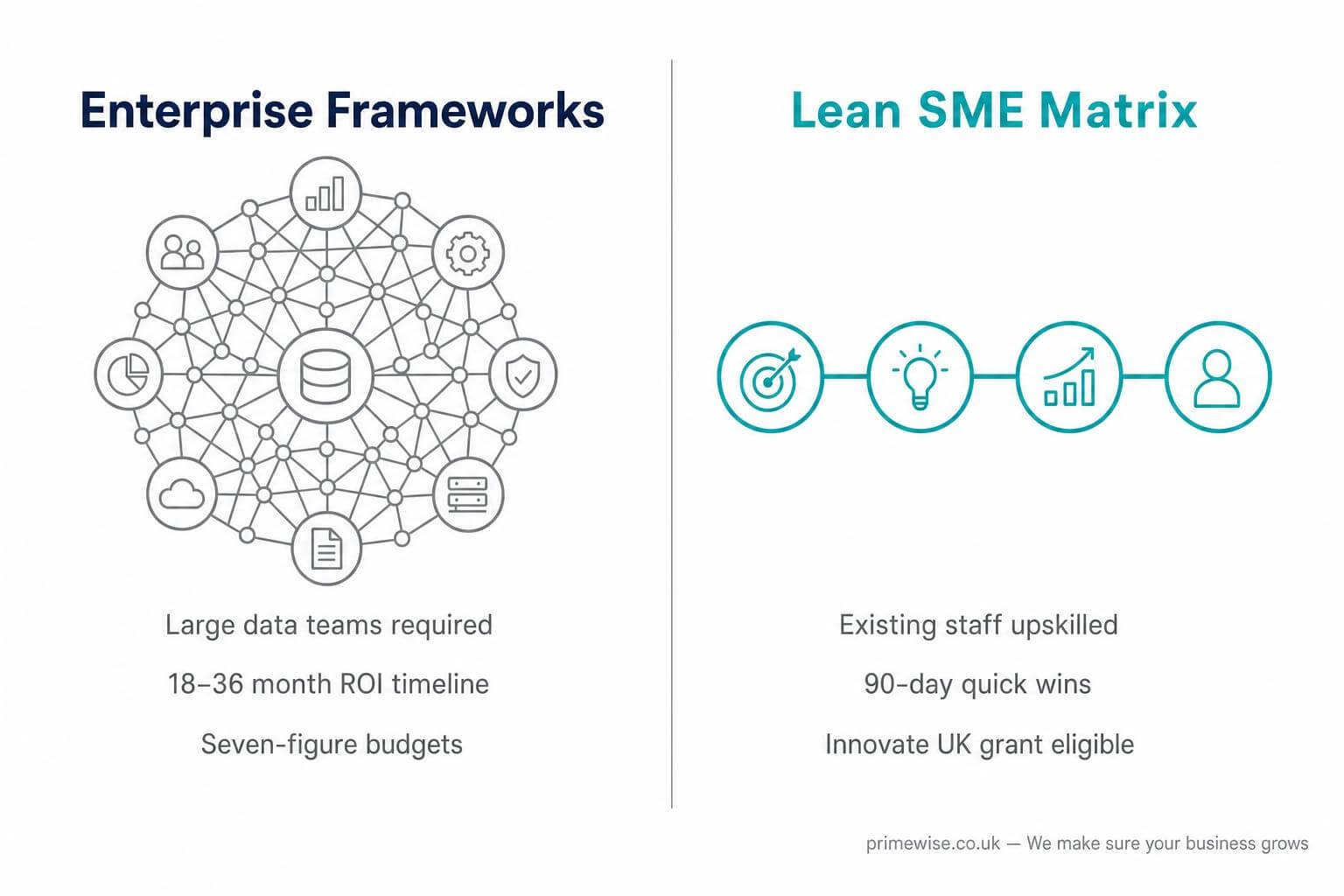
Managing directors frequently encounter decision paralysis when evaluating frameworks produced by global consultancies. The Gartner AI Maturity Model, for example, spans five levels from Awareness to Transformational and assumes the existence of dedicated machine learning engineering teams, clean centralised data lakes, and multi-year transformation budgets. Similarly, the IBM AI Ladder framework comprising Collect, Organise, Analyse, and Infuse is architected around enterprise data fabric infrastructure that most mid-market firms simply do not possess. McKinsey’s AI adoption curve research reinforces this point: firms achieving 20–25% EBITDA improvements through AI are overwhelmingly those with pre-existing data infrastructure investments exceeding seven figures.
UK SMEs operate with an entirely different commercial reality. Tech talent scarcity is acute Office for National Statistics data confirms the UK technology sector faces a structural skills gap affecting over half of digital employers. Attempting to implement sprawling, technically complex frameworks results in budget overruns, operational friction, and a disillusioned workforce. What mid-market businesses require instead is a model anchored in commercial application, rapid deployment of accessible tools, and measurable return on investment within ninety days.
The MIT Sloan Perspective on Incremental Maturity
Research from MIT Sloan Management Review provides a more relevant signal: organisations that progress through AI maturity incrementally prioritising business process integration over algorithmic sophistication achieve sustainable competitive advantage at a fraction of the capital cost. This incremental philosophy is the intellectual foundation of the lean SME framework outlined in this guide.
The Lean AI Maturity Matrix for UK SMEs
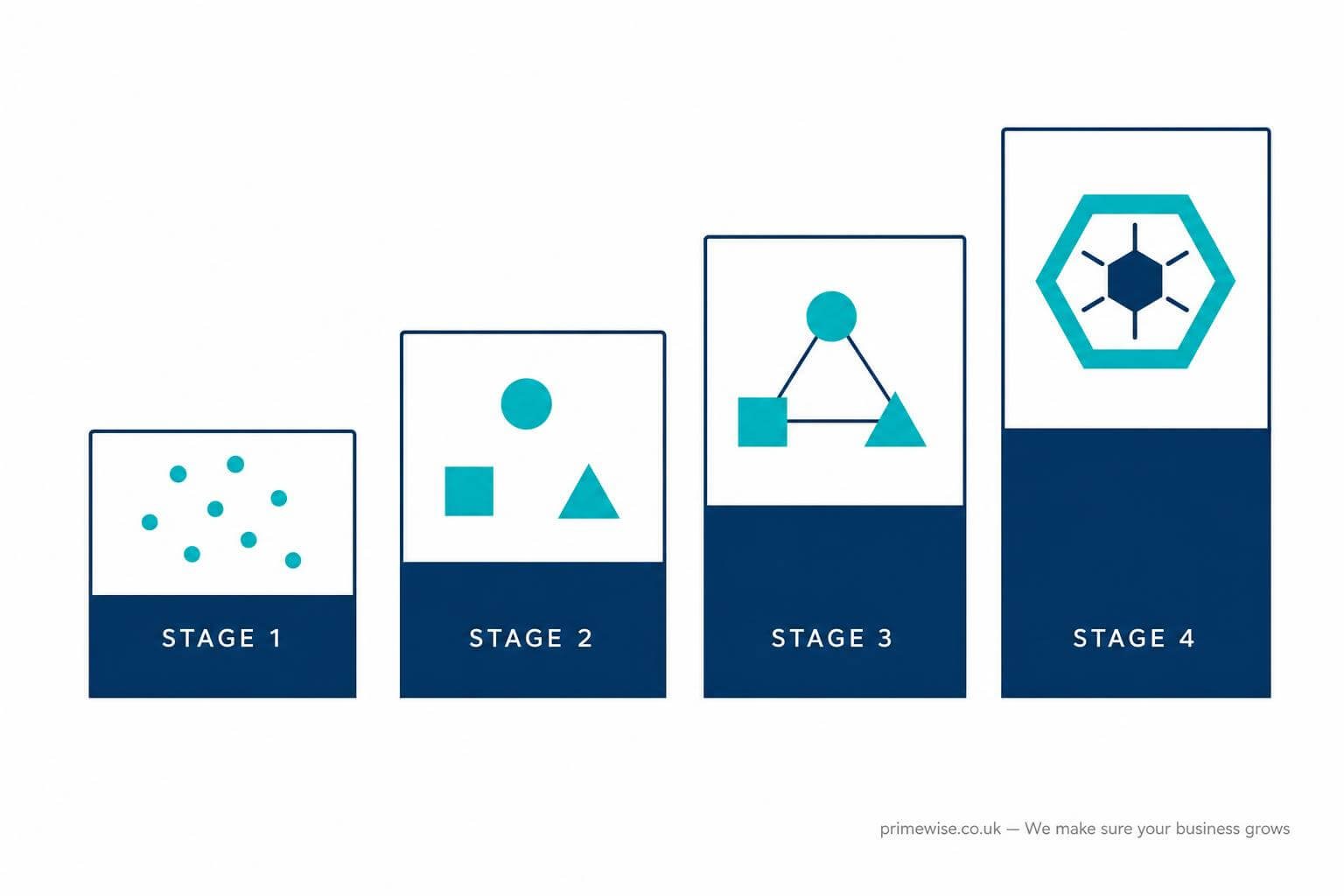
The Lean AI Maturity Matrix is a proprietary four-stage framework developed specifically for mid-market UK businesses. Unlike its enterprise counterparts, it evaluates AI readiness based on commercial impact, governance compliance, and workforce adoption rather than algorithmic complexity or data engineering sophistication. Each stage represents a distinct operational profile with specific diagnostic indicators and a defined transition pathway.
Stage 1 Ad-Hoc Experimentation
Stage 1 is characterised by fragmented, individually-driven usage of generative AI tools. Employees independently use applications such as ChatGPT, Google Gemini, or Microsoft Copilot to draft emails, summarise documents, or accelerate basic research tasks. Individual productivity may improve marginally, but there is zero strategic oversight. This is commonly referred to as the shadow IT phase. The critical risk at this stage is data security: employees entering client information or commercially sensitive data into public consumer-grade models represent a direct breach exposure under UK GDPR Article 22 and the ICO’s guidance on AI and automated decision-making.
Diagnostic indicators for Stage 1 include the absence of any formal AI policy, no visibility at the board level of which tools staff are using, and AI adoption driven entirely by individual curiosity rather than commercial objectives. The Alan Turing Institute’s SME research identifies this stage as the most common entry point for UK mid-market businesses and the most legally vulnerable.
Stage 2 Siloed Implementation
At Stage 2, departments begin purchasing specialist software to address specific operational bottlenecks. A marketing team might subscribe to Jasper or Copy.ai for content production, whilst the finance function adopts Microsoft Copilot for Microsoft 365 to accelerate spreadsheet analysis and report generation. The sales team may deploy a conversational AI tool such as Gong or Salesloft to analyse call recordings and improve pipeline accuracy. This stage delivers targeted return on investment and meaningful operational efficiency improvements within individual functions.
The structural weakness of Stage 2 is isolation. Each tool operates as a silo, with no data sharing or workflow continuity across business units. A lead enriched by the marketing platform does not automatically inform the sales forecasting model. Compliance outputs generated by the finance tool do not feed into the operational risk dashboard. The business is purchasing productivity in fragments rather than building compounding intelligence.
Stage 3 Process Integration
Stage 3 represents the most commercially significant maturity transition. Rather than acquiring additional SaaS subscriptions, the focus shifts to API integration connecting existing datasets and tools to create cross-functional, automated workflows. A customer service interaction captured by an AI-powered CRM automatically informs the sales forecasting model and triggers a compliance review flag where appropriate. AI becomes connective tissue rather than a standalone application.
At this stage, internal AI Champions domain experts upskilled in workflow automation platforms such as Microsoft Power Automate, Zapier, or Make lead process redesign initiatives. The business does not need to hire a £90,000 data scientist; it needs operationally experienced employees who understand both the business process and the automation tooling. This is the stage at which the AI investment begins to generate compounding returns and the technology becomes embedded into institutional knowledge.
Stage 4 AI-First Operations
At Stage 4, artificial intelligence is no longer a tool applied to existing processes it is the primary architecture through which the business creates and delivers value. Predictive analytics inform market expansion decisions. HR processes include structured upskilling programmes aligned to the UK Government’s AI Skills for Business framework. Customer experience is delivered through scalable, automated service pathways that require minimal human intervention for routine interactions. The business achieves distinct market differentiation through operational leverage that competitors operating at Stage 1 or 2 cannot replicate at an equivalent cost.
Key InsightMcKinsey research shows AI-mature firms report 20–25% EBITDA improvements. The differentiating factor is not budget it is structured progression through clearly defined maturity stages with governance built in from the outset.
The 30-Minute AI Readiness Self-Assessment
The following diagnostic framework allows leadership teams to benchmark their organisation across four critical pillars in under thirty minutes. Complete each pillar assessment independently before reviewing your aggregated profile. An honest internal evaluation is more commercially valuable than an optimistic self-assessment that masks strategic gaps.
Pillar One Strategy and Commercial Vision
Evaluate whether AI adoption in your organisation is driven by clear commercial objective-setting or by industry hype and peer pressure. A mature strategic position directly connects AI initiatives to measurable business outcomes: reducing client onboarding time by thirty percent, improving lead qualification accuracy by twenty-five percent, or cutting compliance review costs by forty percent. If your leadership team cannot articulate the specific operational problem each AI tool is solving and the KPI that will confirm success your organisation is operating at Stage 1 regardless of the number of software subscriptions active.
Pillar Two: Data Readiness and Infrastructure
Assess the current state of your business data without getting drawn into technical complexity. The critical question is not whether you have a data warehouse it is whether your operational data is accessible, reasonably clean, and connected. Information trapped in legacy on-premise systems, spreadsheets maintained by individual employees, or disconnected CRM and ERP platforms represents a fundamental blocker to Stage 3 progression. Businesses that have migrated to connected cloud infrastructure Microsoft Azure, Google Cloud, or AWS with at least partial CRM integration are genuinely positioned to progress. ICO guidance on data minimisation and purpose limitation under UK GDPR must also be factored into any data audit at this stage.
Pillar Three: Culture and Talent Readiness
Given the acute tech talent shortage across the UK, hiring an experienced AI engineer as your first internal resource is rarely the optimal deployment of capital. The more commercially effective approach is identifying technically curious domain experts within your existing workforce and investing in structured upskilling. Platforms including Microsoft Learn, Google Cloud Skills Boost, and the AI Skills for Business programme backed by Innovate UK provide accessible pathways to practical AI competency. The key indicator of Stage 3 readiness in this pillar is the presence of at least one internal AI Champion: an employee who bridges the gap between technical capability and everyday business process, with the credibility to drive adoption across their peer group.
Pillar Four Technology and Tools Audit
The final pillar requires a structured vendor assessment of your current SaaS ecosystem. Most mid-market businesses are significantly underutilising the AI features already embedded in tools they pay for. Microsoft 365 Copilot, Google Workspace with Gemini integration, HubSpot’s AI content and forecasting tools, and Salesforce Einstein all contain robust automation and intelligence capabilities that the majority of SME workforces have never activated. Before purchasing any additional software, audit your existing licences for untapped AI functionality. Map the specific features against your operational bottlenecks and identify the three highest-impact quick wins available within your current technology budget.
Executive ActionBefore your next board meeting, assign one senior leader to each pillar assessment. Consolidate the outputs into a single-page AI Readiness Profile. Your aggregate profile determines your current maturity stage and your priority transition actions.
How the Lean Matrix Compares to Gartner, IBM and McKinsey
For business leaders who have already reviewed established enterprise frameworks, the following comparison clarifies why those models are architecturally misaligned with UK SME requirements and how the Lean AI Maturity Matrix addresses each structural gap.
| Dimension | Gartner / IBM / McKinsey Models | Lean AI Maturity Matrix |
|---|---|---|
| Resource Requirement | Dedicated ML engineering teams, data lake infrastructure | Existing domain experts, off-the-shelf SaaS tools |
| UK Regulatory Alignment | Generic GDPR references, US-centric data governance | ICO guidance, UK GDPR Article 22, AI White Paper principles |
| Implementation Timeline | 18–36 months for meaningful ROI | 90-day quick wins built into every stage transition |
| Cost Profile | Seven-figure transformation budgets | Scalable SaaS subscriptions plus Innovate UK grant subsidy |
| Primary Success Metric | Algorithmic capability and model accuracy | Commercial impact margin improvement, time saved, revenue generated |
The distinction is not merely philosophical. A mid-market firm that attempts to implement the Gartner five-level model without dedicated data infrastructure will exhaust its change management capital before reaching the first commercially meaningful milestone. The Lean Matrix is engineered to deliver measurable business impact at every stage transition, ensuring leadership buy-in is sustained throughout the progression journey.
Actionable Transition Roadmaps
Knowing your current maturity stage is only valuable if it is paired with a precise, prioritised action plan. The following roadmaps outline the highest-impact transition steps for each stage, calibrated to the resource constraints of a UK mid-market business.
Moving from Stage 1 to Stage 2
The immediate priority is governance before growth. Draft and enforce a comprehensive Acceptable Use Policy that explicitly defines which categories of data employees may process through external AI tools, which enterprise-grade platforms are approved for business use, and what the reporting obligation is when an employee identifies a data security concern. Establish an enterprise-tier licence for your primary productivity platform Microsoft 365 Copilot or Google Workspace with Gemini which guarantees data ring-fencing and ensures corporate inputs are not used to train public models. Select one high-repetition operational bottleneck, apply the appropriate off-the-shelf tool, and measure the commercial outcome against your pre-defined KPI within sixty days.
Moving from Stage 2 to Stage 3
The transition from siloed implementation to process integration requires a deliberate API strategy. Identify the two or three operational workflows where data is currently manually transferred between systems the handoff from marketing CRM to sales pipeline, or from client intake form to compliance checklist and eliminate those manual steps through automation. Microsoft Power Automate is the most accessible entry point for businesses already operating within the Microsoft 365 ecosystem, offering a low-code environment that an upskilled domain expert can navigate without engineering support. Appoint your first official AI Champion, provide them with dedicated upskilling time, and define their mandate explicitly: they are responsible for identifying, implementing, and measuring automation opportunities across at least two business functions.
Moving from Stage 3 to Stage 4
Reaching AI-first operations requires embedding intelligence into strategic decision-making, not merely operational execution. At this stage, the focus shifts to predictive analytics for commercial planning forecasting demand, modelling pricing scenarios, and identifying customer churn risk before it materialises. HR processes must incorporate structured AI upskilling aligned to the UK Government’s AI Skills for Business framework, ensuring that workforce capability keeps pace with operational ambition. Governance becomes a strategic asset rather than a compliance obligation: a mature responsible AI governance framework, aligned with the UK AI White Paper’s six principles of safety, security, robustness, transparency, fairness, and accountability, differentiates the business to enterprise clients and institutional partners who are increasingly conducting AI due diligence as part of procurement.
UK Case Studies in AI Maturity Progression
Theoretical frameworks gain commercial credibility through real-world application. The following case studies demonstrate the Lean Matrix in operation across two distinct UK sectors.
London Financial Consultancy Compliance Automation
A fifty-person investment and compliance consultancy in the City of London faced a severe operational bottleneck during quarterly client audit cycles. Senior consultants were spending an estimated twelve billable hours per week on routine compliance document review work that was necessary but generated no incremental fee income. The firm was operating at a clear Stage 2 maturity level: Microsoft 365 was deployed but Copilot features were entirely unused, and there was no formal AI policy in place.
Over an eight-week implementation period, the firm activated Microsoft 365 Copilot under an enterprise licence agreement, ensuring full FCA and ICO data governance compliance. An internal AI Champion a compliance analyst with five years of domain expertise was upskilled using Microsoft Learn and given a forty percent time allocation to lead the integration. The outcome: forty percent of routine compliance report generation was automated, saving approximately eight FTE hours per consultant per month. Senior consultants redirected that recovered time toward high-value advisory mandates, improving gross margin per head by an estimated eighteen percent within the first quarter. The firm progressed from Stage 2 to Stage 3 within twelve weeks.
West Midlands Manufacturing Business Production Intelligence
A 130-employee precision components manufacturer in the West Midlands was experiencing significant production planning inefficiencies. Demand forecasting relied on a manually updated spreadsheet model that consistently underestimated lead time variance, resulting in excess inventory and periodic stockout events. The business was at Stage 1 maturity: AI tools were discussed at board level but no structured adoption had occurred.
Working within an Innovate UK Smart Grant allocation of £45,000, the business integrated a no-code predictive analytics layer built on Microsoft Azure Machine Learning Studio into its existing ERP system over fourteen weeks. The integration was led by a production planning manager with no prior data science experience, supported by a structured upskilling programme. The result was a twenty-two percent reduction in excess inventory holding costs and a thirty-one percent improvement in on-time delivery performance within six months of go-live. The business progressed directly from Stage 1 to Stage 3, bypassing the traditional siloed implementation phase through deliberate architectural planning.
Governance and IP Protection for UK SMEs
Accelerated AI adoption must not come at the cost of client confidentiality, intellectual property security, or regulatory compliance. The UK’s post-Brexit regulatory environment creates a specific set of obligations that are distinct from both EU GDPR and US frameworks, and business leaders must engage with these obligations directly rather than delegating them entirely to legal counsel.
Under UK GDPR Article 22, individuals have specific rights regarding automated decision-making that significantly affects them. Any AI-driven process within your business that generates decisions impacting clients, employees, or suppliers including credit assessment, recruitment screening, or performance evaluation must be documented, auditable, and contestable. The ICO’s AI and Data Protection guidance, updated in 2024, provides a practical compliance checklist that mid-market businesses can implement without specialist legal resource. The UK AI White Paper’s six principles safety, security, robustness, transparency, fairness, and accountability provide the strategic governance architecture, whilst the ICO guidance delivers the operational compliance detail.
The UK Government’s ongoing AI and Copyright consultation is particularly relevant for businesses using LLMs to process or generate content derived from proprietary data. Until the consultation concludes and legislation is confirmed, businesses should ensure their enterprise AI licences explicitly prohibit the use of corporate data inputs for model training, and that all AI-generated outputs are reviewed by a human before client-facing deployment. The Employment Rights Bill 2025 also introduces new obligations regarding transparency when AI tools influence workforce decisions, which HR functions must account for in their AI Champion upskilling programmes.
Governance Non-NegotiableDraft your Acceptable Use Policy before any business-wide AI rollout. It must specify approved tools, data classification rules, and the human review requirement for client-facing AI outputs. This is your primary ICO compliance mechanism.
UK Funding for AI Adoption
Financial investment remains the most frequently cited barrier to AI adoption among UK SMEs, yet the government funding landscape in 2025 and 2026 offers meaningful subsidy for businesses willing to engage with available programmes. Innovate UK Smart Grants the primary mechanism for mid-market digital transformation funding offer awards typically ranging from £25,000 to £500,000 for projects demonstrating commercial innovation and scalability. The AI and Data Economy challenge stream within the Innovate UK portfolio is directly relevant to businesses at Stage 2 or Stage 3 seeking funding to progress their integration architecture.
Beyond direct grant funding, regional digital adoption programmes administered through Local Enterprise Partnerships provide matched funding for SaaS adoption and upskilling investment. The UK Government’s AI Skills for Business programme offers subsidised training aligned to the National AI Strategy, covering both foundational AI literacy and practical automation tool competency. Businesses in designated UK Investment Zones may also access additional digital infrastructure support through their local growth hub. Engaging with these resources before committing internal capital to AI adoption is a commercially rational first step that materially reduces the financial risk of the progression journey.
Your Next Step with Primewise
Identifying your current maturity stage through this framework creates a peak decision-making moment the point at which strategic intent must translate into structured action. Primewise works exclusively with UK SMEs and scaleups at every stage of the Lean AI Maturity Matrix, from establishing your first Acceptable Use Policy at Stage 1 through to designing predictive analytics architecture for Stage 4 AI-first operations.
The Primewise AI Readiness Scorecard provides a benchmarked diagnostic report calibrated to your specific industry, workforce profile, and current technology stack. If your business matches the profile of a firm at Stage 1 or Stage 2 and you are ready to move with commercial precision, request a complimentary thirty-minute AI Roadmap Review designed exclusively for UK managing directors and founders leading businesses with 20 to 250 employees. Visit primewise.co.uk to access the Scorecard and book your session.