

A well-defined fractional CMO scope of work is the single most important commercial document you will produce when engaging a fractional CMO consultancy. According to PrimeWise engagement data, UK scale-ups with poorly structured agreements waste an average of £28,000 per engagement on misdirected executive hours paying C-suite day rates for tasks that a junior marketer or specialist agency should be handling. This guide provides a complete, legally structured framework covering in-scope strategic deliverables, explicit out-of-scope exclusions, IR35-compliant contract clauses, and a 90-day success measurement timeline. Whether you are a founder preparing to hire, a PE operating partner reviewing a proposal, or a VC-backed leadership team approaching your first board-aligned marketing engagement, this is the definitive operational reference you need before a contract is signed.
IMPORTANT: Legal DisclaimerThis article constitutes general commercial guidance only and does not represent legal or tax advice. Before executing any fractional executive agreement, seek independent counsel from a UK employment tax specialist, particularly regarding IR35 classification under Chapter 10 of ITEPA 2003.
What Is a Fractional CMO Scope of Work
A fractional CMO scope of work is a legally binding B2B services agreement that defines the strategic deliverables, leadership responsibilities, reporting cadence, and precise operational boundaries of a part-time chief marketing officer engagement. It separates C-suite strategic advisory from tactical execution, protecting both the hiring enterprise and the independent contractor from commercial misalignment, budget erosion, and potential tax liability.
This document functions as the operational blueprint for the entire marketing function during the engagement period. It answers four fundamental questions before day one: what the executive is accountable for delivering, what they are explicitly not responsible for executing, how success will be measured at board level, and how the relationship will be governed and eventually concluded. Without this precision, even the most capable senior marketer defaults to filling operational gaps a catastrophically expensive misuse of advisory-grade expertise. The CIPD 2025 Executive Pay Report confirms that full-time UK CMO salaries now exceed £180,000 per annum plus benefits, which contextualises the premium daily rate a fractional engagement commands and underscores exactly why every hour must be allocated with strategic intent.
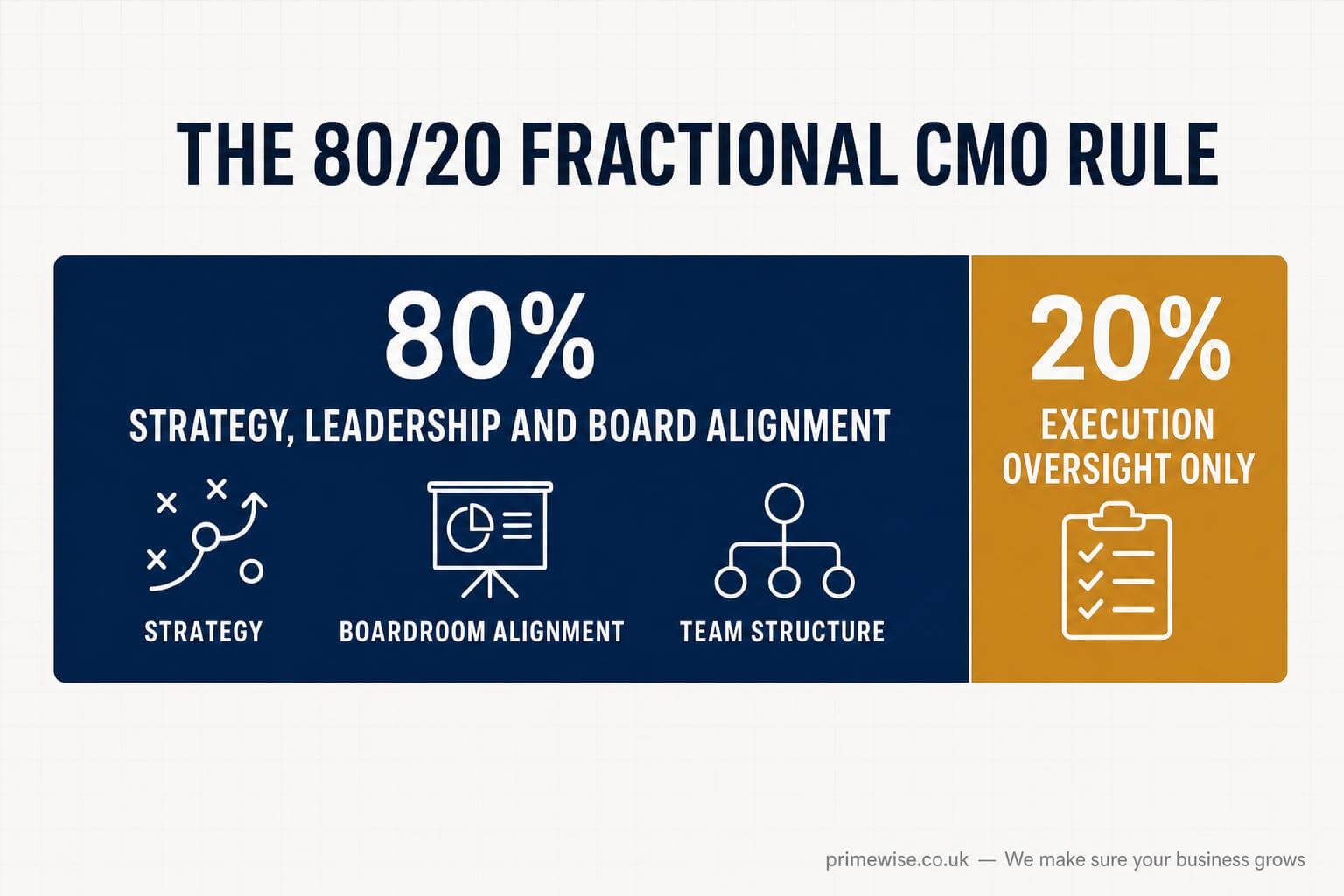
The 80/20 Rule for Fractional CMO Deliverables
The most commercially effective fractional CMO engagements operate on a clear allocation principle: eighty percent of the contractual remit is dedicated to strategy, commercial leadership, and board-level alignment, while the remaining twenty percent covers the governance and oversight of tactical execution. This ratio the PrimeWise 80/20 Fractional CMO Rule ensures founders extract maximum leverage from premium executive advisory rather than inadvertently purchasing an expensive operational manager.
Understanding this ratio before drafting the scope prevents the most common and costly structural error in fractional executive contracting. When the boundaries blur between who designs the strategy and who executes it, retainer burn accelerates rapidly. PrimeWise data from UK scale-up engagements shows that businesses without a formally documented delegation framework burn up to 35% of their fractional CMO retainer budget on execution-level tasks within the first 90 days. The 80/20 rule is not merely a philosophical preference it is a measurable financial protection mechanism that should be explicitly referenced within the scope document itself.
Go-to-Market Strategy and Budget Governance
The primary strategic mandate of any part-time marketing executive is the architectural design of a robust go-to-market strategy. In a B2B SaaS or PE-backed scale-up context, this encompasses precise market positioning, ideal customer profile refinement, competitive differentiation, and the overarching commercial narrative that connects product value to revenue pipeline. The scope must mandate strict financial stewardship, detailing how marketing budgets are allocated across channels to optimise customer acquisition cost and maximise pipeline contribution.
Budget governance is not a passive reporting function it is an active commercial discipline. The fractional CMO should be accountable for recommending budget reallocation based on attribution data, challenging underperforming agency spend, and ensuring marketing investment is tied directly to revenue operations alignment across sales and customer success. The OKR framework for marketing teams is an effective structural tool here, enabling the executive to set quarterly objectives with measurable key results that translate directly into board-reportable metrics.
Board-Level Reporting and Investor Alignment
Institutional investors whether London-based venture capital firms or private equity operating partners demand a level of data transparency that extends far beyond standard marketing dashboards. The scope must explicitly mandate the production of comprehensive board packs tailored to the specific reporting expectations of the firm’s investors, aligning with BVCA (British Private Equity and Venture Capital Association) standards for marketing investment performance in growth-stage companies.
Marketing attribution models for board reporting are a critical competency within this deliverable. The executive must translate departmental output MQL volume, cost per acquisition, pipeline contribution, brand share of voice into institutional-grade financial metrics that speak directly to enterprise valuation. When a fractional CMO can present at board level and articulate how marketing spend correlates with EBITDA trajectory, the engagement moves from a cost line to a value-creation asset in the eyes of PE and VC stakeholders. This alignment is not optional it should be a named deliverable within the scope document.
Team Leadership and Agency Governance
A senior marketing leader is engaged to manage the commercial ecosystem, not to operate within it as an executional resource. The scope must outline clear responsibilities for agency vetting, performance management of existing vendors, and the mentorship of internal marketing team members. This includes establishing structured agency governance protocols regular performance reviews, clearly defined KPIs for each vendor, and a procurement framework that prevents budget leakage across fragmented supplier relationships.
The fractional CMO’s role in team leadership also extends to strategic hiring oversight. If the scale-up requires a full-time marketing hire during the engagement period a content manager, a performance marketing specialist, a marketing operations lead the executive should be responsible for defining the role brief, participating in the interview process, and onboarding the new hire into the existing strategy. This is a high-leverage activity that compounds the long-term value of the engagement and should be explicitly captured in the scope as a named deliverable rather than assumed as an informal responsibility.
Marketing Technology Architecture and UK GDPR Compliance
Modern marketing operations depend on integrated data systems, and a fragmented or poorly configured marketing technology stack is one of the most common sources of inefficiency in scale-up businesses. The fractional CMO’s scope must include strategic oversight of the martech architecture specifically the CRM system, marketing automation platform, attribution tooling, and customer data infrastructure ensuring these systems are configured to support both commercial objectives and regulatory obligations.
For British enterprises, UK GDPR compliance is a non-negotiable operational requirement, not a legal afterthought. The executive must ensure that all data collection, processing, and retention frameworks within the marketing function adhere strictly to UK GDPR standards as maintained by the ICO. This includes consent management for email marketing, cookie policy governance for paid and organic acquisition channels, and data subject rights protocols. Embedding GDPR oversight within the scope protects the business from regulatory risk and signals operational maturity to institutional investors conducting marketing due diligence for private equity purposes.
What Should Be Explicitly Out of Scope
Defining what the fractional CMO does not do is as commercially important as defining what they are accountable for. Operational bottlenecks arise consistently when the distinction between leadership and execution blurs in the first weeks of an engagement. The following categories must appear as explicit out-of-scope exclusions within the signed agreement.
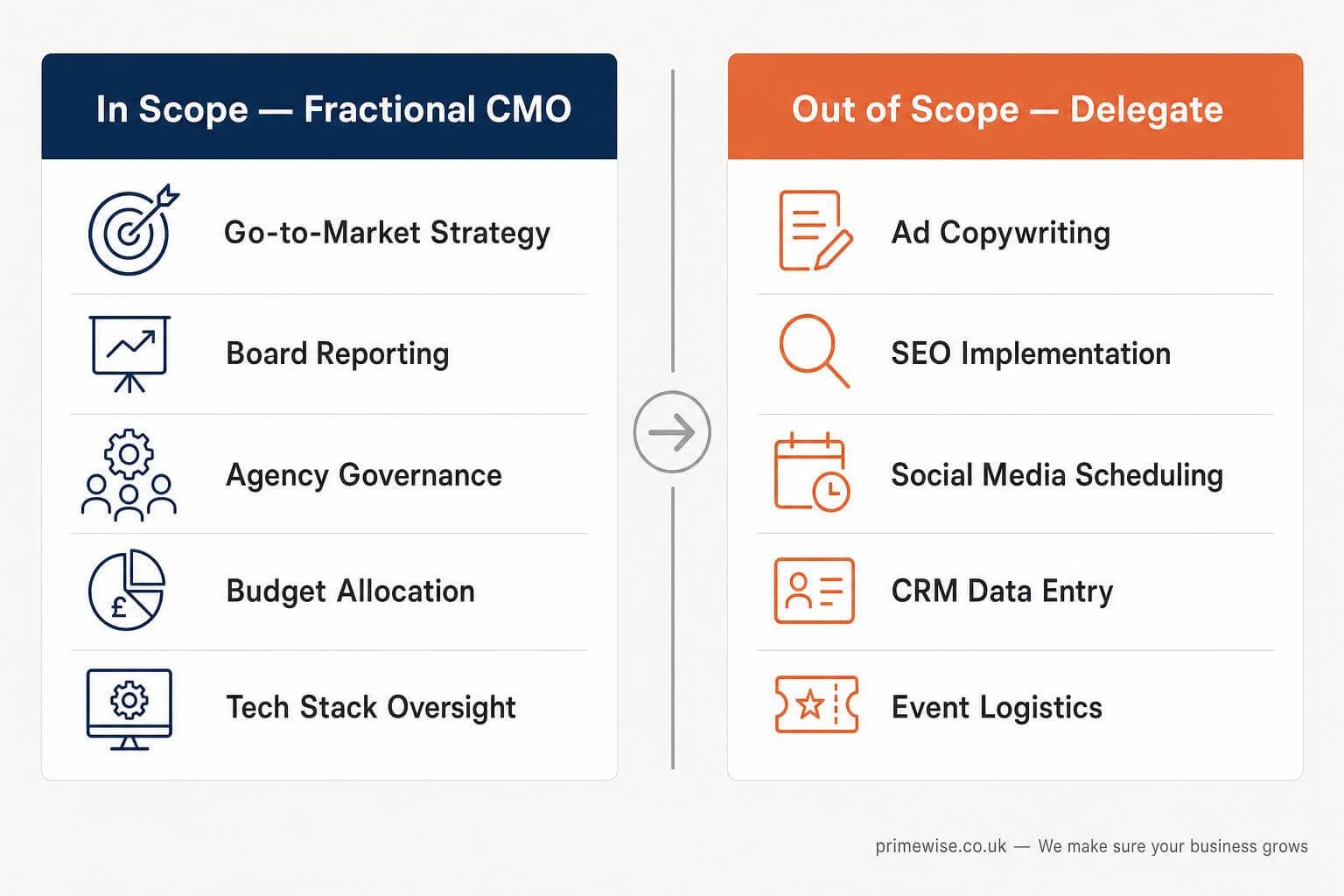
The Strategy-to-Execution SOW Matrix
The PrimeWise Strategy-to-Execution SOW Matrix is a delegation framework that maps every marketing activity against two axes: strategic ownership and executional responsibility. The fractional CMO owns the strategic layer the brief, the budget, the KPI framework, the vendor accountability. The executional layer the actual production, publishing, optimisation, and reporting of daily marketing activity belongs to specialist agencies, internal junior staff, or dedicated contractors. Implementing this matrix within the scope document eliminates ambiguity and gives both parties a shared reference point when the inevitable scope creep conversation arises.
| Deliverable Category | In Scope Fractional CMO | Out of Scope Delegate |
|---|---|---|
| Go-to-Market Strategy | Architecture, positioning, ICP definition | Campaign execution, content calendars |
| Board Reporting | Investor pack creation, KPI narrative | Raw data extraction, CRM reporting admin |
| Paid Media | Budget allocation, agency briefing, KPI setting | Ad copywriting, daily bid management, A/B testing |
| SEO Programme | Strategic content direction, channel prioritisation | Granular keyword research, technical SEO implementation |
| Social Media | Channel strategy, brand voice guidelines | Daily community management, post scheduling |
| Email Marketing | Nurture strategy, segmentation logic | Copywriting, template design, list hygiene |
| CRM Management | Architecture oversight, RevOps alignment | Contact data entry, workflow builds, CRM admin |
| Brand Identity | Brand positioning, messaging hierarchy | Logo design, visual asset production |
| Agency Management | Vetting, KPI setting, performance reviews | Day-to-day agency liaison, invoice approvals |
| Team Hiring | Role brief, interview participation, onboarding strategy | HR administration, contract management |
| Event Marketing | Strategic event prioritisation, ROI framework | Event logistics, stand design, on-site management |
| Marketing Analytics | Attribution model design, dashboard brief | Dashboard builds, data cleaning, report formatting |
This matrix should be appended directly to the signed agreement as a named exhibit, giving it contractual weight rather than treating it as an informal reference document. When a new task arises mid-engagement as it invariably will both parties can reference the matrix to determine whether it falls within the retainer or requires separate resource allocation. This single structural addition is the most effective defence against retainer burn in fractional executive engagements.
Structuring the Agreement to Protect Both Parties
Beyond commercial deliverables, the fractional CMO scope of work requires robust legal formatting tailored specifically to the UK business landscape. The following contractual pillars are non-negotiable for any engagement involving a PE-backed enterprise or a high-growth scale-up operating under institutional investor scrutiny.
IR35 Compliance and HMRC Off-Payroll Rules
IR35 compliance is the most legally consequential structural element of any fractional executive engagement in the UK. Under Chapter 10 of the Income Tax (Earnings and Pensions) Act 2003 (ITEPA 2003), the off-payroll working rules introduced in their reformed 2021 iteration place the liability for correct employment status determination on the medium or large hiring firm rather than the contractor. A misclassified engagement where the fractional CMO is determined by HMRC to be a disguised employee rather than a genuinely independent B2B services provider can result in substantial back-tax liability, national insurance obligations, and penalty charges for the hiring business.
The scope of work itself is a primary piece of evidence in any HMRC employment status enquiry. The document must unequivocally demonstrate substitution rights, the absence of mutuality of obligation, and genuine financial risk on the part of the contractor the three key IR35 status tests. The agreement should also be tested against HMRC’s Check Employment Status for Tax (CEST) tool prior to signature, and the output retained as a compliance record. PrimeWise strongly recommends that all fractional CMO engagement agreements are reviewed by a UK employment tax specialist before execution. This is not optional due diligence it is a legal prerequisite for medium and large firms engaging off-payroll workers in 2026.
Intellectual Property and Confidentiality Provisions
Protecting proprietary enterprise assets requires comprehensive intellectual property clauses within the scope document. All strategies, go-to-market frameworks, campaign architectures, and data structures generated during the engagement must be explicitly assigned to the hiring firm upon delivery or payment, with clear language preventing the executive from repurposing or replicating proprietary methodologies for competing clients without prior written consent. Robust non-disclosure provisions and time-limited restrictive covenants covering named competitors, active prospect lists, and commercially sensitive product roadmaps further safeguard the enterprise’s competitive position.
Retainer Structure and Exit Provisions
Commercial engagements should be structured around a deliverables-based retainer rather than time-and-materials billing. Deliverables-based remuneration aligns payment with strategic output rather than hours logged a critical distinction for both IR35 compliance and commercial accountability. The retainer should specify the exact monthly deliverables, the frequency and format of reporting, and the process for requesting out-of-scope work. Additionally, the agreement must include predefined termination clauses with a notice period typically ranging from 30 to 90 days depending on engagement complexity, providing a clear and professionally structured exit strategy for both parties without triggering employment rights or unfair dismissal considerations.
PERFORMANCE INCENTIVESSophisticated engagements increasingly incorporate milestone-based commercial bonuses or equity options alongside the base retainer. These performance incentives align the fractional CMO's financial interests directly with enterprise valuation growth and long-term revenue targets a structure that PrimeWise recommends for any engagement lasting beyond six months.
The 90-Day Success Framework
Accountability requires a tangible timeline for performance measurement. Integrating a sequenced onboarding and milestone roadmap into the scope document ensures that strategic planning translates into measurable business outcomes within a commercially defined window. This framework also satisfies the due-diligence expectations of PE and VC investors who require evidence of structured onboarding governance before approving executive appointments.
Month One Diagnostics and Baseline
The first 30 days must be dedicated entirely to rigorous diagnostics. The scope should mandate a comprehensive marketing audit covering channel performance, attribution accuracy, agency contract terms, martech configuration, team capability, and existing brand positioning. Stakeholder alignment sessions with the CEO, CFO, and relevant board members should be conducted to ensure the marketing strategy is anchored to the enterprise’s overarching commercial objectives. By the end of month one, the executive should have established baseline KPIs across all key metrics and delivered a written strategic assessment with prioritised recommendations.
Month Two Strategy Deployment and Vendor Governance
The second month focuses on the transition from strategic planning to operational governance. Contractual deliverables for this phase should include the formal presentation and board approval of the revised go-to-market strategy, active restructuring of agency briefs and KPI frameworks, initial deployment of priority campaigns under the new strategic direction, and the establishment of a weekly marketing performance reporting rhythm. The OKR framework should be fully operational by the end of this phase, with all team members and agency partners aligned to the agreed quarterly objectives.
Month Three Scaling Metrics and Board Optimisation
By day 90, the enterprise should be recording a tangible shift in commercial trajectory across at least three core metrics. The scope dictates that month three is focused on tracking leading indicators of pipeline growth, scaling marketing ROI through channel optimisation, and presenting the first iteration of institutional-grade board reporting in a format aligned with PE or VC investor expectations. This board pack should present marketing performance as a direct input to enterprise valuation connecting MQL quality, sales cycle velocity, and customer acquisition cost to the financial metrics that matter most to institutional stakeholders.
PrimeWise Case Study Restructuring a London PE-Backed Technology Firm
A PrimeWise-structured engagement with a London-based private equity-backed B2B SaaS scale-up in 2024 provides a precise illustration of the financial impact of scope precision. At the point of engagement, the business had been operating with a fractional marketing leader on a vague monthly retainer for approximately four months. An operational audit revealed that the executive was spending roughly 40% of their contracted hours managing granular paid search campaigns specifically Google Ads bid management and Meta campaign optimisation tasks that a performance marketing agency was already contracted to execute.
The estimated financial waste during this mis-scoped period was £14,000 in misdirected advisory hours over eight weeks, based on the executive’s contracted day rate applied to the proportion of time spent on execution tasks. PrimeWise restructured the agreement using the Strategy-to-Execution SOW Matrix, explicitly removing all paid media execution responsibilities and redirecting the executive’s focus to agency performance governance, board reporting alignment, and go-to-market strategy refinement for two new target verticals. Within four months of the restructured engagement, the firm recorded a 30% increase in overall marketing ROI measured against MQL-to-SQL conversion rate, cost per acquisition, and pipeline contribution alongside a measurable reduction in agency spend waste of 22% attributable to improved vendor governance and KPI accountability. The engagement was subsequently extended for a further 12 months, transitioning from a remedial restructuring to a proactive growth mandate.
FIND A VETTED FRACTIONAL CMOPrimeWise specialises in placing rigorously vetted Fractional CMOs into UK scale-ups and PE-backed enterprises. Every engagement begins with a structured scope of work review to ensure commercial alignment from day one. Request a scope consultation at primewise.co.uk.
Interim CMO Versus Fractional CMO Understanding the Difference
A question that arises frequently during the scoping process is whether the business requires an interim CMO or a fractional CMO and the distinction is commercially significant. An interim CMO is typically a full-time, temporary appointment designed to bridge a leadership gap during a transition period, such as a post-acquisition integration or a sudden executive departure. The fractional CMO model, by contrast, is a permanent part-time strategic appointment typically one to three days per week designed for businesses that require ongoing C-suite marketing leadership but are not at a stage where a full-time executive salary is commercially justified.
The scope of work structure differs accordingly. An interim CMO engagement often operates closer to an employment contract in its practical day-to-day reality, which introduces elevated IR35 risk if not carefully structured. A fractional CMO engagement, properly documented with a deliverables-based scope, clear substitution provisions, and explicit out-of-scope exclusions, is a significantly cleaner B2B services arrangement from both a commercial and a tax compliance perspective. Understanding this distinction before drafting the scope document ensures the agreement is calibrated correctly for both the business’s operational needs and its regulatory obligations.
How to Find a Vetted Fractional CMO with PE Board Experience
Sourcing a fractional marketing executive through a general freelance platform introduces significant commercial risk the absence of vetting, the lack of institutional reference checks, and no accountability framework for underperformance. For UK scale-ups and PE-backed businesses operating at Series A and beyond, the executive must bring demonstrable experience presenting at board level, managing institutional investor relationships, and operating within the specific commercial dynamics of a high-growth, capital-efficient environment.
PrimeWise.co.uk specialises in placing rigorously vetted fractional CMOs into UK scale-ups and private equity-backed enterprises. The PrimeWise vetting methodology includes a structured assessment of the executive’s PE and VC board reporting track record, their familiarity with marketing due diligence for private equity processes, their technical understanding of revenue operations alignment, and their hands-on experience structuring compliant B2B fractional engagements. Every PrimeWise placement begins with a structured scope of work review ensuring commercial alignment, IR35 clarity, and strategic focus are established before day one. To request a scope consultation or to explore current executive availability, visit primewise.co.uk.