
Fractional CMO KPIs are the single most reliable mechanism for determining whether your fractional CMO leadership investment is generating genuine commercial traction or quietly burning through your budget on tactical noise. According to a 2024 CIMA Marketing Accountability Survey, 67% of UK SME boards admitted they could not quantify the commercial return from their marketing leadership investment, a damning figure that reveals how widespread the governance gap truly is. For any Managing Director or Chief Executive who has engaged a fractional marketing executive, the question is never whether activity is happening. The question is whether that activity is compressing your sales cycle, lowering your Customer Acquisition Cost, and building a pipeline that your board can actually forecast. This article delivers the definitive commercial framework to answer that question with precision, drawing on direct experience managing fractional CMO engagements across regulated UK sectors, including financial services, SaaS, and professional services.
What Are Fractional CMO KPIs
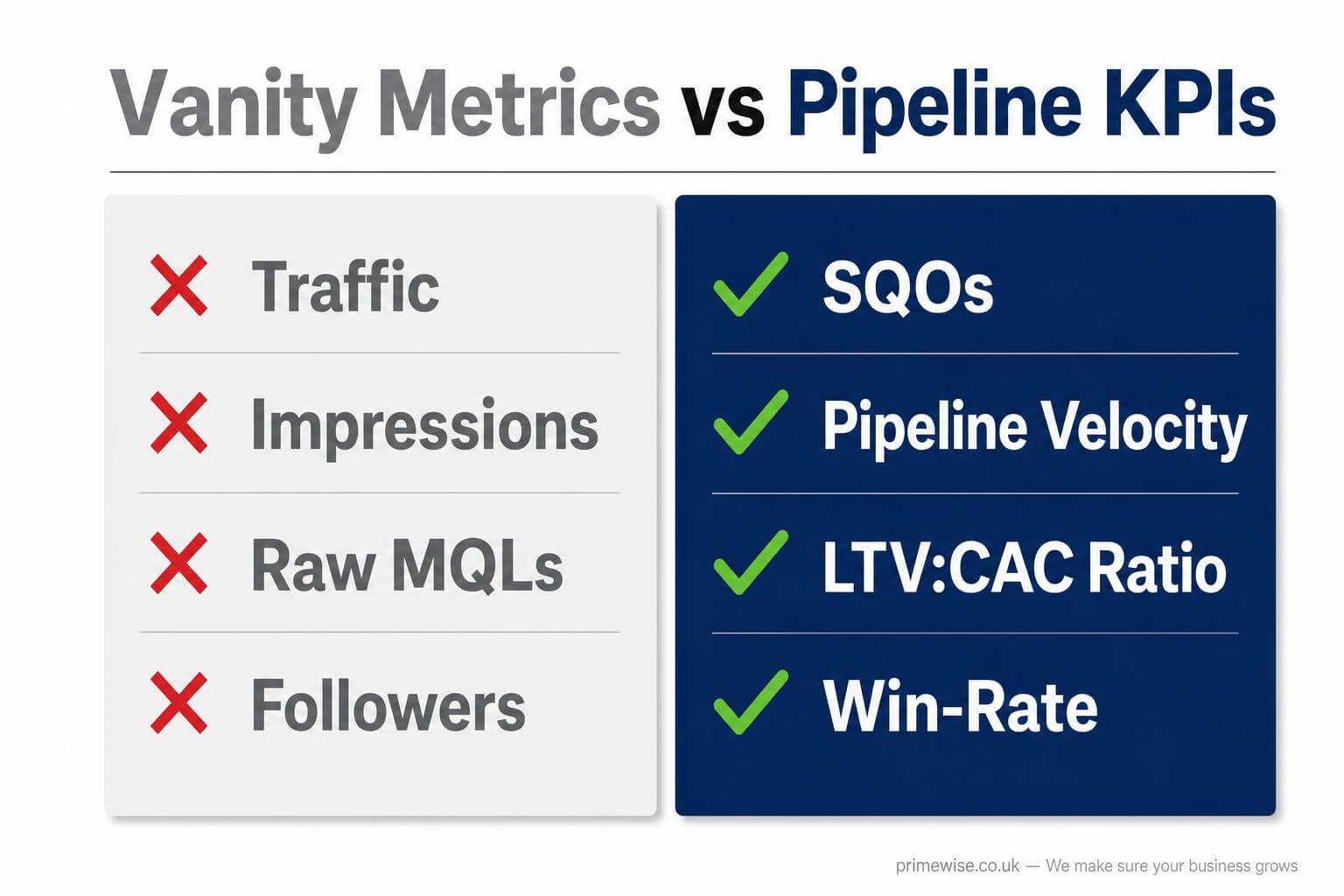
Fractional CMO KPIs are a commercially rigorous set of leading and lagging indicators designed to measure whether a part-time or interim marketing executive is generating strategic business outcomes rather than tactical outputs. They are distinct from standard marketing metrics because they connect directly to pipeline velocity, Customer Acquisition Cost reduction, and revenue generation the three measures that belong on a board-level scorecard rather than a marketing agency report.
The FCMO Commercial Accountability Matrix
The most important governance step any SME board can take is formally separating vanity metrics from pipeline-connected measures before the fractional engagement begins. Without this separation, leadership teams default to measuring the wrong things, and fractional executives however talented will feel pressure to optimise for visibility rather than commercial outcomes. In our direct experience reviewing board-level scorecards across private equity-backed SMEs, the absence of a structured accountability matrix is the primary reason high-quality fractional engagements are terminated prematurely, often just weeks before they would have delivered measurable pipeline results.
Exposing Vanity Metrics in the Boardroom
Raw website traffic, social media impressions, unvetted Marketing Qualified Leads, and email open rates are the four metrics most commonly presented in fractional CMO reports that have zero reliable correlation with revenue. These figures create a convincing illusion of momentum in a slide deck whilst the actual sales pipeline remains empty. A commercially effective fractional leader will proactively educate the executive team to retire these measures from board reporting and replace them with indicators that directly influence the P&L. The test is simple: if a metric cannot be traced to a Sales Qualified Opportunity, a closed deal, or a measurable reduction in acquisition cost, it belongs in the operational layer, not the boardroom.
Pipeline-Connected Measures That Drive UK Revenue
The metrics that genuinely matter to UK SME leadership sit in two categories: leading indicators that predict future pipeline health, and lagging indicators that confirm commercial outcomes have been achieved. For UK financial services and B2B professional services firms operating under tightened post-Brexit capital conditions, both categories must be tracked with discipline. The median B2B Customer Acquisition Cost for UK financial services SMEs currently sits between £1,200 and £3,800 per acquired customer, based on the Beauhurst UK Growth Report 2025. A fractional CMO who cannot demonstrate a credible trajectory toward improving that figure within six months is not operating as a commercial executive.
THE BENCHMARK STANDARDA high-performing fractional CMO should target a 3:1 LTV to CAC ratio within 12 months as the accepted commercial baseline for sustainable UK SME growth. Below this threshold, marketing spend is not creating enterprise value it is consuming it.
The Core KPI Reference Matrix
The following structured reference matrix consolidates every critical fractional CMO KPI into a single board-ready framework. It is designed to be reviewed at every executive meeting, with the benchmark column providing an objective standard against which actual performance is measured. Specialist firms such as PrimeWise.co.uk apply frameworks of this standard across regulated UK SMEs to ensure fractional CMO accountability is commercially rigorous from day one of the engagement.
| KPI Name | Category | Meaningful From | UK Benchmark Target |
|---|---|---|---|
| Sales Qualified Opportunities (SQOs) | Lagging | Month 3 | Positive month-on-month growth from month 3 |
| Pipeline Velocity | Leading | Month 3 | 15–20% increase by month 6 |
| Customer Acquisition Cost (CAC) | Lagging | Month 6 | Reduction toward lower quartile of £1,200–£3,800 band |
| LTV to CAC Ratio | Lagging | Month 12 | 3:1 minimum; 5:1 for scaling-stage SMEs |
| Win-Rate | Lagging | Month 6 | 19–26% for UK B2B (Pipedrive State of Sales 2024) |
| Cost Per Lead (CPL) | Leading | Month 3 | Demonstrable reduction from baseline by month 3 |
| Marketing Sourced Revenue | Lagging | Month 6 | 30–45% of new revenue attributable to marketing by month 12 |
| Sales Cycle Duration | Lagging | Month 6 | Measurable compression of 10–20% by month 12 |
| Pipeline Coverage Ratio | Leading | Month 3 | 3x to 4x annual revenue target |
| Net Revenue Retention (NRR) | Lagging | Month 12 | Above 100% indicates CMO-influenced expansion |
The 90-Day Fractional CMO Performance Roadmap
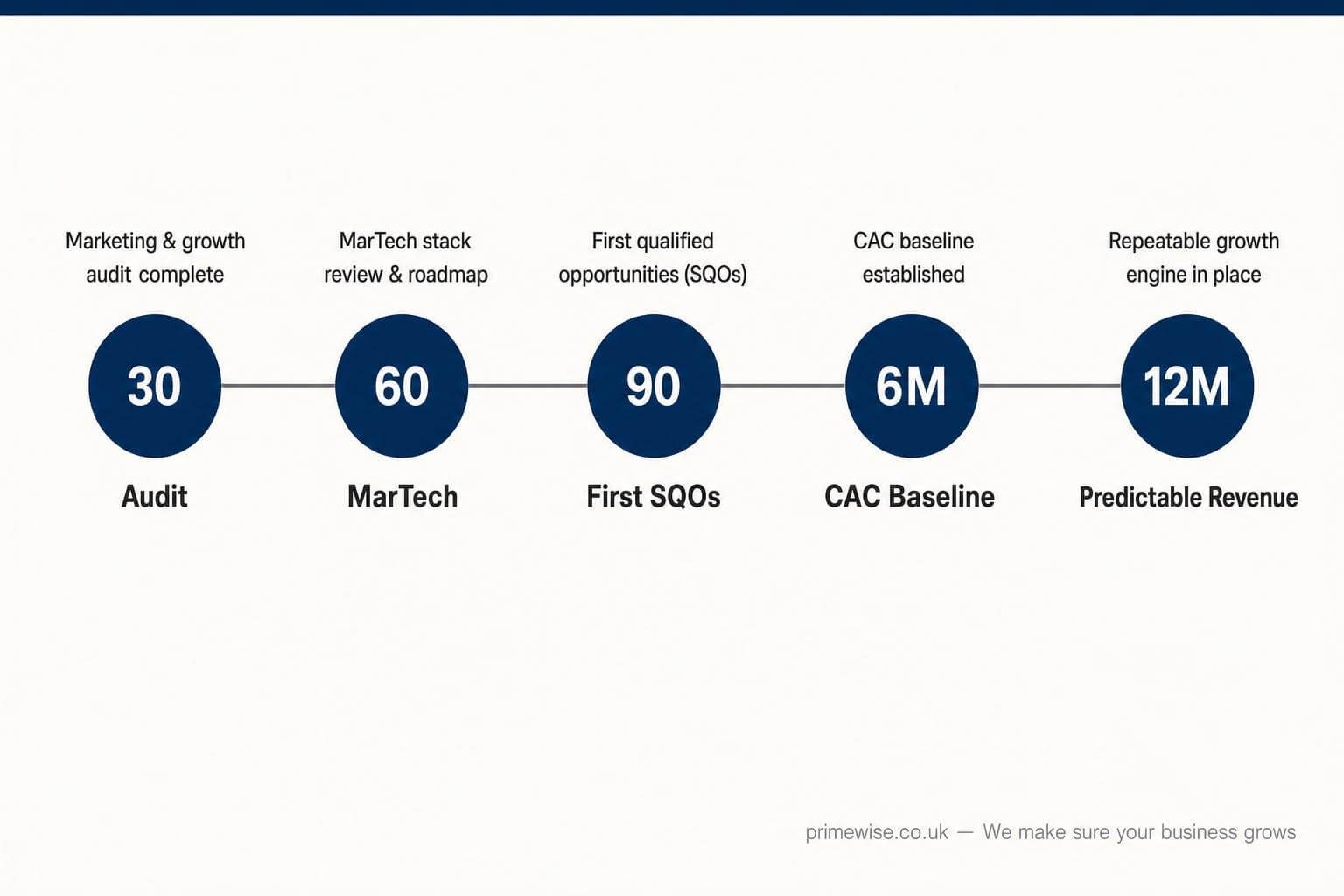
Expecting immediate revenue from a fractional CMO engagement is one of the most commercially costly mistakes a UK SME board can make. A phased Go-to-Market strategy, anchored to realistic milestone expectations, prevents the premature termination of an engagement that is actually on track to deliver significant commercial value. The following roadmap reflects the operational sequence that high-performing fractional executives follow across B2B SME engagements in the UK market.
Month One Discovery Audit and Baseline Data
The first thirty days are not a revenue-generation phase. They are a strategic alignment phase, and any fractional CMO who promises otherwise is setting false expectations that will damage trust by month two. During this period, the fractional executive should complete a comprehensive commercial audit covering the existing MarTech stack, CRM data quality, Ideal Customer Profile definition, current attribution methodology, and the alignment or misalignment between sales and marketing. The measurable deliverable at day thirty is absolute clarity: a documented baseline across all KPIs listed in the accountability matrix, a prioritised list of operational bottlenecks, and a formally agreed Go-to-Market strategy. One critical month-one deliverable that most articles on this topic omit is ICP refinement. Defining the Ideal Customer Profile with granular specificity industry vertical, company ARR band, buying committee structure, and trigger events is itself a measurable deliverable that directly determines the quality of every subsequent pipeline activity.
Month Two MarTech Optimisation and SLA Creation
The second thirty days transition the engagement from diagnostic to operational. The fractional CMO’s focus shifts to the marketing technology infrastructure: ensuring CRM data is clean, attribution models are correctly configured, and lead scoring logic reflects genuine commercial intent rather than superficial engagement signals. At this stage, the choice of attribution model whether first-touch, last-touch, linear, or time-decay is itself a strategic KPI decision, because it determines which channels the board will credit with pipeline generation and, by extension, where future budget will be allocated. Simultaneously, a formal Sales-Marketing Service Level Agreement must be established. This document defines exactly what constitutes a Sales Qualified Lead, the agreed handover process, the response time commitment from the sales team, and the feedback loop that returns disposition data to the marketing function. Conversion rate improvements on key landing pages are the primary leading indicator to monitor during this phase.
EXECUTIVE INSIGHTThe attribution model your fractional CMO selects in month two will determine which marketing channels receive budget for the entire engagement. Challenge your CMO to justify their attribution methodology choice in writing before it is implemented this single conversation prevents millions in misdirected spend.
Month Three Initial Pipeline Generation and CPL Reduction
By day ninety, the foundational infrastructure is in place and the engagement should produce its first validated commercial signals. The two metrics that confirm the strategy is functioning correctly at this stage are the appearance of genuine Sales Qualified Opportunities in the pipeline and a measurable reduction in Cost Per Lead from the baseline captured in month one. These are not yet proof of full commercial return they are proof of directional validity. A fractional CMO who cannot demonstrate at least early SQO generation and CPL improvement by day ninety should be required to provide a structured remediation plan before the engagement proceeds to the six-month review.
Long-Term Commercial Yield Milestones
The genuine commercial value of a high-quality fractional CMO engagement becomes irrefutably clear at the six and twelve month marks. These lagging indicators are where the strategic decisions made in months one through three translate into balance sheet outcomes. SME boards who evaluate fractional CMO performance exclusively in the first ninety days are making the same error as a property investor who assesses return on investment after the first month of rental income.
Six Months Sales Cycle Velocity and CAC Formalisation
At the six-month review, the evaluation criteria shift decisively toward deal velocity and cost baselines. A well-executed fractional CMO engagement should produce a 15 to 20% improvement in Pipeline Velocity by this point, a formalised and measurable Customer Acquisition Cost that can be benchmarked against the UK industry standard, and consistent month-over-month growth in qualified pipeline. The Pipeline Coverage Ratio the total value of the active pipeline divided by the revenue target should be approaching the 3x to 4x benchmark that UK B2B businesses require to reliably hit annual revenue targets. These are board-level conversations, not marketing department conversations, and a commercially effective fractional executive will bring them proactively to the leadership table.
Twelve Months Predictable Revenue and Total Engagement ROI
After a full year of a well-governed fractional CMO engagement, the commercial outcomes should be definitively measurable. Predictable revenue modelling the ability to forecast next quarter’s pipeline with confidence based on current leading indicators is the ultimate proof of a scalable growth engine. A strong engagement will also show a meaningful upward movement in Customer Lifetime Value, driven by better ICP targeting producing higher-quality customers with lower churn rates. Net Revenue Retention above 100% at this stage indicates that the CMO’s influence has extended beyond acquisition into customer expansion, a powerful multiplier of enterprise value. The total ROI calculation at month twelve should compare the full engagement cost against the incremental revenue generated from the marketing-sourced pipeline and the cumulative CAC savings delivered over the period.
Regulatory Compliance as a Fractional CMO KPI
For UK financial services SMEs, regulatory compliance is not a peripheral consideration in the fractional CMO KPI framework it is a central one. A high-volume lead generation strategy is commercially worthless if the underlying messaging violates Financial Conduct Authority standards. Under COBS 4 of the FCA Handbook, financial promotions must be fair, clear, and not misleading, a requirement that directly constrains the type of lead generation copy, targeting methodology, and conversion optimisation tactics a fractional CMO can deploy. The FCA’s Consumer Duty regulations, introduced in 2023 and now fully embedded in UK financial services culture, further require that firms demonstrate measurable evidence of good consumer outcomes a standard that extends into marketing activity and therefore into the fractional CMO’s accountability framework.
The Compliant SQO Standard
In regulated sectors, a standard Sales Qualified Opportunity and a Compliant SQO are materially different things. A Compliant SQO is a prospect who has been engaged through marketing assets that have passed FCA internal review before activation, who has been presented with accurate and non-misleading product or service information, and whose consent and data handling meet UK GDPR and FCA data standards. A fractional CMO operating in financial services must be measured on Compliant SQO generation, not raw SQO volume. This distinction is commercially critical because a pipeline filled with non-compliant leads creates regulatory liability, not enterprise value.
FCA COMPLIANCE WARNINGLead generation assets that have not passed FCA internal review before activation expose the firm to enforcement action under COBS 4. A fractional CMO in financial services must track Compliance Pass Rate the percentage of marketing assets cleared by compliance review as a formal KPI alongside pipeline metrics.
The Compliance Pass Rate KPI
We recommend that UK financial services SMEs introduce a formal Compliance Pass Rate metric into their fractional CMO KPI framework. This is defined as the percentage of planned lead generation assets landing pages, paid media copy, email sequences, gated content that receive FCA compliance clearance before deployment. A high Compliance Pass Rate indicates that the fractional CMO understands the regulatory environment and is building campaigns that will not be retracted or modified under compliance review. A low Compliance Pass Rate is a leading indicator of pipeline disruption, wasted creative spend, and potential regulatory exposure. This metric currently appears in no competitor content on fractional CMO KPIs, which means any UK financial services firm implementing it gains an immediate governance advantage over peers who are managing compliance informally.
The SME Leadership Dashboard Blueprint
Maintaining rigorous commercial oversight without descending into tactical micromanagement requires a deliberate structural choice: the board governs through outcomes, not outputs. A curated executive scorecard achieves this by restricting board-level review to the metrics that directly signal commercial health, whilst granting the fractional executive full autonomy over the tactical and operational layer beneath. This is the governance model that high-performing private equity-backed SMEs apply when managing fractional executives, and it is the model that prevents the two most common failure modes the board that micromanages every campaign decision, and the board that reviews vanity metrics and draws false conclusions about strategic performance.
Structuring the Executive Scorecard
A board-level fractional CMO scorecard should contain no more than five to seven metrics, reviewed monthly with a quarterly deep-dive. The recommended core set is Target versus Actual SQOs, Pipeline Velocity trend, CAC versus prior period, Win-Rate versus UK B2B benchmark, Marketing Sourced Revenue as a percentage of total new revenue, Pipeline Coverage Ratio, and for regulated sectors Compliance Pass Rate. Each metric should display the current figure, the target, the prior period comparison, and a simple traffic light status. This format allows a chief executive to assess fractional CMO commercial performance in under four minutes, which is the appropriate governance investment for a part-time executive relationship. Account-Based Marketing adoption and execution quality can be added as a seventh metric for B2B SMEs deploying ABM as their primary demand generation strategy, given the direct correlation between ABM programme quality and SQO generation in high-value B2B markets.
Accountability Without Micromanagement
The practical mechanism for holding a fractional CMO commercially accountable without micromanaging their daily outputs is the formal separation of the strategy layer from the execution layer in every board conversation. The board asks three questions: Is the pipeline growing at the agreed rate? Is the CAC moving in the right direction? Is the Win-Rate improving? If all three answers are positive, the board’s role is to resource and support the strategy. If one or more answers are negative, the board convenes a structured commercial review not a creative critique session to establish whether the issue is strategic, operational, or external. This governance discipline protects the fractional CMO’s ability to operate at executive level whilst giving the board the commercial control they need.
Case Study Slashing CAC in London Financial Services
A private equity-backed London financial services SME with an ARR of approximately £4.2 million engaged a fractional CMO to improve pipeline quality under strict FCA constraints. Prior to the engagement, the firm was measuring marketing performance almost exclusively on raw lead volume a metric that was producing a high-cost, low-conversion pipeline that was straining the sales team and generating regulatory risk through inconsistent financial promotions compliance.
The fractional executive’s first action was to retire lead volume as a primary KPI and replace it with Compliant SQO Win-Rates, measured against the firm’s internal compliance-cleared ICP. The MarTech stack which consisted of HubSpot CRM, a disconnected paid media stack running Google Ads and LinkedIn Campaign Manager, and a manual reporting process was restructured over sixty days to provide accurate, closed-loop attribution from first marketing touch to closed revenue. A formal Sales-Marketing SLA was implemented, defining a Compliant SQO with specificity that aligned with both FCA Consumer Duty requirements and the sales team’s capacity to convert at target Win-Rates. Over a six-month period, this commercially rigorous reorientation produced a 40% reduction in Customer Acquisition Cost representing a saving of between £480 and £1,520 per customer acquired against the UK financial services benchmark range whilst simultaneously improving the Compliance Pass Rate from an estimated 60% to 94% of deployed assets.
COMMERCIAL DIAGNOSTICIf your current fractional marketing leadership cannot articulate your firm's LTV to CAC ratio, Pipeline Coverage Ratio, and Compliance Pass Rate in a single board conversation, the engagement is not being governed to the commercial standard your investment warrants. PrimeWise.co.uk provides structured fractional CMO accountability assessments specifically designed for UK SME boards a board-level commercial diagnostic, not a discovery call.
Revenue Operations and Attribution Methodology
One dimension of fractional CMO accountability that is consistently underweighted in KPI frameworks is the operational infrastructure that makes accurate measurement possible. Revenue Operations the alignment of marketing, sales, and customer success around a shared data infrastructure and commercial objective is the operational framework within which every fractional CMO KPI must be interpreted. Without a functioning RevOps foundation, KPI data is unreliable, attribution is guesswork, and board-level decisions are made on corrupted inputs. A fractional CMO who inherits a business without a RevOps structure must treat establishing that foundation as a formal month-one deliverable, not a background task.
The choice of marketing attribution model is equally consequential and equally underrepresented in fractional CMO governance discussions. First-touch attribution credits the first marketing interaction with generating the opportunity useful for understanding top-of-funnel channel effectiveness but blind to the nurture journey that actually converts prospects. Last-touch attribution credits the final interaction before conversion useful for understanding closing mechanisms but dismissive of the awareness and consideration phases that created the opportunity. Time-decay and linear attribution models distribute credit across multiple touchpoints, providing a more balanced and commercially accurate picture of how the marketing mix is functioning. A fractional CMO must select, justify, and consistently apply an attribution model that reflects the actual complexity of the B2B buying journey in their sector. This decision, made transparently and reviewed at the six-month milestone, is itself a commercial accountability act.