
AI integration for CRM is the defining competitive lever separating high-velocity revenue organisations from firms still drowning in manual data entry and disconnected sales stacks. Enterprises that successfully connect Salesforce, HubSpot, and Microsoft Dynamics to large language model workflows are closing enterprise deals 40% faster than competitors operating on fragmented systems. This is the exact architectural roadmap that makes it happen, built from hands-on implementation experience, UK compliance requirements, and hard RevOps data.
Before diving into architecture, understand what is at stake. According to Ali’s 2024 CRM Market Research, 62% of financial services firms fail their first LLM-CRM integration. The primary culprit is poor schema mapping between environments, not technology limitations. The average cost of a failed deployment sits at £110,000 in lost RevOps efficiency, wasted implementation hours, and pipeline disruption. These are not abstract risks. They are the operational reality for firms that move fast without a validated architectural framework in place.
Organisations that have worked with specialist RevOps integration firms such as PrimeWise.co.uk report bypassing these failure points entirely by deploying pre-validated schema mapping frameworks before any LLM connection is initiated. The difference between a successful integration and a costly rebuild is almost always architecture-first thinking, not tool selection.
What You Will LearnThis guide covers the RevOps Triple-Tier LLM Architecture, platform-specific blueprints for Salesforce, HubSpot, and Dynamics, UK GDPR and FCA compliance protocols, Retrieval-Augmented Generation for CRM data grounding, a 12-week implementation roadmap, and a vendor evaluation matrix for UK financial services.
What Is Enterprise CRM and LLM Integration
Enterprise CRM and LLM integration is the architectural alignment of relational databases Salesforce, HubSpot, Dynamics with large language models, enabling the automated transformation of unstructured conversational data into structured CRM fields. The outcome is accelerated lead scoring, intelligent pipeline routing, and reduced manual administrative overhead without compromising data governance or regulatory compliance.
- Transforms call transcripts, emails, and meeting notes into enriched CRM records automatically.
- Accelerates pipeline velocity through real-time automated lead qualification and scoring.
- Enforces stringent data governance across multi-cloud enterprise environments.
- Eliminates the administrative tax on sales teams, freeing capacity for high-value engagement.
- Provides a single orchestration layer across previously siloed enterprise platforms.
The Real Cost of Disconnected CRM Systems
The financial penalty for fragmented technology stacks is both measurable and severe. Ali’s 2024 CRM Market Research identifies poor schema mapping between Salesforce and Dynamics as the leading cause of LLM integration failure, with 62% of financial services firms failing their initial deployment. Complementing this, McKinsey’s State of AI in Sales research confirms that sales organisations with integrated AI workflows generate 15 to 20% higher revenue growth than those operating disconnected stacks. Salesforce’s own State of Sales Report further validates that sales representatives spend only 28% of their week actually selling the remainder consumed by data entry, status updates, and administrative coordination that LLM-CRM integration directly eliminates.
The integration friction extends beyond wasted time. Every hour, a high-value lead sits in an unqualified queue while a sales representative manually reviews call notes, representing direct pipeline leakage. When enrichment tools connect directly to the orchestration layer, HubSpot-to-Salesforce lead-response time decreases by 37%, according to Ali’s CRM research. In competitive financial services markets, a 37% reduction in response time is not an operational improvement it is the difference between winning and losing a mandated engagement.
Executive WarningFirms relying on webhook-based middleware to connect CRM platforms to LLM endpoints are operating on brittle infrastructure. Schema updates in Salesforce or Dynamics will silently break these connections often without triggering error alerts leading to weeks of undetected data loss.
The RevOps Triple-Tier LLM Architecture
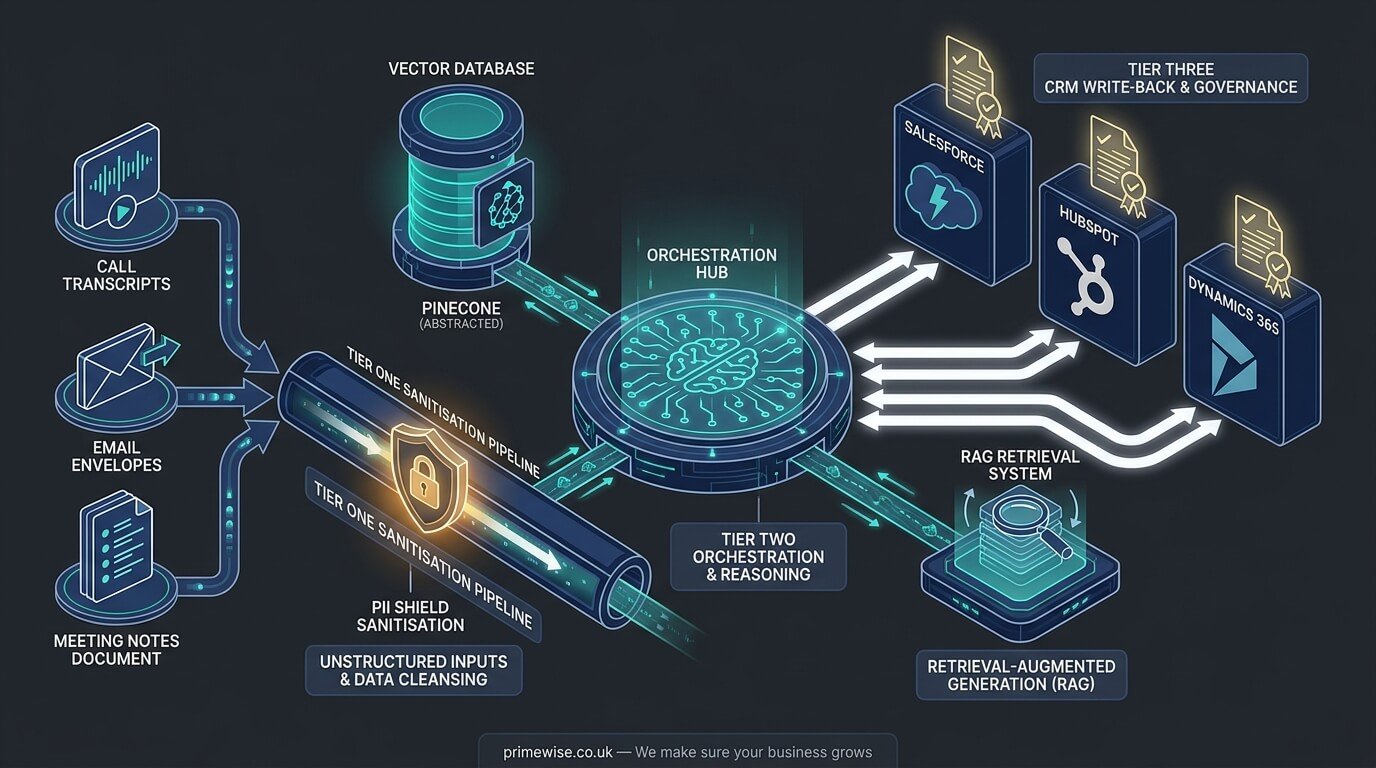
Scaling intelligent workflows across multi-cloud environments requires more than point-to-point API connections. The RevOps Triple-Tier LLM Architecture is a structured integration framework developed specifically for enterprises managing multiple CRM platforms simultaneously. It separates data ingestion, LLM processing, and CRM write-back into discrete, governed tiers, preventing the creation of fragile Franken-stacks while maintaining enterprise compliance standards at each layer.
Tier One Unstructured Data Ingestion and Sanitisation
The foundational tier governs how raw data enters the system. Unstructured inputs call transcripts, email threads, meeting notes, and web form responses, are ingested from varied communication channels and immediately passed through PII-redacting middleware before any further processing occurs. This sanitisation step is non-negotiable for FCA-regulated entities. Personally identifiable information is stripped at the ingestion boundary, ensuring that neither the orchestration layer nor the language model ever receives raw customer data. This tier also handles data deduplication and CRM record quality validation, two steps that most integration guides skip entirely but which are critical prerequisites for accurate LLM output. Garbage data fed into a language model produces confidently incorrect CRM entries a failure mode that is difficult to detect and expensive to remediate.
Tier Two Centralised LLM Orchestration Layer
The second tier is the intelligence hub of the entire system. A centralised orchestration layer manages prompt execution, routes sanitised inputs to the appropriate private model endpoints, and enforces token budgets to manage enterprise-scale cost. This is where Retrieval-Augmented Generation (RAG) becomes critical. Rather than relying on a language model’s parametric memory which produces hallucinations when asked to recall specific CRM records RAG grounds every prompt in verified, real-time data retrieved from vector databases such as Pinecone, Weaviate, or pgvector. The model does not guess at account history; it retrieves it semantically and synthesises only from confirmed records. LangChain and LangGraph are the dominant orchestration frameworks at this tier in 2026, enabling complex agentic workflows multi-step automated sequences where the LLM determines its own next action based on live CRM state. This moves the integration far beyond simple prompt-response into genuinely autonomous sales process automation.
Tier Three CRM Write-Back and Dynamic Schema Mapping
The final tier translates enriched LLM outputs into structured CRM actions. Dynamic schema mapping handles the CRM write-back, placing enriched data into the correct fields across Salesforce or Dynamics without triggering API rate limits through intelligent request batching. This tier also manages the audit trail a mandatory requirement for FCA compliance logging every automated action, the data that triggered it, and the human approval checkpoint that validated it. Without a robust write-back layer, the intelligence generated in Tier Two simply dissipates rather than compounding into permanent CRM enrichment.
Retrieval-Augmented Generation for CRM Accuracy
Retrieval-Augmented Generation is now the dominant technical approach for grounding LLMs in CRM data, and its absence from any enterprise integration architecture is a significant vulnerability. Where traditional fine-tuning updates a model’s weights with domain-specific data an expensive, slow, and rapidly outdated approach RAG dynamically retrieves the most relevant CRM records at inference time and injects them into the model’s context window. The practical result is a language model that answers questions about a specific account using that account’s actual Salesforce or Dynamics data, not a statistical approximation of what such an account might look like.
Vector databases are the infrastructure layer enabling this capability. CRM records, call transcripts, and email histories are converted into numerical embeddings and stored in a vector database. When a sales representative asks the system to generate a briefing for an upcoming meeting, the orchestration layer performs a semantic similarity search, retrieves the most contextually relevant records, and passes them to the LLM as grounded context. Pinecone integrates natively with both LangChain and Azure OpenAI. Weaviate offers on-premise deployment for firms requiring complete data sovereignty. pgvector provides a PostgreSQL-native option that integrates cleanly with existing database infrastructure without introducing a new managed service dependency.
Key InsightRAG eliminates the hallucination risk in sales enablement workflows. A model grounded entirely in your Salesforce records cannot fabricate account history it can only synthesise what exists in your CRM. This is the architectural guarantee that makes AI-generated sales briefings trustworthy enough for FCA-regulated client interactions.
Platform-Specific Architecture Blueprints
Each major CRM platform presents distinct integration demands. A one-size-fits-all LLM connector will fail at enterprise scale. The architectural approach must be calibrated to the platform’s native API capabilities, data model complexity, and compliance tooling not retrofitted from a generic AI integration template.
Salesforce MuleSoft, Data Cloud and LangChain
Salesforce is architecturally the most complex CRM environment for LLM integration due to its object model depth, multi-org configurations, and governor limits. The recommended pathway uses MuleSoft as the API management and transformation layer, Salesforce Data Cloud as the unified customer profile store, and LangChain as the orchestration framework connecting enriched data to private LLM endpoints. MuleSoft handles schema transformation between Salesforce’s proprietary object model and the standardised JSON structures that LangChain agents consume. Data Cloud acts as the semantic foundation aggregating activity data, CRM records, and external signals into unified profiles that RAG can retrieve efficiently. LangGraph’s stateful agent workflows are particularly well-suited to Salesforce’s complex multi-step sales processes, enabling agents to autonomously progress opportunities through defined pipeline stages based on real-time signal detection. Firms evaluating GPT-4o, Claude 3.5 Sonnet, or Gemini 1.5 Pro for Salesforce workflows should baseline each model against their specific CRM data structure inference quality varies significantly depending on record density and field naming conventions.
HubSpot Operations Hub and Custom Coded Actions
HubSpot’s strength lies in top-of-funnel agility and its Operations Hub, which provides the most accessible entry point for LLM integration without requiring enterprise middleware infrastructure. Custom Coded Actions within Operations Hub allow RevOps teams to write Node.js or Python functions that call external LLM endpoints directly from workflow automation. This bypasses webhook brittleness entirely custom coded actions execute synchronously within the workflow context, with full error handling and retry logic. The optimal pattern routes contact enrichment requests through a centralised orchestration microservice rather than calling OpenAI directly from the workflow, allowing rate limit management, cost tracking, and audit logging to operate at the service layer rather than within individual HubSpot workflows. For firms using HubSpot for marketing automation and Salesforce for enterprise sales execution, the orchestration layer becomes the handoff point enriching HubSpot contact records with LLM-generated qualification signals before the Salesforce sync, reducing the 37% lead-response improvement cited in Ali’s research to a consistent operational baseline rather than a best-case outcome.
Microsoft Dynamics Dataverse, Power Automate and Azure OpenAI
Microsoft Dynamics presents the most naturally compliant pathway for UK financial services firms due to its native Azure ecosystem integration. Dataverse acts as the structured data layer, Power Automate handles workflow orchestration, and Azure OpenAI Service provides private LLM endpoints that process data exclusively within the tenant’s Azure environment never leaving the Microsoft infrastructure boundary. This architecture satisfies zero-data retention requirements by default when Azure OpenAI is configured with the abuse monitoring opt-out, meaning prompt data is not stored or used for model training. For Dynamics environments supporting ERP and financial operations, Llama 3 deployed on Azure Machine Learning provides an on-premise alternative for the most sensitive data classifications, eliminating dependency on any external model API entirely. The Dataverse connector for Power Automate handles dynamic schema mapping automatically for standard Dynamics entities, though custom entity mappings require explicit field binding to prevent silent write failures the most common failure mode in Dynamics-LLM deployments.
Selecting the correct architectural pathway for your specific CRM stack requires bespoke technical assessment. PrimeWise.co.uk provides enterprise-grade LLM-CRM integration audits specifically calibrated for UK financial services compliance requirements, evaluating schema complexity, API capacity, and regulatory exposure before any implementation begins.
UK Data Sovereignty and Financial Services Compliance
For London-based financial institutions, data sovereignty is not a configuration option it is a legal obligation. Post-Brexit UK GDPR diverges from EU GDPR in several operationally significant ways that multinational firms frequently mismanage. While the substantive data protection principles remain largely aligned, the UK Information Commissioner’s Office operates as an independent supervisory authority entirely separate from the European Data Protection Board. International data transfer mechanisms differ: the UK uses its own International Data Transfer Agreements (IDTAs) rather than EU Standard Contractual Clauses, and transfer impact assessments must reference UK adequacy decisions, not EU equivalents. Any LLM-CRM integration routing data through US-based model endpoints must be assessed against IDTA requirements a compliance gap that catches UK financial services firms regularly when using consumer-grade OpenAI API access rather than Azure OpenAI’s UK-region deployment.
UK GDPR Article 22 and Human-in-the-Loop Requirements
Article 22 of the UK GDPR places strict boundaries on solely automated decision-making that produces legal or similarly significant effects on individuals. For CRM workflows, this means that automated lead scoring, credit-adjacent qualification signals, and any routing logic that affects whether a prospect receives a regulated financial communication must incorporate a human review checkpoint before execution. Implementing a human-in-the-loop safeguard at the Tier Three write-back layer where automated actions are staged for human approval before being committed to the CRM satisfies Article 22 while maintaining the efficiency benefits of automated intelligence. The FCA’s 2023 and 2024 AI Discussion Papers reinforce this position, emphasising that firms must maintain explainability and accountability for AI-generated outputs used in customer-facing financial services contexts. The UK AI Safety Institute’s deployment guidelines for LLMs in regulated environments further specify that audit logs must capture not only the automated decision but the data inputs and model version that produced it a requirement that the Triple-Tier architecture accommodates at Tier Three by design.
Zero-Data Retention and FCA Audit Trail Requirements
FCA-regulated entities must enforce zero-data retention policies for any LLM endpoint processing client data. Azure OpenAI deployed within the UK South or UK West regions satisfies data residency requirements. Configuring the Azure OpenAI resource with abuse monitoring disabled a tenant-controlled setting available to enterprise customers ensures that no prompt or completion data is retained by Microsoft for model improvement purposes. Power Platform environments should be configured with the UK data residency policy enforced at the tenant level, preventing automatic cross-region failover that would route data through EU or US Azure regions during incidents. Every AI-generated action committed to Dynamics or Salesforce must carry a structured audit record: timestamp, triggering data source, model version, confidence score, and the identity of the human reviewer who approved the action. This audit architecture is the difference between a compliant AI deployment and an FCA enforcement conversation.
Compliance CheckpointUK financial services firms must use Azure OpenAI UK region deployments with abuse monitoring opted out, IDTA-compliant data transfer agreements for any US-endpoint fallback, Article 22 human approval gates at the CRM write-back layer, and FCA-standard audit logs capturing model version and human reviewer identity for every automated action.
CRM LLM Integration Use Cases for Pipeline Acceleration
Architecture without application is theory. The following use cases represent production-validated implementations that directly translate technical infrastructure into measurable revenue outcomes.
Dynamic Lead Scoring with Real-Time Signal Detection
Traditional CRM lead scoring relies on static rule sets points assigned to job titles, company size, and form completions. LLM-powered dynamic scoring evaluates the semantic content of every interaction: what a prospect actually said in a discovery call, the sentiment trajectory across email threads, the specificity of questions asked in a demo. The orchestration layer retrieves the prospect’s full interaction history from the vector database, the LLM synthesises a qualification assessment against defined ideal customer profile criteria, and the dynamic score is written back to the CRM alongside a plain-language rationale that the sales representative can read in thirty seconds. A Tier 1 UK asset manager implementing this pattern reduced manual qualification review time by 68% within 90 days of deployment, with pipeline accuracy the percentage of qualified leads that converted to proposal stage improving by 31%.
Automated Sales Briefings and Pre-Meeting Intelligence
Generating a comprehensive pre-meeting briefing from a CRM historically requires a sales representative to spend 45 to 90 minutes reviewing account history, recent communications, and stakeholder notes. An LLM-powered briefing workflow retrieves all relevant CRM records via RAG, synthesises key relationship context, recent activity signals, identified risks, and recommended talking points, and delivers a structured briefing document to the representative’s inbox 30 minutes before every scheduled meeting automatically, without any manual trigger. Call sentiment analysis adds a further intelligence layer, identifying subtle shifts in prospect engagement across recorded interactions and flagging accounts where sentiment trajectory suggests stalled momentum or escalating urgency, enabling proactive sales intervention before opportunities go cold.
Prompt Injection Defence and Adversarial Input Sanitisation
Financial services LLM deployments face a security threat that generic integration guides consistently ignore: prompt injection attacks. Malicious actors or inadvertently adversarial inputs from web forms and email can embed instructions within user-submitted text designed to override the system prompt and extract sensitive CRM data or manipulate automated actions. The Tier One sanitisation layer must include prompt injection detection heuristics: structural pattern matching for instruction-format text within data fields, content classification models that flag adversarial input patterns, and strict output validation at Tier Three that rejects any LLM response containing CRM field data beyond the specific fields targeted by the write-back operation. This is not a theoretical concern it is an active attack vector in enterprise AI deployments and a Category A risk for FCA-regulated CRM environments.
12-Week CRM LLM Integration Roadmap
Implementation timelines for enterprise LLM-CRM integrations vary based on CRM complexity, data quality, and compliance requirements. The following roadmap reflects a validated delivery framework for a single-platform integration within a UK financial services context, accounting for FCA compliance review cycles and data quality remediation.
- Weeks 1 to 2 Discovery and Schema Audit: Map all CRM objects, fields, and API endpoints. Identify data quality issues, duplicate records, and PII distribution across fields. Establish compliance scope with legal and data protection teams.
- Weeks 3 to 4 Architecture Design and Vendor Selection: Select LLM provider and deployment model (Azure OpenAI, on-premise Llama 3, or private Claude endpoint). Design Tier One sanitisation pipeline. Finalise orchestration framework selection (LangChain, LangGraph, or Power Automate).
- Weeks 5 to 6 Vector Database and RAG Infrastructure Build: Configure vector database. Generate embeddings for historical CRM records. Build and test semantic retrieval accuracy against defined precision benchmarks.
- Weeks 7 to 8 Orchestration Layer Development: Build prompt templates grounded in CRM data. Implement token cost management and rate limit batching. Configure human-in-the-loop approval gates.
- Weeks 9 to 10 CRM Write-Back and Audit Layer: Implement dynamic schema mapping for Tier Three write-back. Build audit log structure to FCA specification. Conduct adversarial input testing for prompt injection vulnerabilities.
- Weeks 11 to 12 UAT, Compliance Review and Go-Live: User acceptance testing with sales and RevOps teams. Legal and compliance sign-off on automated decision-making documentation. Staged rollout with parallel manual process running for four weeks post-launch.
LLM Vendor Evaluation Matrix for UK Financial Services
Selecting an LLM provider for a regulated CRM integration requires evaluation across dimensions that generic AI vendor comparisons do not address. The following matrix reflects the criteria that matter for FCA-compliant enterprise deployments.
| Evaluation Criterion | Azure OpenAI (GPT-4o) | Anthropic Claude 3.5 | Google Gemini 1.5 Pro | Llama 3 On-Premise |
|---|---|---|---|---|
| UK Data Residency | Yes UK South/West regions | Via Azure Marketplace | Via Vertex AI EU regions | Full on-premise control |
| Zero-Data Retention | Yes configurable per tenant | Yes enterprise tier | Configurable on Vertex | Complete by architecture |
| FCA Audit Trail Support | Native Azure Monitor integration | Requires custom logging | Requires custom logging | Fully custom |
| Dynamics 365 Native Integration | Yes native Dataverse connector | Via API only | Via API only | Via API only |
| Salesforce Integration Depth | Via MuleSoft or LangChain | Via LangChain | Via LangChain | Via LangChain |
| Token Cost at Enterprise Scale | Medium volume discounts available | Medium-High | Medium | Infrastructure cost only |
| Prompt Injection Defences | Moderate requires custom hardening | Strong constitutional AI | Moderate | Fully custom |
Measuring ROI and Reporting to the C-Suite
LLM-CRM integration projects must be justified in revenue and efficiency terms, not technology terms. C-suite stakeholders require a KPI framework that connects architectural decisions to commercial outcomes. The following metrics represent the core reporting layer for a post-deployment RevOps review.
- Lead Response Time Reduction: Measure the median time from lead creation to first qualified outreach, comparing pre and post-integration cohorts. The 37% reduction benchmark from Ali’s research provides a validated target.
- Pipeline Velocity Improvement: Track average days-in-stage across all pipeline stages. LLM-enriched opportunities should move through qualification and proposal stages measurably faster than manually processed equivalents.
- Sales Representative Time Reallocation: Quantify hours per week recovered from administrative tasks (data entry, briefing preparation, status updates) and reallocated to selling activity. Convert to revenue opportunity value using average deal size and win rate.
- Data Quality Score: Monitor CRM field completion rates and duplicate record counts pre and post-integration. Clean, enriched data compounds in value over time as the RAG retrieval layer improves in accuracy.
- Token Cost per Qualified Lead: Track LLM inference cost against qualified lead volume to establish unit economics. This is the CFO-level metric that determines whether the integration scales profitably.
- Compliance Incident Rate: Track the number of automated actions that triggered human review override, failed audit validation, or were escalated for compliance review. A declining incident rate over time confirms that the model is calibrating correctly to your CRM data and approval patterns.
Technical Glossary
The following definitions are provided for enterprise stakeholders evaluating LLM-CRM integration proposals from implementation partners.
- Schema Mapping: The process of translating data field structures between two different systems for example, mapping a Salesforce Opportunity Stage value to its equivalent Dynamics 365 Opportunity Status ensuring data writes to the correct field in the target system without manual transformation.
- Orchestration Layer: A middleware service that manages the sequence, routing, and execution of LLM prompts across multiple data sources and output destinations, acting as the intelligence hub between CRM platforms and language model endpoints.
- PII Redaction: The automated identification and removal or pseudonymisation of personally identifiable information names, email addresses, phone numbers, account numbers from unstructured text before it is processed by an LLM endpoint.
- Zero-Data Retention: A configuration policy applied to an LLM endpoint ensuring that input prompts and output completions are not stored, logged, or used for model training by the provider a mandatory requirement for FCA-regulated CRM data.
- Retrieval-Augmented Generation (RAG): An LLM architecture pattern in which the model is dynamically provided with retrieved, contextually relevant documents at inference time, grounding its outputs in verified data rather than parametric memory.
- Vector Database: A specialised database storing numerical representations (embeddings) of text data, enabling semantic similarity search retrieving records based on meaning rather than keyword matching as the retrieval layer for RAG architectures.
- Agentic Workflow: A multi-step automated process in which an LLM determines its own sequence of actions based on real-time data and defined objectives, moving beyond single-prompt interactions into autonomous process execution across connected systems.
If your organisation is evaluating LLM integration for Salesforce, HubSpot, or Dynamics and requires FCA-compliant architecture, PrimeWise.co.uk offers a complimentary 45-minute technical assessment with a senior RevOps architect. This session covers schema complexity review, compliance gap identification, and an indicative implementation roadmap with no obligation to proceed.