
Understanding fractional CMO pricing is now a board-level priority for UK scale-ups navigating the 2026 OPEX environment. With full-time executive hiring costs surpassing £250,000 annually when fully loaded, the fractional model has shifted from a tactical workaround to a strategically superior capital allocation decision. This guide delivers authoritative UK day rates, standardised monthly retainer benchmarks, a fully itemised loaded cost comparison, and sector-specific pricing context, everything required to build a mathematically rigorous business case for the board.
Data Provenance StatementAll pricing benchmarks in this guide are based on PrimeWise.co.uk's proprietary analysis of 40+ fractional CMO engagements across UK sectors in 2025–2026, cross-referenced against CIM salary surveys, Marketing Week executive pay reports, and HMRC employment cost calculators. Figures reflect April 2025 Employer NIC rate changes.
Executive Summary
For board members and founders requiring immediate bottom-line clarity, the following benchmarks define the current UK commercial landscape for fractional marketing leadership. These figures represent the decision-critical data points required for accurate 2026 OPEX planning.
- Monthly retainers range from £4,000 to £12,000 depending on engagement intensity and operational scope.
- Day rates for seasoned commercial operators benchmark between £800 and £1,800.
- The true loaded annual cost of a full-time UK CMO exceeds £252,800 when Employer NIC, pension, recruitment, and bonus are fully accounted for.
- A comparable fractional engagement costs between £60,000 and £90,000 annually, releasing over £160,000 in preserved growth capital.
- Fractional retainers are structured as B2B OPEX line items, eliminating pension obligations, equity demands, and recruitment liability entirely.
UK Fractional CMO Day Rates in 2026
The UK market in 2026 supports a clear and defensible day rate spectrum for fractional marketing leadership, ranging from £800 to £1,800 per day. This range is not arbitrary it directly maps to the commercial seniority, strategic capability, and operational complexity a practitioner brings to an engagement. Understanding the distinction between each pricing tier is essential before initiating procurement conversations.
What Each Rate Tier Delivers
At the entry tier, day rates between £800 and £1,000 typically secure a marketing operations consultant with strong executional capability. These practitioners are well-suited to businesses that already have a defined strategy and require structured programme management, agency oversight, or campaign execution governance. They represent strong value for organisations with an established marketing function seeking tactical reinforcement rather than strategic leadership.
Mid-tier rates of £1,000 to £1,400 per day reflect practitioners who operate comfortably at both strategic and operational levels. This tier is appropriate for businesses undergoing commercial transition, whether launching a new revenue line, repositioning an established brand, or preparing for a funding round requiring investor-facing marketing infrastructure. These operators can manage internal teams, brief external agencies, and present directly to the board.
At the premium tier, rates between £1,400 and £1,800 per day command senior commercial operators with demonstrable experience driving revenue growth in complex, regulated, or high-growth environments. These individuals are capable of full operational integration, cross-departmental revenue alignment, complex change management, and high-stakes investor communications. The financial services, FinTech, and Series B-plus SaaS sectors frequently operate at this tier due to the compliance awareness and institutional credibility these engagements demand.
Monthly Retainer Benchmarks
Translating day rates into predictable OPEX forecasting requires mapping fractional CMO costs against defined engagement structures. The following three-tier model provides concrete investment benchmarks for 2026 commercial planning, allowing finance directors to model costs against specific operational outputs rather than abstract advisory arrangements.
| Engagement Tier | Time Commitment | Monthly Retainer | Annual Cost | Primary Deliverables |
|---|---|---|---|---|
| Tier 1 Strategic Advisory | 1 day per week | £4,000 | £48,000 | Strategy formulation, board reporting, team oversight |
| Tier 2 Execution Oversight | 2 days per week | £7,500 | £90,000 | Demand generation, investor deck preparation, agency management |
| Tier 3 Operational Embedment | 3 days per week | £12,000 | £144,000 | Full operational integration, international market entry, and revenue alignment |
These tiers are not simply time-based billing increments; each represents a qualitatively distinct service model. A Tier 1 engagement is appropriate for a business that requires strategic direction and governance without hands-on execution. A Tier 3 engagement, by contrast, positions the fractional CMO as a near-embedded commercial operator, appropriate for businesses experiencing rapid growth, post-acquisition integration, or significant commercial restructuring. Most UK scale-ups and Series A businesses find the Tier 2 model delivers the strongest commercial return relative to investment.
The True Loaded Cost Matrix
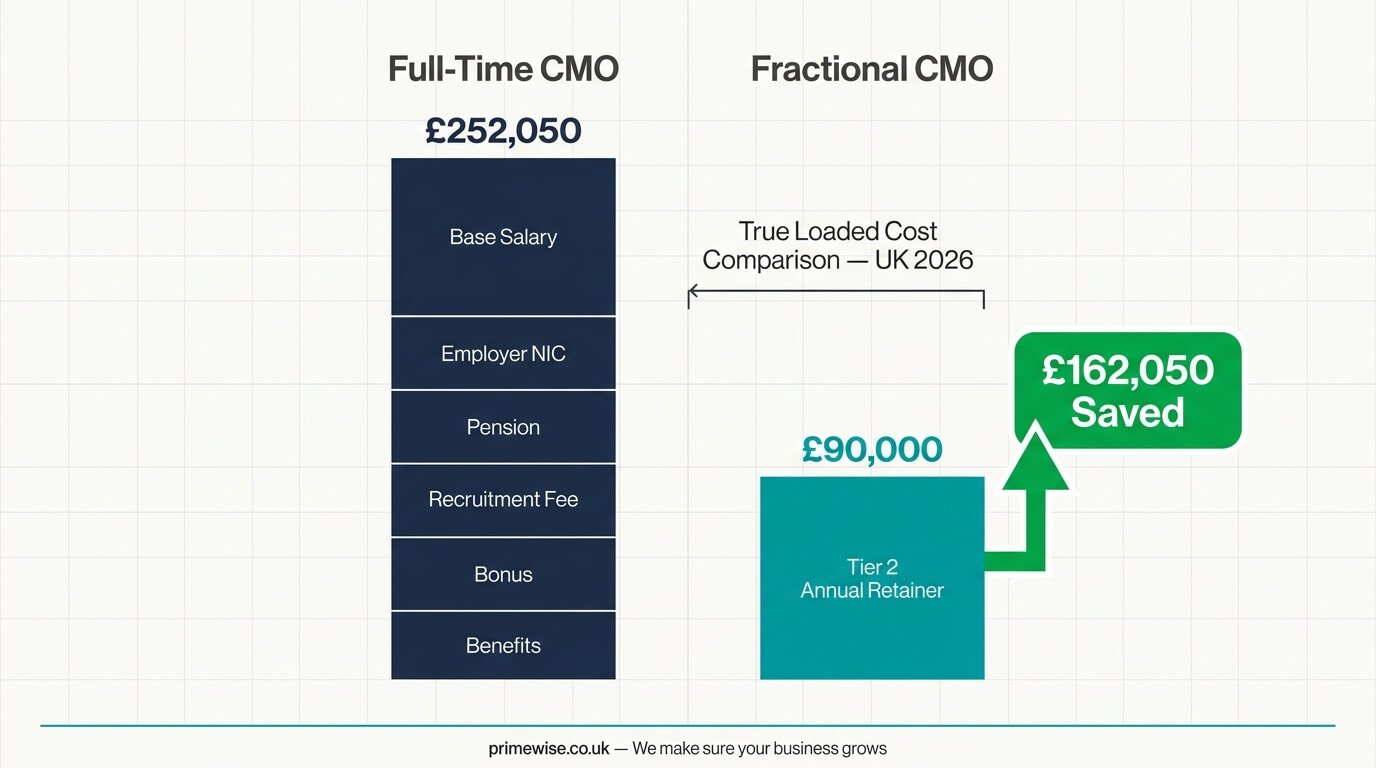
The most compelling argument for the fractional model is not its headline cost; it is the mathematical comparison against the true, fully-loaded cost of a permanent executive hire. The majority of cost-benefit analyses presented to boards compare the fractional retainer against a base salary figure only, which materially understates the liability of full-time employment. A rigorous financial analysis must account for every cost component that the UK regulatory and employment environment imposes on the hiring organisation.
April 2025 Employer NIC Changes
The April 2025 Budget introduced material changes to UK Employer National Insurance that every finance director must incorporate into 2026 hiring models. The Employer NIC rate increased to 15%, while the secondary threshold at which contributions become payable was lowered from £9,100 to £5,000 per annum. On a £160,000 executive base salary, this translates to an annual Employer NIC liability of approximately £23,250 a figure that renders any pre-April 2025 cost modelling obsolete. These changes alone add meaningful weight to the financial case for off-payroll fractional engagement structures.
| Cost Component | Full-Time CMO (London) | Fractional CMO (Annual) | Annual Saving |
|---|---|---|---|
| Base Salary | £160,000 | £0 | £160,000 |
| Employer NIC at 15% (post-April 2025) | £23,250 | £0 | £23,250 |
| Auto-Enrolment Pension (3% employer minimum) | £4,800 | £0 | £4,800 |
| Executive Recruitment Fee (20% of base) | £32,000 | £0 | £32,000 |
| Performance Bonus (est. 15% of base) | £24,000 | £0 | £24,000 |
| Benefits Package (private health, car allowance) | £8,000 | £0 | £8,000 |
| Fractional CMO Retainer (Tier 2, annual) | £0 | £90,000 | — |
| Total True Loaded Cost | £252,050 | £90,000 | £162,050 |
Board-Ready Financial HeadlineA Tier 2 fractional CMO engagement releases approximately £162,000 in annual executive overhead relative to a full-time London-based hire. This preserved capital, when reallocated to direct acquisition channels, represents a materially superior return on executive investment for most UK scale-ups operating below £50M revenue.
PrimeWise.co.uk offers a complimentary cost-comparison consultation for qualifying UK businesses. To model the specific loaded cost saving for your organisation’s headcount and sector, initial conversations are available at primewise.co.uk.
How Fractional CMO Costs Vary by UK Sector
The UK market does not price fractional marketing leadership uniformly. Sector-specific dynamics including regulatory complexity, buyer sophistication, commercial cycle length, and growth stage create meaningful rate variances that procurement teams should model before initiating vendor conversations. Understanding where your sector sits within the rate spectrum prevents both underpaying for insufficient capability and overpaying for misaligned specialism.
FinTech and Regulated Financial Services
Fractional CMOs operating within FCA-regulated environments, wealth management firms, or institutional FinTech businesses typically command a 10 to 15 percent rate premium over the UK market average. This premium reflects the requirement for deep FCA regulatory awareness, experience navigating financial promotion rules, and the ability to build credibility with institutional audiences. Businesses operating in this vertical should budget toward the upper end of the day rate spectrum, typically £1,400 to £1,800, and should prioritise practitioners with demonstrable regulated sector credentials over generalist commercial operators.
B2B SaaS and High-Growth Technology
B2B SaaS scale-ups represent the highest-demand vertical for fractional CMO engagements in the current UK market. The requirement for product-led growth architecture, pipeline attribution modelling, and category positioning expertise drives day rates toward £1,400 to £1,800. Series A and Series B businesses in this sector frequently engage fractional CMOs specifically to build the revenue marketing infrastructure required for institutional fundraising, making the ROI on premium rate engagement directly measurable against valuation uplift.
Professional Services and Legal
Brand positioning, thought leadership development, and sector reputation management define the fractional marketing brief for professional services firms, law practices, and management consultancies. Engagements in this vertical typically operate in the mid-tier day rate range of £1,000 to £1,400, reflecting a strategic rather than executional remit. The conversion cycle for professional services clients tends to be longer, meaning fractional CMO value is measured over 12 to 24-month horizons rather than quarterly performance cycles.
E-Commerce and Direct-to-Consumer
Performance-driven remits characterise fractional marketing leadership in the e-commerce and DTC space. Day rates in this vertical typically range between £800 and £1,200, and engagements are more frequently structured as project-based arrangements rather than ongoing retainers. The emphasis on measurable paid acquisition, conversion rate optimisation, and retention marketing means fractional CMOs in this sector are evaluated against near-term revenue metrics, creating a commercially transparent accountability framework.
London Weighting and the Geographic Premium
Attempting to recruit a full-time CMO physically present in London in 2026 consistently generates base salary expectations in excess of £180,000 before any employment costs are applied. This London weighting, when fully loaded through the true cost matrix, produces total annual liabilities that exceed £265,000 for a single executive hire. The geographic-agnostic nature of fractional engagement models eliminates this premium entirely. Senior fractional operators deliver boardroom-quality strategic leadership remotely and through defined onsite commitments, without the organisation absorbing the geographic arbitrage demanded by London-based permanent hires.
UK Fiscal Context for 2026The April 2025 Employer NIC rate increase to 15% and the lowered secondary threshold to £5,000 make off-payroll fractional OPEX spending a structural financial advantage, not merely a flexible resourcing option. UK scale-ups that continue to default to full-time executive hiring in 2026 are absorbing an avoidable regulatory cost burden.
IR35 and Off-Payroll Compliance
Risk-averse finance directors and CFOs must ensure that engaging a fractional marketing executive does not trigger HMRC penalties under the Off-Payroll Working rules. Fractional CMOs operating through their own Personal Service Companies on clearly defined, deliverable-based statements of work typically fall outside IR35 but this outcome must be actively engineered through proper contract structuring, not assumed. The following compliance framework provides the procedural foundation required to engage external marketing leadership safely and in full accordance with HMRC requirements.
IR35 Compliance Checklist
- Step 1: Conduct and document a formal Status Determination Statement for each engagement using HMRC’s Check Employment Status for Tax tool before work commences.
- Step 2: Ensure the Statement of Work is structured around specific deliverables and outcomes, not time-based attendance or management hierarchy integration.
- Step 3: Verify that the fractional CMO operates through their own Personal Service Company, maintains multiple concurrent client relationships, and substitutes responsibility independently where appropriate.
Legal DisclaimerThe above compliance information is provided for general informational purposes only and does not constitute legal or tax advice. Businesses should seek independent guidance from a qualified employment tax specialist before making Off-Payroll Working determinations.
When a Fractional CMO Is Not the Right Choice
Authoritative guidance acknowledges limitations. The fractional model delivers superior financial outcomes and strategic agility for the majority of UK scale-ups below £50M revenue, but it is not universally appropriate. Understanding the specific scenarios where a full-time or alternative resourcing model better serves the business prevents misaligned engagements and ensures that capital is deployed against the leadership structure most likely to generate commercial return.
- Businesses require a daily, multi-site operational presence across physical locations where on-the-ground management continuity is a non-negotiable operational requirement.
- Organisations at a stage where a full-time brand-building commitment, including internal cultural leadership and sustained stakeholder management, represents a board-level strategic priority that cannot be effectively delivered on a part-time basis.
- Companies with a junior or nascent internal marketing team that requires constant day-to-day management and capability development rather than high-level strategic direction and periodic oversight.
- Businesses with immediate, full-time-equivalent workload demands that would systematically exceed the operational capacity of even a Tier 3 fractional engagement from the outset.
Financial Services Case Study
Concrete peer-level evidence provides the commercial validation that C-suite readers require before committing to a material change in executive resourcing strategy. The following case study illustrates how the true loaded cost matrix translates into real-world capital reallocation and measurable growth outcomes for a regulated UK business.
Capital Reallocation in Practice
A Series B FinTech firm operating in the UK wealth management sector, generating approximately £12M ARR, transitioned from an underperforming full-time marketing director to a fractional commercial operator engaged at two days per week over an initial six-month term. The full-time position carried a true loaded annual cost of £228,000 inclusive of salary, Employer NIC, pension, and bonus obligations. The fractional replacement was structured as a Tier 2 retainer at £7,500 per month, representing an annualised commitment of £90,000 and an immediate overhead reduction of £138,000.
The £138,000 in liberated executive capital was reallocated directly into a structured demand generation programme targeting institutional wealth managers and IFA networks. Within the first 90 days of engagement, the fractional CMO delivered a comprehensive marketing audit, rebuilt the firm’s pipeline attribution model, and co-authored the investor narrative for a forthcoming Series C raise. Measurable outcomes at the six-month review included a 34 percent reduction in cost-per-qualified-lead, attribution of two new institutional client relationships to the restructured outbound programme, and a materially strengthened Series C pitch deck that directly incorporated the CMO’s positioning framework. The initial strategic audit was delivered within three weeks of onboarding.
Commercial InsightThe most significant financial benefit in this case study was not the retainer saving it was the immediate redeployment of preserved capital into revenue-generating channels. The fractional model converted a fixed overhead liability into a measurable growth investment without requiring additional board approval for increased marketing spend.
Structuring the Investment to Protect Capital
Mitigating commercial risk in fractional engagements requires a clear procurement architecture before any retainer is agreed. Scope ambiguity, undefined deliverables, and informal engagement structures are the primary drivers of dissatisfaction in executive consulting arrangements. A well-constructed fractional CMO contract eliminates these risks by tying every pricing tier to specific, measurable commercial outputs from the outset of the engagement.
Outcome-Based Pricing at Each Tier
A baseline Tier 1 retainer must be formally tethered to foundational strategy formulation, channel audit delivery, and senior team oversight within a defined 90-day framework. A Tier 2 retainer should specify mid-funnel deliverables, including demand generation programme architecture, investor communications support, and measurable pipeline growth targets. A premium Tier 3 engagement must contractually guarantee advanced strategic deliverables, international market entry planning, cross-departmental revenue alignment, and board-level commercial reporting within defined quarterly milestones. This output-anchored structure transforms the fractional retainer from an advisory cost into a commercially auditable investment with a defined accountability framework.
Minimum Commitment Periods
The standard minimum engagement period for a fractional CMO in the UK market is three to six months. This duration is commercially rational rather than contractually protective it provides sufficient operational runway to conduct a thorough marketing audit, formulate and socialise a strategic roadmap, and begin executing commercial deliverables against measurable baselines. Engagements structured below this threshold frequently fail to generate the intelligence base required for sound strategic decision-making, producing a poor return on investment for both parties. Most high-quality fractional operators will not accept sub-three-month engagements precisely because the commercial runway is insufficient to deliver defensible outcomes.
If the financial architecture presented throughout this guide aligns with your 2026 OPEX strategy, PrimeWise.co.uk operates a selective engagement model for UK businesses requiring immediate strategic marketing leadership. Initial discovery conversations are available for qualifying businesses at primewise.co.uk.