
The AI automation agency vs AI integration consultant decision is one of the most consequential procurement choices a UK operations director will make in 2026, yet most businesses arrive at it without a structured framework, a compliance checklist, or an honest internal audit. Having sat on both sides of this engagement first as an in-house Head of Operations scoping these exact vendor relationships, and later running AI integration consulting projects for UK SMEs I can tell you that the wrong choice does not just waste budget. It creates technical debt that takes years to unwind. According to McKinsey’s 2024 State of AI report, 72% of organisations globally have adopted AI in at least one business function, up from 55% in 2023. Yet the DSIT AI Activity in UK Businesses survey consistently identifies poor process documentation and misaligned vendor selection as the primary drivers of failed deployments. This guide gives you the diagnostic framework, the commercial data, and the compliance architecture to make the right call before you commit a single pound.
What Actually Separates an Agency from a Consultant
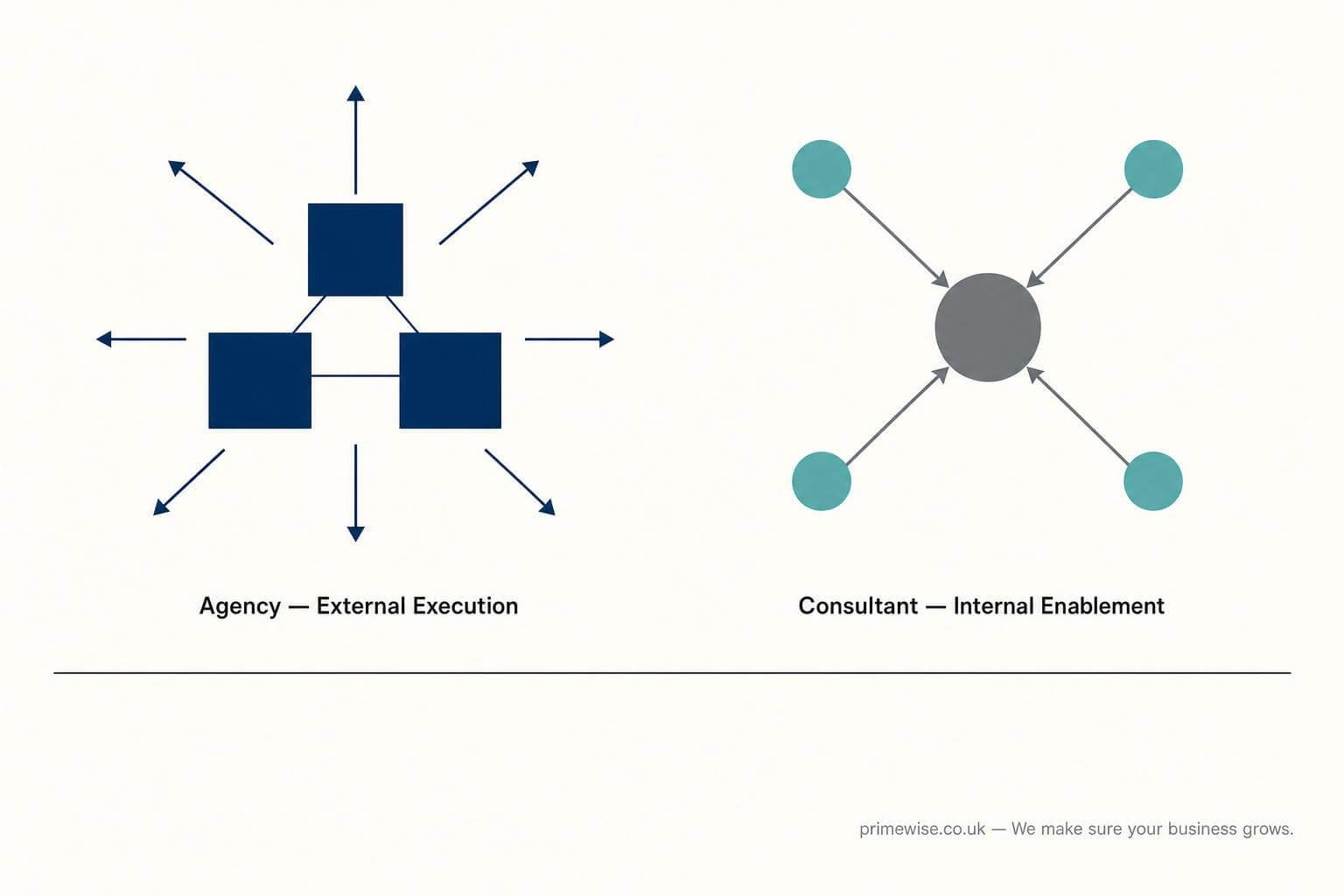
An AI automation agency is a full-service execution partner. It builds, deploys, and maintains proprietary technical architecture on your behalf, functioning as an outsourced engineering arm with software developers, integration specialists, and project managers operating under a managed service contract. A consultant is a strategic enablement partner. They assess your existing workflows, identify where low-code or enterprise-native tools such as Microsoft Power Automate or Copilot for Microsoft 365 can be deployed, and then upskill your internal team to own those systems independently. The agency builds the machine. The consultant teaches your people to build and run it themselves.
Understanding this demarcation line is not an academic exercise. Procuring the wrong model leads to one of two failure states: an over-engineered, bespoke system that your team cannot maintain without ongoing vendor support, or a strategic roadmap that lacks the internal engineering bandwidth to ever materialise. Both outcomes represent a significant misallocation of capital and operational focus at precisely the moment when your competitors are accelerating.
Where Agency Execution Creates Genuine Value
An AI automation agency delivers disproportionate value when internal engineering resource is genuinely absent. These firms provide immediate technical leverage custom API integrations across complex enterprise ecosystems, robotic process automation deployments using platforms such as UiPath or Automation Anywhere, and bespoke workflow engines that sit outside the boundaries of any standard SaaS product. For organisations that need to digitise high-volume, rule-based processes urgently and cannot hire development talent in time, the agency model removes the bottleneck entirely.
The trade-off is structural dependency. Because the agency architects and maintains the proprietary codebase, the client inherits a black box. If the commercial relationship terminates, you are left with a system no one internally understands, a migration cost that was never budgeted, and a vendor who holds implicit leverage over your operational continuity. This is not a hypothetical risk. It is the most common complaint I hear from operations directors who engaged agencies without mandating comprehensive documentation and IP ownership clauses from day one.
Where a Consultant Builds Lasting Operational Resilience
A consultant operates from a fundamentally different philosophy: the objective is to make themselves unnecessary. Rather than building proprietary code, the consultant maps your existing process landscape, identifies the automation opportunities that your current enterprise licences already support, and designs an enablement programme that transfers genuine capability to your internal team. Microsoft 365 enterprise subscribers, for example, frequently have access to Power Automate, Copilot Studio, and the broader Power Platform suite without any additional licensing cost tools that a competent consultant can configure to automate significant workflow volume within weeks rather than months.
This model requires something the agency model does not: internal readiness. You need at least one tech-capable operations manager or process owner on your side who has the bandwidth and the mandate to learn, test, and ultimately own the new systems. The consultant acts as the architect and the trainer. Your internal team becomes the builder and operator. If that internal capacity does not exist, the consultant’s roadmap gathers dust and the engagement delivers no measurable return.
The Most Expensive Mistake in AI ProcurementIn my direct experience working with UK wealth management and professional services firms, the single most common procurement error is commissioning a bespoke agency build for a problem that Microsoft 365 Power Automate already solves natively. This single decision routinely inflates project costs by 200% to 300% and introduces data residency risks that create FCA compliance exposure. Always audit your existing enterprise licence stack before issuing a single RFP.
The PrimeWise Operational Readiness Score
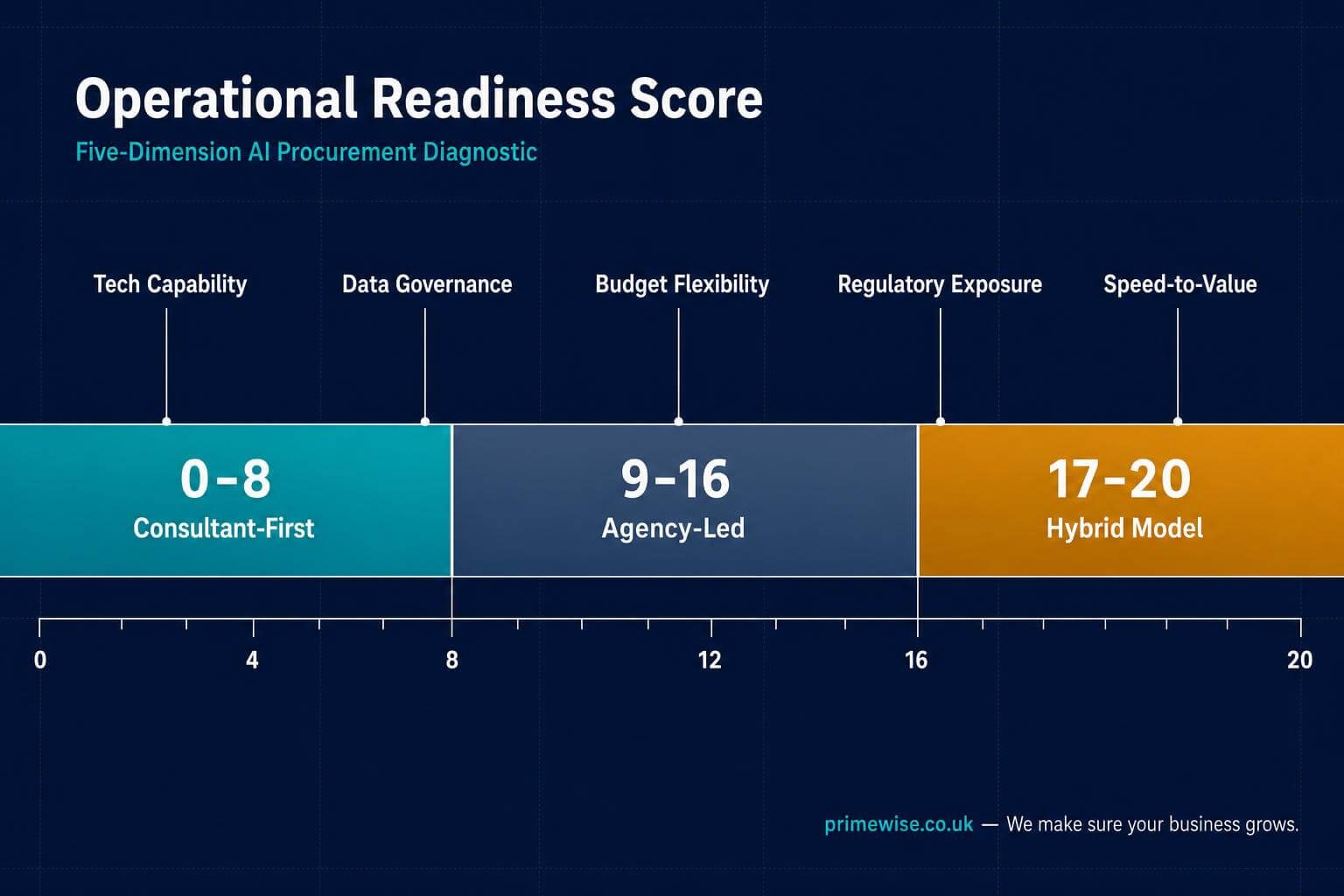
Before soliciting any vendor proposal, you need an honest internal diagnostic. The PrimeWise Operational Readiness Score (ORS) is a five-dimension framework developed from direct engagement experience with UK SMEs and mid-market firms across financial services, professional services, and technology sectors. Score your organisation against each dimension on a scale of zero to four, where zero represents critical deficiency and four represents mature capability. Your aggregate score determines the appropriate procurement model before a single conversation with a vendor takes place.
The five ORS dimensions are as follows. Internal Tech Capability measures whether your team includes developers, technical ops managers, or systems administrators who can own automation tooling post-deployment. Data Governance Maturity assesses whether your operational data is structured, accessible, and documented to a standard that AI systems can process reliably. Budget Flexibility evaluates whether your capital expenditure model can absorb ongoing retainer-based agency costs or whether fixed-fee day-rate engagements are operationally necessary. Regulatory Exposure scores the sensitivity of the data flowing through any proposed automation, with highly regulated data commanding greater scrutiny of third-party access. Speed-to-Value Requirement captures the urgency of your deployment timeline and whether internal upskilling is a commercially viable option given competitive pressures.
| ORS Score Range | Recommended Procurement Model | Primary Rationale |
|---|---|---|
| 0 – 8 | Consultant-First Engagement | Internal capability is sufficient to own systems; strategic enablement delivers the highest ROI |
| 9 – 16 | Agency-Led Deployment | Engineering gaps require external execution bandwidth; internal team needs turnkey delivery |
| 17 – 20 | Hybrid Procurement Model | Complex custom build required alongside strategic oversight; deploy both simultaneously |
A score below eight does not mean your organisation is technically unsophisticated. It means you have the internal capability to absorb and own a consultant-designed system, which is the most commercially efficient outcome available. A score approaching twenty indicates that you require both agency engineering bandwidth and consultant-level strategic governance operating in parallel the hybrid model discussed in detail later in this guide.
UK Market Rates and Commercial Realities
Financial transparency is a prerequisite for sound capital expenditure planning. The UK market for AI expertise has matured significantly, and understanding the commercial structures of each engagement model is essential for building a board-defensible procurement rationale.
Consultant Day Rates and Agency Retainers Compared
AI integration consultants in the UK currently command day rates ranging from £800 to £1,500, depending on sector specialism, enterprise experience, and the complexity of the tool ecosystems involved. A well-scoped consultant engagement of ten to fifteen days therefore represents a capital outlay of £8,000 to £22,500 a figure that includes strategic diagnostic work, solution design, implementation guidance, and team enablement. For the majority of UK SMEs operating within existing Microsoft or Google enterprise ecosystems, this expenditure delivers a fully operational, internally owned automation capability.
AI automation agencies operate on structurally different commercial models. Project fees for bespoke builds typically begin at £25,000 and scale to £100,000 or beyond for complex, multi-system integrations. Ongoing monthly retainers for managed maintenance, iterative development, and support range from £5,000 to £15,000 per month. These figures reflect the genuine cost of maintaining a dedicated engineering team developers, QA specialists, and project managers on the client’s account. The capital outlay is substantially higher, but for organisations with no internal technical capability and genuine bespoke requirements, it represents the only viable path to deployment.
A UK Financial Services Case Study
A mid-sized UK wealth management firm approached our team after receiving agency quotes exceeding £60,000 for a bespoke client onboarding automation. The existing process took fourteen business days end-to-end, spanning manual data entry across three disconnected systems: a CRM platform, a compliance documentation portal, and an internal case management tool. The agency proposed a custom-coded integration layer connecting all three, with ongoing managed service support at £8,000 per month.
Applying the PrimeWise ORS framework, the firm scored eleven out of twenty placing it in the agency-assisted range but critically, the Data Governance Maturity dimension revealed that the firm already held a Microsoft 365 E3 enterprise licence covering Power Automate, Power Apps, and SharePoint. The firm had been licensing these capabilities for two years without deploying them. A ten-day consultant engagement was scoped instead, during which the operations team was upskilled to configure Power Automate flows connecting their CRM to SharePoint-based compliance templates, with Copilot for Microsoft 365 accelerating document review. All data remained within the firm’s Azure-tenanted environment, maintaining full FCA data residency compliance and eliminating the third-party data transit risk the agency model would have introduced.
The outcome: client onboarding reduced from fourteen to 3.5 business days, representing a 75% process improvement. Total engagement cost was £12,500 in consultant fees, representing a saving of approximately £47,500 against the original agency quote, with zero ongoing retainer liability. Results are representative of a real engagement; individual outcomes will vary based on organisational readiness and existing tool infrastructure.
Key Financial BenchmarkUK AI integration consultant day rates range from £800 to £1,500. Agency project fees typically begin at £25,000, with monthly retainers of £5,000 to £15,000. Before approving either budget line, audit your existing enterprise SaaS licences the automation capability you need may already be paid for.
When to Deploy the Hybrid Procurement Model
The 2026 UK enterprise market has moved decisively beyond the binary choice between agency and consultant. The fastest-growing procurement pattern is the hybrid engagement model, where an AI integration consultant designs the solution architecture, manages quality assurance, and governs the overall transformation programme, while an AI automation agency provides the engineering bandwidth for complex custom builds that exceed the scope of low-code platforms. This model is particularly well suited to organisations with PrimeWise ORS scores in the upper range those with strong internal capability and strategic clarity but a genuine requirement for bespoke technical execution.
In practice, the hybrid model works as follows. The consultant conducts the initial diagnostic, maps the process landscape, defines the automation architecture, and specifies the exact technical requirements for any custom components. The agency receives a precise, expert-authored technical brief rather than a vague business requirement, which dramatically reduces build risk, scope creep, and cost overrun. The consultant then remains engaged throughout the delivery phase as an independent quality assurance layer, ensuring the agency’s output meets the original specification and that the internal team receives adequate knowledge transfer. This structured approach treats the consultant as the strategic orchestration layer and the agency as the execution resource a division of labour that maximises the ROI of both engagements simultaneously.
Organisations evolving beyond even the hybrid model often invest in establishing an internal AI Centre of Excellence (CoE) a dedicated internal capability function that internalises the consultant’s strategic role and gradually reduces external dependency on both agency and advisory partners. Hyperautomation, the Gartner-coined framework describing the systematic identification and automation of every business process that can be automated, represents the strategic destination that both the hybrid model and the CoE are architected to reach. Change management methodology specifically the Prosci ADKAR model or Kotter’s 8-Step framework provides the human adoption architecture that ensures automated systems are actually used by the people they are designed to support, which remains the most underinvested dimension of every AI deployment regardless of vendor model.
UK Compliance, Governance, and Risk Management
For UK businesses operating in regulated sectors, AI procurement cannot occur in a regulatory vacuum. The governance implications of choosing an agency versus a consultant extend well beyond cost and capability into data sovereignty, legal classification, and regulatory accountability.
UK GDPR, ICO Guidance, and FCA Obligations
Any external vendor accessing your operational data must be governed by a robust Article 28 UK GDPR data processing agreement before a single data point is shared. The ICO’s 2024 Guidance on AI and Data Protection provides specific requirements for organisations deploying AI systems that process personal or sensitive data, including mandatory transparency obligations, data minimisation principles, and human oversight requirements for automated decision-making. An AI automation agency building external tools and pipelines presents a materially higher data transit risk than a consultant configuring systems within your existing, ring-fenced Azure or Google Cloud tenanted environment. For FCA-regulated firms, PS24/1 the FCA’s published guidance on the use of AI in regulated activities sets out specific expectations around model governance, auditability, and the maintenance of complete audit trails for automated decisions affecting client outcomes. Failing to structure your agency contract around these requirements is not a technical oversight; it is a regulatory liability.
IR35 and Contractual Classification
Hiring an independent AI consultant in the UK requires a careful IR35 assessment under Chapter 10 of ITEPA 2003, the off-payroll working rules that determine whether an engagement is classified as employment or genuine self-employment for tax purposes. Procurement and HR teams should use the HMRC Check Employment Status for Tax (CEST) tool as a baseline assessment, but for engagements exceeding £50,000 in annual value, independent legal review of the contract structure is strongly advisable. A consultant operating outside IR35 requires a contract that demonstrates genuine substitution rights, absence of mutuality of obligation, and control over their working methods all of which are operationally relevant to how the engagement is scoped and managed.
Engaging an AI automation agency under a managed service contract typically bypasses IR35 classification entirely, because the agency is a corporate entity providing a deliverable rather than an individual providing personal service. This contractual simplicity is a genuine commercial advantage of the agency model, though procurement departments should ensure the managed service contract includes explicit SLA provisions, data processing terms compliant with UK GDPR Article 28, IP assignment clauses, and a structured exit protocol that guarantees full system documentation and transition support if the commercial relationship ends.
Regulatory Checklist Before Any AI Vendor EngagementConfirm UK GDPR Article 28 DPA is in place before granting data access. For FCA-regulated firms, review PS24/1 AI guidance before scoping any automated decision-making system. Conduct an IR35 assessment via HMRC CEST for individual consultant engagements. Mandate IP ownership and full system documentation clauses in all agency contracts.
When Neither Option Is the Right Answer
The most strategically important advice in this guide is also the most commercially uncomfortable: sometimes the correct answer is to engage neither an agency nor a consultant until your internal operations are ready to absorb what they deliver. Premature AI deployment across fractured operational foundations does not accelerate efficiency it automates existing dysfunction at scale and compounds technical debt at a rate that can take years to reverse.
Diagnosing Operational Immaturity Before You Spend
There are four unambiguous red flags that indicate your organisation is not yet ready for AI deployment. First, your operational data exists primarily in unstructured formats email threads, PDF attachments, siloed spreadsheets with inconsistent naming conventions, and legacy databases with no documented schema. Artificial intelligence requires structured, accessible, consistently formatted data to generate reliable outputs. Feeding disorganised data into even the most sophisticated automation produces unreliable results that users will reject within weeks of deployment. Second, your standard operating procedures are undocumented or exist only in the institutional memory of individual team members. Automation requires rules, and rules require standardisation. If the process you want to automate cannot be written down in a step-by-step format that a new hire could follow without assistance, it cannot be reliably automated. Third, your operational bottlenecks have not been formally mapped or prioritised. Automating the wrong process even flawlessly delivers no measurable business outcome. Without a documented process improvement framework, vendor selection is premature. Fourth, change management capability is absent. If your organisation has a history of technology adoption failures driven by user resistance, deploying AI without a formal change management programme whether Prosci ADKAR or an equivalent structured methodology will replicate that failure pattern regardless of how technically excellent the vendor is.
Process Optimisation Must Come First
Organisations exhibiting any of the four red flags above must invest in process optimisation as a non-negotiable first step. This means mapping current workflows using a recognised methodology such as Lean or Six Sigma process mapping, documenting all standard operating procedures to a level of precision that allows consistent execution, identifying and quantifying the highest-impact bottlenecks using time-study data or process mining tools, and establishing a data governance framework that structures and centralises operational data before any automation layer is applied. This preparation phase is not a delay to AI deployment it is the work that determines whether your AI deployment succeeds or fails. It also dramatically reduces the scope, cost, and timeline of subsequent agency or consultant engagement, because the vendor receives a clean operational baseline rather than a remediation project disguised as an automation brief.
The AI Vendor Fit Matrix for UK Business Leaders
Consolidating the diagnostic frameworks in this guide, the following matrix maps the five critical procurement variables against the three engagement models available to UK organisations in 2026. Use this alongside your PrimeWise ORS score to build a board-ready vendor selection rationale that is defensible on both commercial and compliance grounds.
| Procurement Variable | AI Integration Consultant | AI Automation Agency | Hybrid Model |
|---|---|---|---|
| Internal Tech Capability | Moderate to High Required | Not Required | Low to Moderate Required |
| Budget Structure | Fixed Day Rate (£800–£1,500/day) | Project Fee + Retainer (£25k+ / £5–15k/month) | Combined but Phased |
| Speed to Deployment | Slower requires internal adoption cycle | Faster turnkey delivery | Balanced architecture-first then build |
| Regulatory Tolerance | High data stays in-house | Lower external data transit risk | High if consultant governs data architecture |
| Long-Term Dependency Risk | Low internal ownership built | High vendor lock-in risk | Low if IP and documentation are mandated |
- Internal Tech Capability determines whether external engineering resource is essential or whether strategic enablement is commercially sufficient.
- Budget Allocation must account not just for initial deployment cost but for the ongoing total cost of ownership across a minimum three-year horizon.
- Speed to Deployment must be evaluated honestly against the internal change management capacity available to support adoption.
- Regulatory Tolerance directly limits the viability of external managed services for any organisation processing sensitive client or financial data.
- Long-Term Dependency Risk is the variable most consistently underweighted by procurement teams under time and budget pressure and the one that creates the most expensive post-deployment problems.
If you want a structured, scored version of this diagnostic applied to your specific organisation, PrimeWise offers a complimentary Operational Readiness Score assessment a focused 45-minute diagnostic call that produces a scored procurement recommendation report built specifically for operations directors and CFOs who need a board-ready vendor selection rationale before committing capital to AI deployment. Visit primewise.co.uk to request your assessment.
Your Next StepBefore issuing any AI vendor RFP, complete the PrimeWise ORS diagnostic. A 45-minute structured assessment produces a scored, board-ready procurement recommendation eliminating vendor selection paralysis and protecting your capital expenditure from misalignment risk.