
Your AI adoption and automation support investment is sitting dormant, and the reason your team is not using AI tools is almost certainly not what your IT department told you. Millions of pounds are haemorrhaged annually on enterprise AI shelfware, expensive licenses procured with significant capital expenditure that never graduate from the pilot phase into daily operational reality. Microsoft Copilot seats go untouched. ChatGPT Enterprise licenses expire at low utilisation. The pilot to production chasm widens. And the root cause is not a lack of prompt engineering training. It is a fundamental failure to treat AI deployment as a behavioural change programme rather than a software installation. This article delivers the diagnostic framework, the structural fixes, and the CORE AI Adoption Matrix that UK enterprises need to stop wasting investment and start driving measurable return.
EXECUTIVE SUMMARYEnterprise AI shelfware is not a technology problem, it is a structural one. The pilot to production chasm is driven by FCA compliance anxiety, legacy tech friction, misaligned managerial KPIs, and compensation models that actively punish efficiency. The CORE AI Adoption Matrix (Compliance, Operations, Reward, Empowerment) provides a four-component framework to move AI from an isolated experiment to a daily operational standard. PrimeWise diagnostic data shows 78% of stalled UK enterprise AI rollouts trace back to managerial misalignment, not technical complexity.
What Is the Pilot to Production Chasm
The pilot to production chasm is the critical gap between a successful, isolated AI experiment and mandatory, daily operational integration across an entire business. It is the phase where enthusiasm from IT leadership collides with apprehension from frontline teams, and where the absence of structural alignment turns expensive technology into expensive shelfware. AI shelfware occurs when enterprise licenses remain underutilised, not because the technology is inadequate, but because the business has failed to redesign the human systems around it, the incentives, the workflows, the managerial behaviours, and the governance frameworks that determine whether a tool gets opened or ignored.
- AI shelfware drains sunk capital expenditure and signals a failure in enterprise change management, not product quality.
- Enterprise licenses like Microsoft Copilot require behavioural and cultural rewiring, not just technical onboarding.
- The pilot to production chasm exposes the structural gap between the IT department’s enthusiasm and frontline operational apprehension.
- Closing this gap demands alignment between commercial workflows, individual user incentives, and managerial accountability.
- Firms that successfully bridge this chasm treat AI deployment as a change management programme with defined milestones and governance checkpoints.

Diagnosing Why Your Team Is Resisting AI Tools
Business leaders instinctively reach for the wrong diagnosis. When adoption stalls, the default response is to book another round of prompt engineering workshops or push out a company-wide memo reminding staff that the tools are available. Neither intervention addresses the real problem. Based on PrimeWise Enterprise Adoption Diagnostic Data (2025), the barriers to AI adoption in UK firms are psychological, structural, operational, and managerial and they layer over each other in ways that generic training programmes cannot resolve.
FCA Compliance Anxiety and Professional Reputation Risk
Within London-based financial services teams and regulated UK sectors, regulatory paralysis is the single most underestimated adoption blocker. Professionals operating under the Financial Conduct Authority’s Consumer Duty obligations and UK GDPR as governed by the Information Commissioner’s Office are acutely aware that algorithmic errors carry professional and institutional consequences that far exceed any time-saving benefit. When an analyst fears that an AI hallucination embedded in a client deliverable could trigger an FCA Consumer Duty breach, the rational decision is to avoid the tool entirely. This is not irrationality. It is well-calibrated professional risk management in the absence of a compliant AI governance framework.
Regulated firms cannot address this blocker with reassurance alone. They need enterprise-grade environments with documented data governance policies, zero-retention configurations for external large language models, and written internal protocols defining which data classifications are permissible within AI prompts. Without these structural assurances, the compliance anxiety that paralyses adoption is entirely justified.
Legacy Infrastructure Friction in City Institutions
Cutting-edge generative AI tools are designed to sit on top of clean, well-structured data environments. The City of London is not that environment. Traditional UK financial institutions carry decades of accumulated technical debt fragmented databases, siloed legacy systems, and data architectures that predate modern API connectivity. When an employee attempts to leverage Microsoft Copilot or a comparable enterprise AI tool and encounters broken integrations, inaccessible data, or inconsistent outputs caused by poor underlying data quality, they abandon the tool within the first week. The technology gets blamed when the fault lies with the infrastructure beneath it.
Resolving this requires honest enterprise architecture auditing before AI deployment, not after. Firms that skip the infrastructure harmonisation phase and deploy AI directly onto legacy stacks are constructing the pilot to production chasm themselves.
Managerial Misalignment and the Leadership Modelling Deficit
Frontline employees model their behaviour on middle management. If a team’s direct manager is not visibly using AI tools, is not referencing AI outputs in team meetings, and is not championing process innovation in their weekly one-to-ones, the implicit message is that AI adoption is optional and that the real path to career progression runs through the legacy process. According to PrimeWise Enterprise Adoption Diagnostic Data (2025), 78% of stalled enterprise AI rollouts in the UK financial sector trace directly to misaligned managerial KPIs rather than technological complexity. This is the most powerful and most frequently overlooked lever in enterprise AI change management.
KEY INSIGHT78% of stalled enterprise AI rollouts in UK financial services are caused by misaligned managerial KPIs, not technical failure. This is PrimeWise proprietary diagnostic data from 2025 enterprise engagements. The fix is managerial, not technological.
The Billable Hours Paradox
The deepest structural barrier to AI adoption in professional services is the one nobody wants to discuss openly. If a senior associate uses generative AI to compress a four-hour analytical task into twelve minutes, a firm operating on traditional billable-hours models has just lost revenue. The employee has delivered the same output in a fraction of the time, but has nothing to show for the efficiency gain within their current appraisal framework and may have actively shortened a billing cycle. The structural incentive is to perform the task slowly, visibly, and in the traditional manner.
This is not laziness or technophobia. This is rational behaviour inside a broken incentive structure. Until compensation frameworks reward process innovation rather than output volume, AI tools will remain shelfware regardless of how intuitive or powerful they are. Solving AI adoption in professional services is fundamentally a compensation design problem.
The CORE AI Adoption Matrix
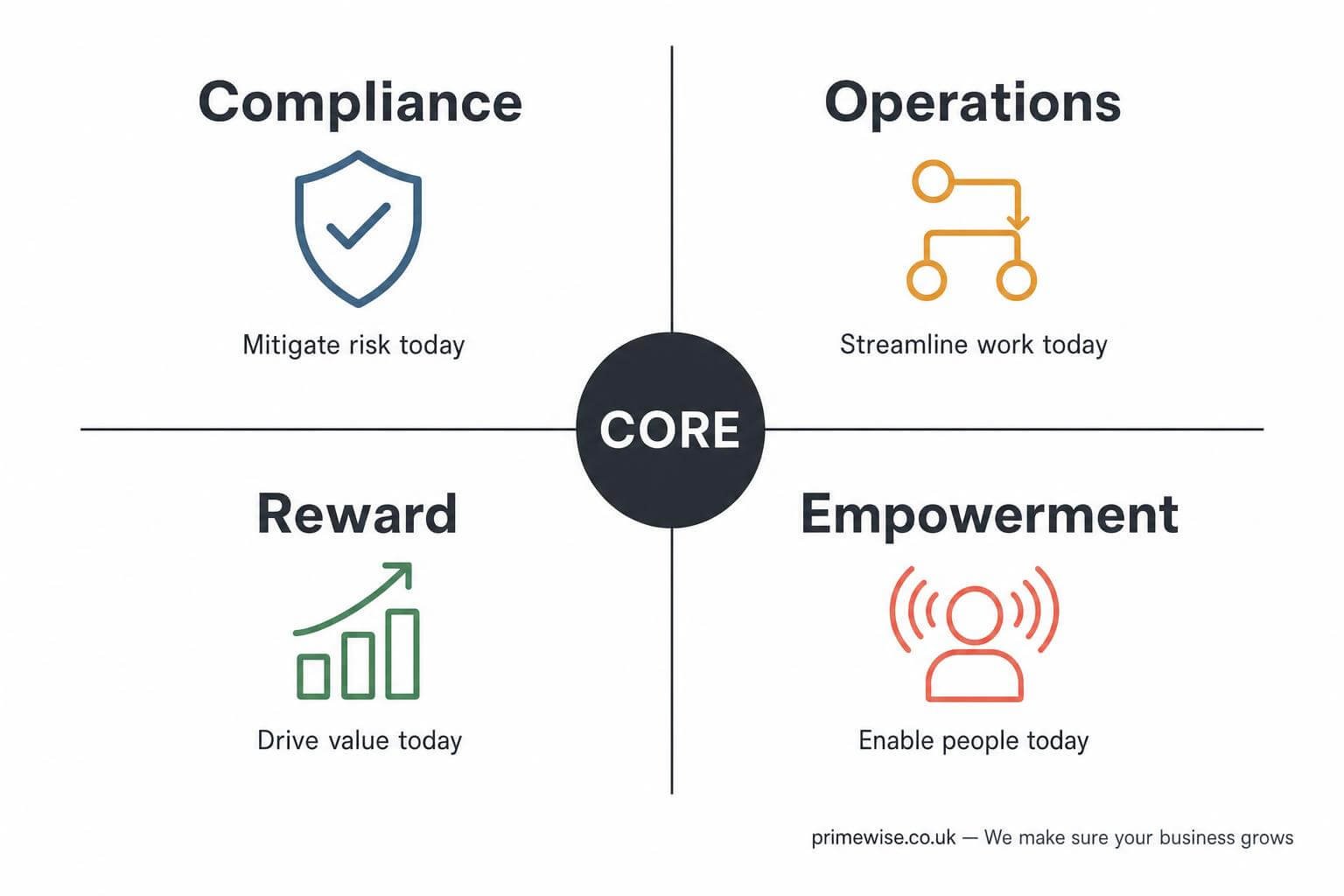
Moving from costly shelfware to daily operational integration requires a structured change management blueprint that addresses all four dimensions of adoption failure simultaneously. PrimeWise developed the CORE AI Adoption Matrix specifically for UK-regulated enterprises navigating the pilot to production chasm. The framework has four components Compliance, Operations, Reward, and Empowerment each targeting a distinct layer of the resistance stack. Firms working with PrimeWise using this methodology have recovered full CapEx on AI investments within two financial quarters.
| CORE Component | Adoption Barrier Addressed | Primary Intervention |
|---|---|---|
| Compliance | FCA and UK GDPR anxiety | Ring-fenced AI sandboxes with documented governance protocols |
| Operations | Legacy friction and generic tooling | AI mapped directly to high-friction, recurring workflows |
| Reward | Billable hours and misaligned KPIs | Compensation redesign rewarding process innovation |
| Empowerment | Change fatigue and role irrelevance | Contextual, role-specific upskilling programmes |
Compliance Building FCA-Safe AI Sandboxes
The first component of the CORE matrix neutralises regulatory paralysis by constructing the governance architecture that makes safe AI usage possible. This means deploying ring-fenced AI environments that isolate sensitive corporate and client data, configuring enterprise-grade LLM deployments with zero external data retention, and producing documented internal protocols aligned with FCA Consumer Duty requirements and ICO UK GDPR guidance. These are not optional governance steps. They are the foundational precondition for any regulated UK firm to achieve meaningful adoption. Without them, the compliance anxiety that blocks adoption is entirely rational and will persist regardless of training investment.
Practical implementation involves working with legal, compliance, and IT teams to produce a tiered data classification policy that defines what categories of information can and cannot be used within AI prompts. This policy then becomes the foundation for staff training, removing ambiguity and replacing fear with a structured decision framework that employees can apply confidently in their daily work.
Operations Mapping AI to High-Friction Workflows
Generic AI training fails because it teaches people what a tool can theoretically do rather than demonstrating what it can do right now for their specific daily workload. The Operations component of the CORE matrix requires mapping AI capabilities directly to the highest-friction, highest-repetition workflows that already exist within the team. For a financial analyst, this means pitchbook generation, data reconciliation, and regulatory reporting. For a management consultant, it means first-draft proposal writing, market sizing models, and client research synthesis. The goal is to create an immediate, undeniable proof of value within the employee’s actual job not in a training scenario.
Microsoft Copilot, for example, is one of the most widely procured and least utilised enterprise AI tools in UK organisations. Copilot’s native integration across the Microsoft 365 suite Word, Excel, PowerPoint, Teams, and Outlook makes it ideally positioned to automate repetitive documentation, meeting summarisation, and email drafting. But deployment teams consistently make the error of launching it enterprise-wide without mapping its specific features to the exact tasks where it eliminates the most friction for each role. When that mapping exercise is completed and demonstrated in role-specific workshops, adoption rates shift materially within the first four weeks.
Reward Redesigning Compensation for AI-Native Teams
The Reward component is the most commercially sensitive element of the CORE matrix and the one most frequently avoided by leadership teams reluctant to open a conversation about compensation restructuring. But it is non-negotiable. Firms must move away from appraisal systems that reward hours logged and toward frameworks that reward outcomes delivered and processes improved. In practice, this means introducing process innovation metrics into quarterly appraisals, creating bonus structures tied to demonstrable AI-driven efficiency gains, and exploring value-based pricing models for client-facing teams that decouple revenue from time spent.
Progressive UK professional services firms are piloting a dual-track recognition model: a short-term incentive tied to documented AI adoption milestones (for example, a team member who delivers a client report using Copilot in two hours rather than ten receives a performance recognition note linked to their annual bonus calculation) and a longer-term career framework that formally designates AI fluency as a prerequisite for promotion to senior grades. This dual structure creates both immediate and sustained incentives for adoption without dismantling existing compensation architecture overnight.
Empowerment Delivering Contextual Upskilling
Change fatigue is real, and it is particularly acute in UK corporate environments that have absorbed multiple waves of digital transformation initiatives over the past decade. When a new AI training programme lands in a staff inbox, the default reaction from high-performing professionals is exhaustion rather than enthusiasm. The Empowerment component of the CORE matrix addresses this by replacing generic, one-size-fits-all prompt engineering workshops with tightly focused, role-specific upskilling that is built around the exact workflows already identified in the Operations phase.
An analyst and a senior partner have fundamentally different daily workloads, different risk tolerances, and different definitions of what useful looks like. Treating them to the same training content signals that the organisation does not understand their role and that the technology is being imposed rather than integrated. Role-specific empowerment programmes, delivered in small cohorts with real use-case demonstrations rather than theoretical capability showcases, consistently outperform enterprise-wide training rollouts on every adoption metric.
How to Audit Your Current AI Adoption Rate
Before implementing the CORE matrix, executives need an honest baseline. Most organisations rely on login metrics the number of users who have authenticated into a platform in a given period as a proxy for adoption. This data is almost always flattering and almost always misleading. True adoption is a behavioural state, not an access event. The following diagnostic checklist provides a more accurate and actionable picture of where your organisation currently sits.
- Track task completion time reductions across high-friction workflows before and after AI tool deployment to establish a genuine output-level adoption signal.
- Audit the frequency with which AI-generated outputs formally appear in client deliverables, internal reports, and management presentations.
- Survey middle managers on whether AI utilisation is currently a topic in their weekly team meetings and one-to-ones the answer will reveal managerial alignment gaps immediately.
- Review whether AI usage is referenced in any current performance appraisal documentation, KPI dashboards, or career development frameworks.
- Assess infrastructure compatibility by testing whether AI tools can access the data they need to perform the specific tasks employees actually require, rather than only the data the IT team prepared for the pilot.
- Measure the ratio of active AI users to licensed seats on a weekly rather than monthly basis monthly aggregates consistently mask mid-week abandonment patterns that are the earliest signal of structural resistance.
DIAGNOSTIC ACTIONIf fewer than 40% of licensed AI seats show weekly active usage within 90 days of deployment, your organisation has entered the pilot to production chasm. The fix is structural, not motivational. A targeted CORE framework intervention is required before the investment is written off.
How UK Firms Compare on AI Adoption Readiness
The UK Government’s AI Opportunities Action Plan, published in early 2025, identified workforce adoption and skills infrastructure as the primary bottleneck to realising the productivity gains that AI investment is intended to deliver. CIPD research from the same period found that fewer than one in three UK employees who have access to AI tools at work report using them regularly as part of their standard workflow. Separately, McKinsey’s 2024 global AI adoption data indicated that firms investing in structured change management alongside AI deployment achieve adoption rates three times higher than those that rely on technology deployment alone.
These figures contextualise what PrimeWise observes consistently in enterprise diagnostic engagements: the technology is rarely the limiting factor. The limiting factors are the human systems wrapped around it the managerial behaviours, the incentive structures, the governance frameworks, and the training methodologies. UK firms, particularly those in regulated financial and professional services sectors, face a more complex adoption challenge than their US counterparts because the regulatory environment is more prescriptive and the management culture is more hierarchical. Both factors demand a more structured, risk-mitigated approach to AI change management than the Silicon Valley playbook typically prescribes.
Enterprise AI Tools and Their Adoption Profiles
Not all enterprise AI tools present identical adoption challenges. Understanding the specific friction profile of the tools your organisation has procured is a prerequisite for targeted intervention.
Microsoft Copilot for Microsoft 365 is the most widely deployed enterprise AI tool in the UK market and the one generating the highest volumes of shelfware. Its deep integration into familiar applications is both its greatest strength and its most significant adoption risk: because it sits within tools employees already use, organisations frequently assume that adoption will happen organically. It does not. Copilot requires explicit workflow mapping and role-specific demonstration before users understand where and how it changes their actual working day. Without this, it remains an optional button that most professionals never press.
GitHub Copilot for Business presents a different adoption challenge, concentrated in software development and engineering teams. Resistance here is typically less about compliance anxiety and more about professional identity experienced developers who pride themselves on code craftsmanship often resist AI-assisted coding on the grounds that it produces lower-quality outputs or undermines their expertise. Adoption in this cohort requires peer-led demonstration rather than top-down mandate, and benefits substantially from internal champions who can demonstrate measurable quality improvements alongside speed gains.
Salesforce Einstein and similar CRM-embedded AI tools face adoption challenges rooted primarily in data quality. CRM AI is only as good as the underlying customer data it is trained on, and in organisations where CRM hygiene is poor a near-universal condition in the early stages of any CRM implementation AI outputs are unreliable enough to undermine user trust rapidly. The remediation path here runs through data governance and CRM adoption before it runs through AI adoption.
Recovering a Stalled Two-Million-Pound AI Rollout
In late 2024, a Tier One Global Management Consultancy operating in UK financial services engaged PrimeWise after its generative AI rollout a two-million-pound investment in enterprise LLM licensing, infrastructure, and initial training had reached an active utilisation rate of less than eleven percent across its UK practice. Partners had declined to alter their billing methodologies, middle management had received no updated KPIs referencing AI utilisation, and the compliance team had not produced written governance protocols, leaving fee earners to make individual judgements about what was and was not safe to use the tools for. The cumulative effect was near-total abandonment.
PrimeWise deployed the CORE AI Adoption Matrix across a twelve-week initial engagement. In the Compliance phase, documented AI governance protocols were produced in collaboration with the firm’s General Counsel and Head of Compliance, establishing a clear data classification policy and a set of FCA Consumer Duty-aligned usage guidelines. In the Operations phase, AI was mapped to five specific high-volume workflows: pitch deck first drafts, regulatory filing summaries, competitor benchmarking reports, meeting note synthesis, and internal knowledge retrieval. Each workflow received a role-specific demonstration session rather than a generic training event.
In the Reward phase, the partnership group agreed to introduce a process innovation multiplier into annual bonus calculations, explicitly recognising and financially rewarding evidence of AI-driven efficiency. In the Empowerment phase, a cohort of twelve internal AI champions drawn from mid-level associate and manager grades received intensive role-specific coaching and were empowered to lead peer adoption sessions. Within six months, the firm achieved full CapEx recovery on its AI investment. Active weekly utilisation exceeded sixty-seven percent of licensed seats. AI-generated content formally appeared in over forty percent of client deliverables. The investment that had been approaching write-off status became a measurable competitive differentiator.
READY TO RESCUE YOUR AI INVESTMENT?If your organisation has procured AI tooling that remains underutilised, PrimeWise offers a complimentary AI Adoption Diagnostic that identifies your specific adoption blockers within five working days. Request your diagnostic at primewise.co.uk.
Changing Behaviour at the Middle Management Level
The CORE matrix can be designed perfectly and still fail if middle management does not visibly champion it. Executives can mandate AI usage and procurement teams can license the tools, but the daily behavioural signals that determine whether a team adopts or abandons a new workflow come from the layer of management closest to the work. This is why managerial intervention protocols are not a supplementary consideration; they are a primary delivery mechanism for any AI adoption programme.
Integrating AI utilisation into weekly one-to-one meeting agendas is the single highest-leverage behavioural intervention available to enterprise change management programmes. When a manager routinely asks a team member what AI tools they used this week, what worked, and what did not, the implicit message is that AI adoption is a professional expectation rather than a personal choice. Making AI utilisation a standing agenda item, not a disciplinary conversation, but a professional development discussion, normalises it within the team’s operational culture within four to six weeks.
Complementing this, AI utilisation should be incorporated into formal performance appraisal documentation at every grade level. This does not require a complete KPI overhaul. Adding a single mandatory comment field to quarterly appraisals, asking managers and their reports to document one process that was improved using AI tools in the preceding quarter creates a measurable accountability trail without restructuring the entire appraisal architecture. Over time, this trail becomes the evidence base for promotion decisions that formally recognise AI fluency as a career-defining competency.
What AI-Native UK Firms Will Look Like by 2027
Organisations that solve the pilot to production chasm in 2025 and 2026 are building a structural competitive advantage that will be difficult for late adopters to close by 2027. The distinguishing characteristics of AI-native UK firms are already becoming visible in early-adopter organisations: they have moved from time-based billing to value-based commercial models; they have embedded AI fluency into graduate recruitment criteria and senior promotion frameworks; they have designated Chief AI Officers or AI Governance Leads at the Board level; and they have built proprietary internal knowledge systems on top of enterprise LLM infrastructure that competitors cannot easily replicate.
For firms still trapped in the pilot to production chasm, the window for a managed transition is narrowing. The gap between AI-native competitors and shelfware-laden laggards is compounding quarterly, not annually. Addressing the structural barriers outlined in this article, the compliance anxiety, the legacy infrastructure friction, the managerial misalignment, and the broken incentive systems, is not a digital transformation aspiration. It is an urgent commercial priority for any UK enterprise that has already made the capital investment and is not yet seeing the return.