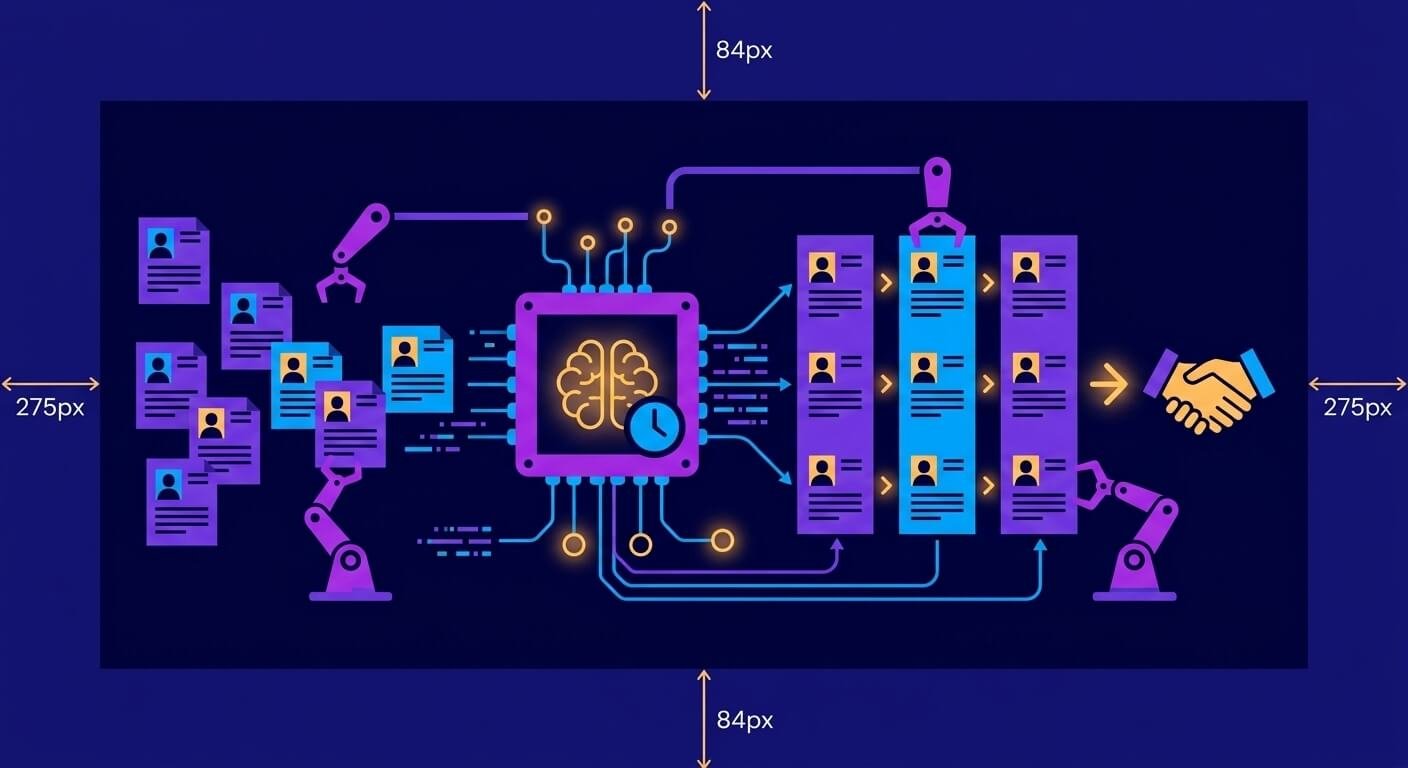

Why AI pilots fail is the most expensive unanswered question in UK financial services today. Despite record investment in AI integration and automation service capabilities, the majority of enterprise machine learning initiatives collapse before a single live transaction is processed. The algorithms are not at fault. The environment surrounding them is fundamentally broken and unless the structural causes are diagnosed and fixed from week one, every subsequent pilot will end in the same graveyard.

The AI Pilot Crisis in UK Financial Services
Enterprise AI in the City of London has arrived at a decisive inflection point. Corporate boards across Tier 1 institutions are no longer willing to fund conceptual demonstrations. They demand measurable efficiency gains, defensible compliance postures, and models that operate reliably inside live production environments not sanitised sandbox conditions.
The scale of the failure is significant. According to McKinsey’s State of AI report and corroborated by Gartner’s AI in Financial Services Hype Cycle analysis, the overwhelming majority of enterprise AI pilots never complete the journey from proof of concept to production. In UK financial services specifically, data fragmentation and absent change management not algorithmic inadequacy account for the dominant share of stalled initiatives. The IBM Global AI Adoption Index further identifies organisational friction and integration complexity as the leading barriers to AI scale-up in regulated industries.
- Estimated sunk cost per failed AI pilot in UK banking ranges from £1.2 million to £4.7 million per initiative, based on benchmarks published by Celent and Oliver Wyman.
- The majority of machine learning models that fail do so not because of statistical error, but because of broken data pipelines, unclear ownership, and missing operational infrastructure.
- Institutions that cannot operationalise their predictive models compound their technical debt whilst yielding ground to more agile global competitors investing in production-grade MLOps from day one.
EXECUTIVE ALERTIf your organisation has launched more than one AI pilot in the past 24 months without reaching production, the root cause is structural not technical. The algorithm is not the problem. The operational scaffolding around it is.
Diagnosing Structural AI Stagnation
Genuine diagnosis demands an unflinching audit of project architecture, not the neural network itself. The symptoms of pilot stagnation are almost always found in the scaffolding surrounding the model the data infrastructure, the governance structure, the ownership model, and the human systems expected to absorb it.
Fragmented Data Pipelines and Isolated Data Lakes
Models built inside isolated sandboxes thrive on manually curated, historically clean data. That same model, exposed to the erratic real-time feeds of a live banking environment, breaks with predictable regularity. Legacy banking infrastructure much of it built across decades of incremental acquisition and system consolidation produces fragmented data architectures where no single pipeline delivers the unified, governed, high-quality inputs a production model requires. This is not a data science problem. It is a DataOps problem, and it cannot be solved retroactively once a model has been built to accommodate clean data only.
The production-ready fix requires building a governed feature store tools such as Feast or Tecton allow engineering teams to define, share, and serve model features consistently across both training and serving environments. Without this infrastructure, model performance in production will invariably diverge from sandbox benchmarks, a phenomenon known as training-serving skew, which is one of the leading causes of silent model degradation after deployment.
Unclear Ownership and Siloed Objectives
When AI is treated as an IT initiative rather than a commercial programme, it loses its connection to the performance metrics that justify sustained executive funding. The chasm between technical teams and business lines is not a cultural inconvenience it is an organisational failure that produces models which technically function but commercially solve nothing. Without a named executive sponsor accountable for both delivery and business outcome, sponsorship erodes the moment complexity increases or timelines slip.
The Senior Managers and Certification Regime (SM&CR), which the FCA enforces across UK-regulated financial institutions, has direct implications here. Under SM&CR, individual accountability for AI-driven decisions can now be attributed to named senior managers. This means that the ambiguity of cross-functional ownership is not only a project risk it is a personal regulatory risk for the executives nominally responsible for the programme. Establishing named ownership at both technical and commercial levels is therefore both a delivery imperative and a compliance requirement.
The Silent Assassin of Adoption
The most technically sophisticated model in the institution will die on the vine if the people expected to use it refuse to trust it. End users traders, risk analysts, compliance officers, wealth managers have built operational habits over years or decades. An automated system deployed without a comprehensive change management blueprint is not perceived as an upgrade; it is perceived as a threat. When the system operates as an unexplained black box, that suspicion hardens into active resistance.
Human-in-the-loop design is not an optional enhancement. It is a structural requirement for adoption. Systems that present their reasoning transparently, that allow human override with audit logging, and that were co-designed with the end users who operate them achieve adoption rates that purely top-down deployments never reach. The absence of this design philosophy is one of the most consistently underestimated reasons why AI pilots fail at the final operational hurdle.
Navigating UK Regulatory and Operational Headwinds
UK financial institutions face a regulatory environment of escalating complexity. The convergence of FCA model risk guidance, EU AI Act extraterritorial obligations, and DORA operational resilience requirements creates a compliance landscape that must be engineered into the model architecture from day one not appended at the point of deployment review.
FCA Model Risk Management and SM&CR Accountability
The FCA’s Discussion Paper DP5/22 on Artificial Intelligence and Machine Learning established clear expectations for algorithmic transparency, explainability, and bias mitigation in UK financial services. The Bank of England’s Supervisory Statement SS1/23 further codifies Model Risk Management obligations, requiring institutions to maintain documented model inventories, validation frameworks, and ongoing performance monitoring for any model that influences a regulated decision. Retrofitting these requirements onto a completed model is technically possible but operationally catastrophic typically adding three to six months to deployment timelines and frequently triggering a full rebuild. Compliance cannot be an afterthought in a YMYL-regulated environment. It must be a week-one deliverable.
The EU AI Act and UK Multinational Exposure
UK firms operating with EU subsidiaries, EU client portfolios, or EU data subjects are subject to the extraterritorial obligations of the EU AI Act under Article 6 high-risk AI system classifications. Credit scoring models, risk assessment engines, and automated underwriting systems all fall within this high-risk category, meaning they require conformity assessments, technical documentation, human oversight provisions, and transparency obligations before deployment. UK institutions that assume post-Brexit regulatory divergence insulates them from these requirements are exposing themselves to significant enforcement risk across their EU operations.
Bridging Legacy Mainframes with Modern MLOps
Tier 1 UK banks process millions of transactions daily on mainframe architectures that were engineered before modern containerisation frameworks existed. Deploying neural networks alongside this infrastructure is not a simple API call it requires carefully designed middleware, robust API gateways, and an operational layer that translates between the deterministic world of mainframe batch processing and the probabilistic, latency-sensitive world of real-time inference. Batch inference and real-time inference architectures serve fundamentally different use cases: batch pipelines suit overnight risk recalculation; real-time inference is essential for fraud detection and live pricing. Conflating the two in the initial architecture is a common and costly structural error.
MLOps tooling specifically platforms such as MLflow for experiment tracking, Kubeflow for pipeline orchestration on Kubernetes, and Seldon Core for production model serving provides the operational connective tissue between the data science environment and the production engineering environment. Without this infrastructure, the model exists as an artefact rather than a deployable asset.
REGULATORY CHECKPOINTUK financial institutions with EU client exposure must classify AI systems under EU AI Act Article 6 before deployment. Credit scoring, automated underwriting, and risk assessment models are high-risk by definition. Non-compliance is not a technical failure it is a boardroom liability.
The MLOps Talent Gap in London
London produces exceptional quantitative analysts and data scientists. The pipeline from UCL, Imperial College London’s Data Science Institute, and King’s College is world-class for theoretical model design. The acute shortage lies not in model creation but in production engineering the MLOps engineers, DataOps architects, and platform reliability engineers who build the fault-tolerant, scalable software infrastructure required to run a model across an entire global banking network at production load. Hiring a data science team without a corresponding MLOps capability is the institutional equivalent of designing a Formula One car without building a pit crew.
The Week-One Production Readiness Checklist
The single most effective intervention available to a technical leader is the imposition of production readiness requirements before development begins. The following checklist represents the non-negotiable structural prerequisites that must be verified and enacted in the first week of any AI programme intended to reach live deployment.
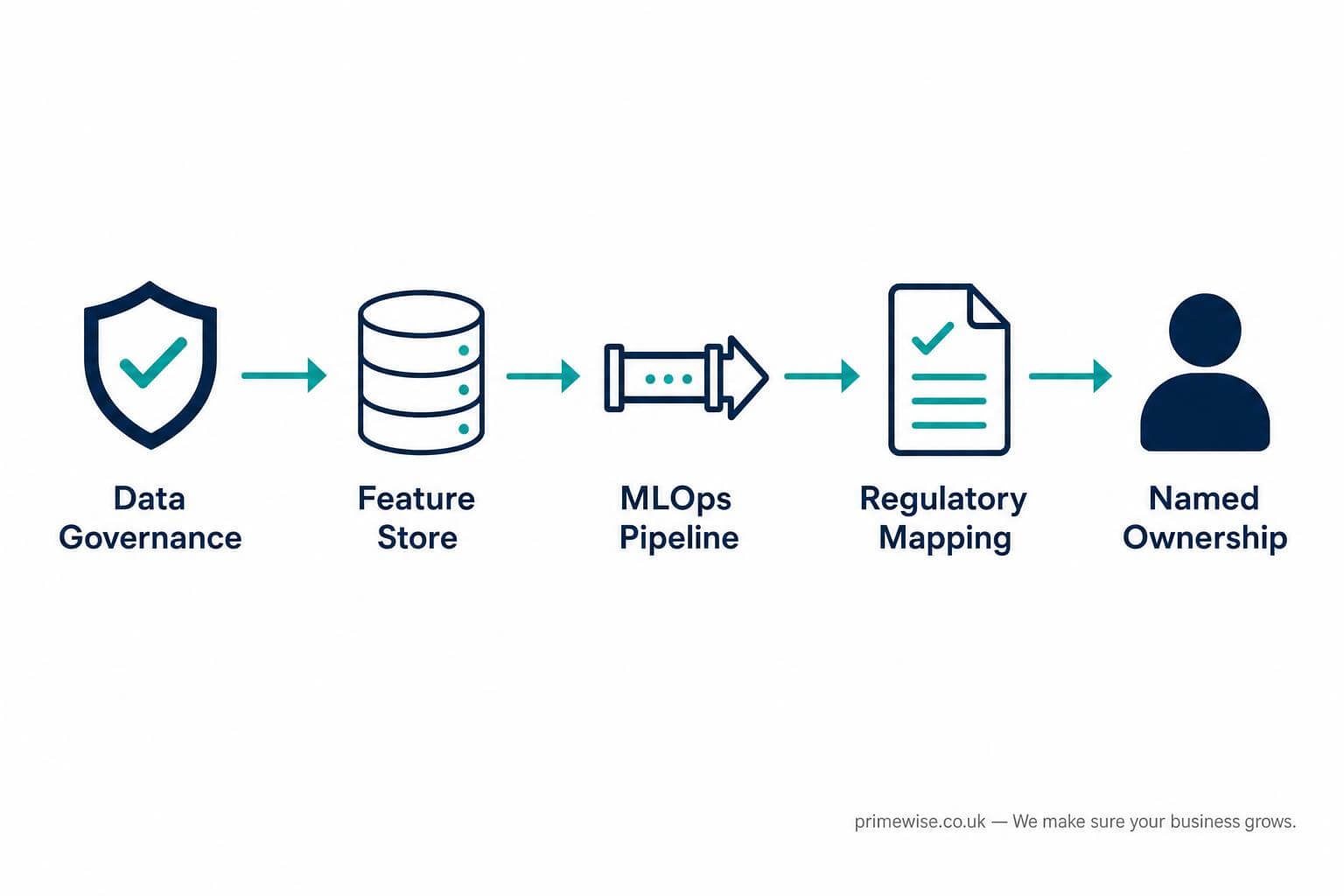
- Data governance framework: Define data ownership, access controls, lineage tracking, and quality thresholds for all model inputs before a single training run is executed.
- Feature store architecture: Stand up a governed feature store (Feast, Tecton, or equivalent) to eliminate training-serving skew and ensure consistent feature definitions across environments.
- MLOps pipeline infrastructure: Configure CI/CD pipelines for model training, validation, and deployment using MLflow, Kubeflow, or an equivalent orchestration layer.
- API integration design: Map all upstream data sources and downstream consuming systems. Define API contracts, authentication standards, and latency SLAs before model development begins.
- Regulatory compliance mapping: Document model purpose, risk classification under SS1/23 and EU AI Act Article 6, explainability requirements, and SM&CR accountability assignment on day one.
- Named executive ownership: Assign a single named senior manager accountable for both technical delivery and commercial outcome, with explicit performance metrics defined at kick-off.
- Business line co-design: Involve end users risk analysts, compliance officers, front office teams in requirements definition from week one to prevent adoption friction downstream.
- Model card and documentation standard: Establish the model card template, bias testing protocol, and performance benchmarking methodology before model training commences.
- Champion-challenger deployment strategy: Define the champion-challenger framework and model drift detection thresholds that will trigger retraining before the first model version is promoted to production.
- DORA operational resilience alignment: Map the AI system’s continuity requirements against the Digital Operational Resilience Act obligations applicable to the institution’s operational classification.
PRODUCTION FIRSTPrimeWise applies the Production-First Delivery Matrix to every AI programme it delivers for UK financial institutions ensuring commercial viability, technical scalability, and regulatory compliance are validated before a single line of model code is written. If your upcoming pilot needs this framework applied from week one, a diagnostic conversation with the PrimeWise team is the most capital-efficient first step you can take.
The Production-First Delivery Matrix
The Production-First Delivery Matrix is a proprietary programme governance tool developed specifically to prevent the common failure mode of building scientifically interesting but operationally undeployable models. It mandates that cross-functional teams score and validate three concurrent dimensions before development authority is granted: commercial viability (does the model solve a measurable business problem with a defined ROI threshold?), technical scalability (can the architecture sustain production load under live data conditions?), and regulatory compliance (have all applicable FCA, PRA, SM&CR, EU AI Act, and DORA obligations been mapped and assigned?). Any programme that cannot achieve a validated baseline across all three dimensions at week one does not proceed. This is not a bureaucratic checkpoint it is capital protection.
The Comparison: Failure Mode Versus Production-Ready Alternative
Understanding the structural contrast between a pilot that stalls and one that deploys successfully is most effectively communicated through direct comparison. The table below maps the five most common failure modes against their production-ready structural alternatives and the expected commercial outcome of making the shift.
| Failure Mode | Root Cause | Production-Ready Fix | Expected Commercial Outcome |
|---|---|---|---|
| Fragmented data pipeline | No governed feature store or unified data contract | Feast or Tecton feature store with API-governed access | Up to 60% reduction in model retraining cycles |
| Training-serving skew | Inconsistent feature definitions between sandbox and production | Shared feature registry enforced across all environments | Elimination of silent post-deployment performance degradation |
| Unclear ownership | No named SM&CR accountable senior manager | Named executive owner with dual technical and commercial KPIs | Sustained funding through deployment and into BAU |
| Compliance retrofitting | FCA/PRA/EU AI Act requirements identified post-build | Regulatory mapping completed at week one of development | Elimination of 3–6 month deployment delays at compliance review |
| Low user adoption | Black-box deployment without change management | Human-in-the-loop co-design with end users from sprint one | Measurable increase in daily active usage within 90 days of deployment |
Securing End-User Adoption at Scale
Technical delivery accounts for approximately half of what determines whether an AI programme succeeds in an enterprise environment. The other half is human. Cultivating genuine adoption across a large, hierarchical organisation requires a change management blueprint that is as rigorously engineered as the model itself.
Co-Designing AI With the Business Line
Involving front-office end users wealth managers, risk analysts, compliance officers, and operations leads directly in the pilot phase is not a consultative nicety. It is an adoption insurance policy. When the business line participates in defining requirements, reviewing prototype outputs, and shaping the user interface, the resulting system reflects the operational reality of the people expected to use it daily. The psychological result is a sense of ownership that reduces adoption friction exponentially. A co-designed tool is not perceived as a threat to established workflows it is perceived as an extension of the analyst’s own capability, which is the precise framing required for sustainable human-in-the-loop integration.
LLMOps the operational discipline governing the deployment and management of large language model-based systems introduces additional change management complexity in 2026. As generative AI pilots proliferate across compliance, customer service, and research functions, the explainability expectations of end users become even more demanding. Teams that have navigated traditional ML adoption successfully are discovering that LLM-based outputs require a different trust-building curriculum, particularly in regulated environments where auditability of generated content is a compliance obligation.
The Pilot Rescue Framework
For technical leaders currently managing a stalled proof of concept, immediate and dispassionate diagnostic action is required. The longer a failing pilot consumes budget without producing a path to production, the deeper the sunk cost fallacy embeds itself into programme governance decisions.
The Pilot Rescue Triage Protocol
The Pilot Rescue Triage Protocol is a structured diagnostic methodology that enables programme managers to objectively determine whether a stalled model is suffering from data drift, unmanageable technical debt, or fundamental commercial misalignment. The audit examines three domains sequentially: the data pipeline integrity and feature consistency, the algorithmic performance against production-representative data, and the alignment of the original business case with current commercial priorities. The outcome of the triage is one of three executable decisions: retrain and relaunch with corrected infrastructure, pivot the use case to a commercially viable adjacent application, or execute a documented and graceful programme termination that protects the organisation’s institutional learning and prevents repeated failure.
Rescuing a Risk Assessment NLP Pipeline
The following case illustrates the triage protocol in practice. A natural language processing pipeline designed to automate enterprise risk assessment had been in development for eleven months and was consuming significant operational budget without achieving deployment readiness. The diagnosis revealed three compounding failures: the model had been trained exclusively on historical regulatory documents rather than live filing feeds, the API endpoints connecting the model to the compliance platform were undocumented and inconsistent, and the compliance team expected to operate the system had never been consulted during design. The rescue intervention halted all feature development immediately. Over six weeks, the team standardised all API contracts, retrained the core model on a sanitised and representative live dataset, and ran four co-design workshops with the compliance team to align the output format with their actual workflow. The pipeline reached production at week seven and delivered a measurable reduction in manual compliance processing hours within the first month of live operation. The critical variable was not algorithmic it was structural.
STALLED PILOTIf your organisation is currently managing a stalled AI initiative, PrimeWise delivers the Pilot Rescue Triage Protocol as a structured diagnostic engagement. The output is a clear, boardroom-ready recommendation: retrain, pivot, or terminate with the capital protection rationale documented for each option. Contact the PrimeWise team to protect further investment from erosion.
The Definitive Structural Fix
The pattern across every failed pilot is consistent: the model was built as a science experiment rather than as production software. The fix is equally consistent impose production-grade engineering standards, governance frameworks, and commercial accountability from the first day of development, not the last. The organisations that are successfully deploying AI at scale in UK financial services in 2026 are not doing so because they have better algorithms. They are doing so because they made different structural decisions at week one.