
Why restaurant sales drop is rarely a single catastrophic event, it is the compounded result of overlapping system failures that most operators never isolate with precision. If your weekly covers are declining and reactionary discounting feels like the only lever available, you are treating the symptom rather than the disease. Experienced restaurant marketing strategists apply a structured diagnostic framework before prescribing any commercial fix, examining seven distinct failure points that collectively account for the vast majority of revenue attrition across the UK’s eating-out sector. This article replicates that clinical methodology so you can stress-test your own operation and identify exactly where your acquisition and retention funnels are hemorrhaging profitable covers.
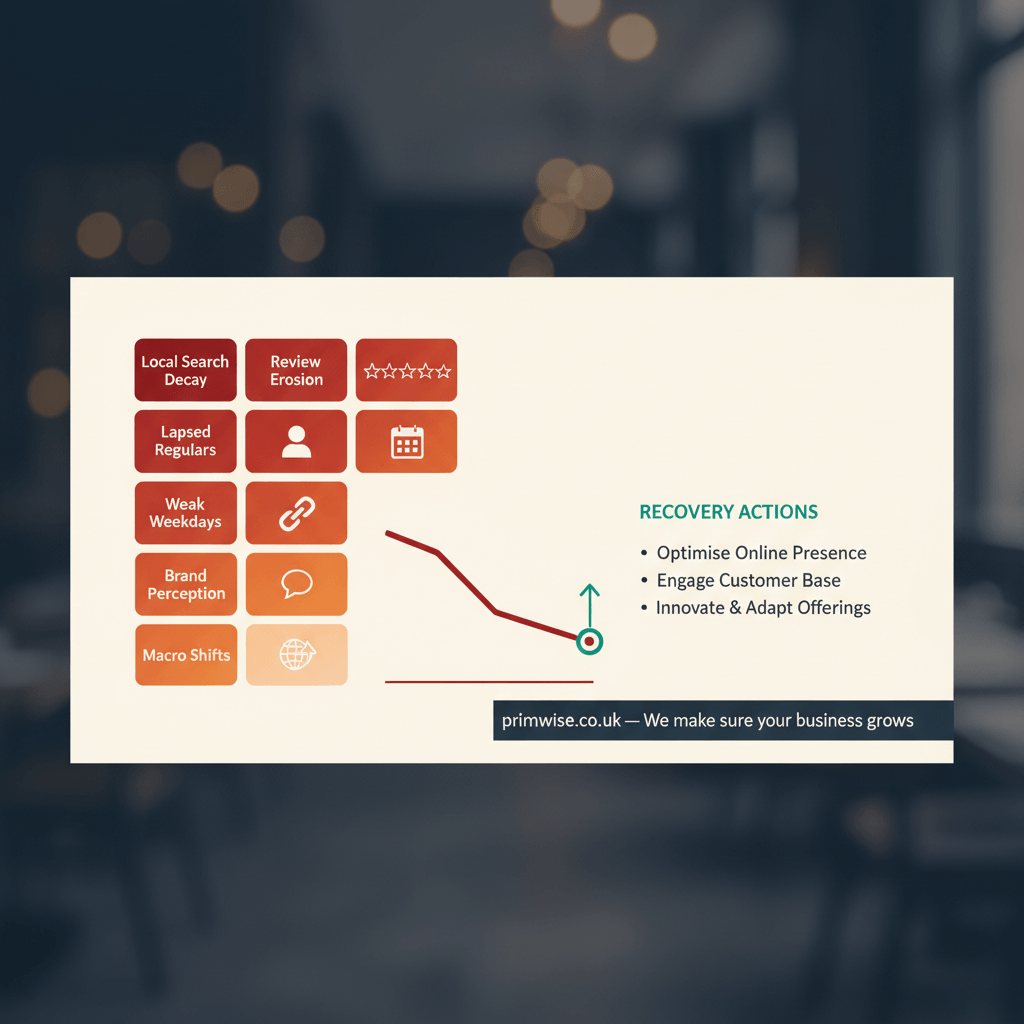
Revenue attrition is the delayed symptom of operational friction or digital invisibility, never a standalone market verdict. According to UKHospitality’s 2024 Hospitality Sector Report, the UK recorded over 4,000 net restaurant site losses in 2024, the highest figure in five years, with persistent mid-week footfall voids and cost-of-living pressure cited as the primary structural drivers. CGA by NIQ data further confirms that UK on-trade visits declined by approximately 3.2% year-on-year in the twelve months to Q3 2024, with weekday lunch occasions suffering the steepest indexed decline. These are not isolated business failures. They are the predictable outcome of operators applying intuition where data-led intervention was required. Restaurant sales drop for seven primary reasons: local search visibility decline, review velocity erosion, lapsed guest attrition, weak weekday programming, broken CRM architecture, outdated brand perception, and neighbourhood macro shifts. Diagnosing which of these seven forces is driving your specific revenue decline is the only legitimate starting point for commercial recovery.
Local Search Visibility Decline
Local search visibility decline occurs when a restaurant loses its position in the Google Local Pack for high-intent, non-branded queries. When this happens, you become invisible on the digital high street and no amount of internal operational excellence will fill your empty tables. BrightLocal’s Local Consumer Review Survey confirms that 98% of UK consumers used the internet to find local business information in 2023 and that 87% actively read online reviews before choosing a venue. If your restaurant is absent from the top three map results, the overwhelming majority of potential diners in your immediate catchment will never encounter your brand at all.
The Incognito Protocol Test
Before investing a single pound in paid media or brand refresh, operators must conduct a zero-cost objective assessment to confirm they are suffering from search decay rather than a genuine collapse in local demand. Open a private browsing window on a mobile device located approximately one mile from your venue and search for generic, category-specific terms relevant to your offering for example, ‘Italian restaurant near me’ or ‘Sunday roast in Shoreditch.’ If your venue fails to appear in the top three map pack results, your primary problem is not consumer demand but algorithmic obscurity. This single test takes four minutes and can save operators from misallocating tens of thousands of pounds in the wrong direction.
- Use a private browsing window to eliminate personalised search history from results
- Search using category-specific terms rather than your brand name to replicate cold discovery behaviour
- Identify the top three competitors occupying the prime local pack positions
- Compare their Google Business Profile attributes against your own to identify specific gaps
- Note whether competing venues have more recent reviews, geo-tagged images, or structured menu data indexed
Clinical GBP Rehabilitation
Regaining lost algorithmic real estate requires a structured Google Business Profile rehabilitation strategy that extends far beyond updating opening hours. The first priority is NAP standardisation: your Name, Address, and Phone number must be identical across every global directory, citation source, and social platform to rebuild trust with Google’s local ranking algorithm. In 2026, the GBP attributes most heavily weighted by Google’s local algorithm include ‘Dine-in,’ ‘Takeaway,’ ‘Delivery,’ and ‘Reservations’ service attributes all of which must be accurately populated. Beyond attributes, operators must upload geo-tagged interior and food imagery on a weekly cadence, respond to every review using keyword-rich semantic language, and implement API-connected menu structuring so that Google can index every dish served. Venues that fail the Incognito Protocol Test and require rapid GBP rehabilitation can access PrimeWise’s structured local SEO recovery programme, which has restored Google Local Pack rankings for independent operators across London, Manchester, and Edinburgh within forty-five days.
ALGORITHMIC INVISIBILITY COSTS MORE THAN POOR SERVICEIf your venue is absent from the Google Local Pack for category-level search terms, you are losing prospective diners before they ever encounter your reviews, your menu, or your brand story. Local search visibility is the single highest-leverage fix available to most UK operators.
Recent Review Erosion
Past prestige does not guarantee future covers. A venue carrying a lifetime rating of 4.5 stars can still experience severe revenue haemorrhaging if recent sentiment trends downward. Modern diners prioritise the velocity and sentiment of your most recent reviews over historical accolades, and the modern consumer decision-making process takes fewer than ninety seconds meaning prospective bookings are won or lost on the first page of your digital feedback. ReviewTrackers data confirms that restaurants with management responses posted within 24 hours see between 12% and 16% higher booking conversion rates than venues that leave reviews unanswered.
The Velocity Audit Test
Operators must move beyond monitoring their lifetime star rating and conduct a strict audit of the past thirty days of public feedback. Extract your twenty most recent reviews from Google and TripAdvisor and calculate their average star rating independently of your historical score. If this rolling average is lower than your all-time figure, you are experiencing active review velocity erosion that is suppressing booking conversion in real time. Identify recurring negative keywords related to specific operational failures slow service, cold food, noise levels as these patterns will recur and compound unless the root operational issue is resolved before the marketing fix is applied.
- Calculate the average star rating of your twenty most recent public reviews in isolation
- Identify recurring negative keywords that point to specific, repeatable operational failures
- Measure your review frequency against your two nearest direct competitors
- Audit the average response time from management to negative feedback
- Assess whether positive reviews mention the same attributes that your brand narrative prioritises
The Automated Feedback Loop
To intercept negative sentiment before it reaches public domains, operators must integrate a technology-driven private feedback loop connected directly to the point of sale system. An automated SMS or email trigger is deployed precisely two hours after a diner settles their bill, soliciting a private satisfaction rating. Positive responses are algorithmically routed through to Google or TripAdvisor review request links, while negative feedback is funnelled into a private management inbox for immediate service recovery before the experience calcifies into a one-star public review. This single system, when deployed correctly, dramatically improves review velocity, Net Promoter Score, and booking conversion simultaneously. Connecting NPS methodology to this automated loop also provides operators with a longitudinal measure of guest sentiment that transcends the binary nature of star ratings.
REVIEW VELOCITY OUTRANKS REVIEW VOLUMEA restaurant with 200 five-star reviews and no recent activity will consistently lose bookings to a competitor with 80 reviews and a consistent weekly cadence of fresh four-star feedback. Recency signals dominate the consumer decision process in 2026.
Lapsed Regulars
Customer acquisition costs across the UK digital landscape continue to escalate. Industry benchmarks consistently indicate that acquiring a new restaurant diner costs between three and seven times more than retaining an existing one, making the silent churn of loyal local guests one of the most financially destructive forces in hospitality. Focusing exclusively on acquiring new covers while ignoring database attrition creates a leaky bucket scenario where marketing expenditure scales in absolute terms but net revenue remains entirely stagnant. The hidden cost of this churn is rarely quantified by operators until it is too late to reverse without significant investment.
The Cohort Analysis Test
You must leverage your reservation platform data to conduct a retention audit over a ninety-day rolling period. Extract a cohort of diners who visited three months ago and determine exactly what percentage returned within the subsequent quarter. If your repeat visitation rate falls materially below competitors in your segment, your primary revenue decline is rooted in failed loyalty mechanics rather than weak top-of-funnel visibility. This distinction is critical: pouring more marketing budget into acquisition when the retention funnel is broken is equivalent to filling a punctured vessel.
- Export historical reservation data to isolate guests who visited once and never returned
- Filter for guests absent from the booking system for more than ninety consecutive days
- Cross-reference lapsed guests against their average spend per cover
- Calculate the total annualised revenue represented by the churned segment
- Identify whether churn clusters around a specific time period that correlates with an operational or environmental change
The Win-Back Sequence
An anonymised case study from a sixty-cover independent brasserie in Manchester demonstrates the commercial power of this intervention: following implementation of a structured win-back email sequence, the venue recovered an estimated £14,000 in incremental annual revenue within ninety days, without a single pound spent on paid advertising. The mechanism is a plain-text email triggered from the general manager’s personal address, sent to any guest absent for ninety days, offering a complimentary starter or glass of wine as a quiet gesture of hospitality. This approach bypasses marketing fatigue entirely, lands outside promotional email folders, and restores the human element of the hospitality relationship that mass newsletters systematically erode. The psychological weight of a personal, low-friction invitation from a named individual carries conversion rates that image-heavy broadcast campaigns cannot replicate.
Weak Weekday Programming
Macroeconomic shifts in working patterns have fundamentally restructured high street footfall in the UK. Office for National Statistics Labour Force Survey data confirms that as of late 2024, approximately 28% of UK workers operate on a hybrid model, with Tuesday to Thursday representing the primary office attendance days. This creates predictable mid-week footfall patterns that operators can model, but it also means that the Monday and Friday lunchtime trade that once sustained many urban restaurants has structurally collapsed. A failure to adapt operational programming to this new reality results in sharp and widening variance between weekend capacity and weekday desolation.
The Weekly Cover Variance Audit
To validate this specific macroeconomic pain point, extract your daily cover counts and calculate the percentage differential between peak Saturday service and Wednesday lunch service. If this variance has widened significantly over the past two years and correlates with the acceleration of hybrid working adoption, your sales decline is a direct structural symptom of changed workforce geography rather than a product or marketing failure. This distinction liberates operators from misallocating resource into brand campaigns that cannot solve a location-specific demand problem. A venue in London’s financial district, for example, experienced a 34% increase in Wednesday covers within twelve weeks of implementing structured experiential programming rather than promotional pricing.
- Compare current weekday cover counts against your own pre-2022 historical benchmarks
- Isolate point of sale data to identify the precise hours where footfall becomes unprofitable
- Review local commercial property occupancy reports to understand neighbourhood demand limits
- Calculate the fixed operational cost being absorbed during identified dead zones
- Model the revenue required to make mid-week service commercially viable at current cost structures
Lifestyle Programming Interventions
Desperate mid-week discounting is the most common and most destructive response to weekday footfall decline. It trains your most price-sensitive customers to delay bookings until a deal appears, permanently compresses average spend per cover, and signals brand weakness to the broader market. The correct prescription is experiential programming that creates compelling, time-specific reasons to visit that transcend basic price convenience. Localised supper clubs, pre-theatre set menus, exclusive supplier tasting evenings, and targeted industry networking dinners manufacture bespoke demand during operational voids while protecting the pricing integrity of your weekend service. The critical distinction is that these interventions sell a premium experience at full margin rather than discounting an existing one at reduced margin.
DISCOUNTING TRAINS CUSTOMERS TO WAITEvery mid-week promotional deal you run teaches price-sensitive diners to delay their booking until the next offer appears. Experiential programming creates urgency without eroding the brand equity that justifies your full weekend pricing.
Broken CRM Architecture
Possessing a database of twenty thousand email addresses is entirely commercially useless if the underlying technology stack is fragmented. When point of sale systems operate in isolation from reservation platforms, and when Wi-Fi capture tools remain disconnected from email marketing systems, customer data remains siloed across incompatible software environments. This prevents operators from understanding who their highest-value guests are, what they spend on specific categories, and how to build targeted campaigns that incentivise profitable return visits rather than broadcasting generic promotions to an undifferentiated list.
The Micro-Segment Test
Test the agility of your internal marketing capability or external agency by making a precise data request: ask them to isolate a list of guests who have spent over £200 on wine in the past six months but have not visited on a Tuesday in that period. If your team cannot generate this micro-segment within five minutes, your CRM architecture is fundamentally broken and is actively preventing revenue recovery at scale. Operators who identify fragmentation at this diagnostic stage typically require an independent external audit before any meaningful recovery programme can be designed and deployed. PrimeWise provides a complimentary hospitality marketing audit that benchmarks your current data architecture against sector-leading operators across the UK, identifying the exact integration gaps costing you measurable revenue.
- Audit all third-party software platforms for live API integration capabilities
- Verify whether customer spend data is automatically mapped to individual guest email profiles
- Assess the accuracy of Wi-Fi data capture records against reservation platform logs
- Identify any manual data entry processes creating bottlenecks and data degradation
- Confirm whether your email platform can trigger behavioural sequences based on spend, visit frequency, or lapse duration
Tech Stack Consolidation
Modern hospitality revenue recovery demands integrated systems that marry transactional data with personal guest identity in real time. Consolidated hospitality CRM platforms such as SevenRooms, Tenzo, or Access Collins pull live data directly from EPOS systems and booking widgets, creating a unified guest profile that evolves with every interaction. This unification enables hyper-targeted campaigns where bespoke, behavioural messaging is delivered exclusively to the cohort most statistically likely to convert at a specific spend threshold. The measurable improvement in return on marketing investment from this architecture versus a fragmented stack is not marginal it is transformational for operators managing margins within the UK restaurant average EBITDA range of 8% to 12%.
Outdated Brand Perception
The hospitality landscape evolves rapidly and consumer aesthetic expectations shift with it. A venue that positioned itself as a premium, trend-forward destination in 2019 may now communicate as tired and misaligned to the demographics it is actively trying to attract in 2026. Operator bias is a powerful suppressant of objective brand evaluation when you have built something, it is structurally difficult to perceive it as the market perceives it. This gap between internal brand self-assessment and external market perception is frequently the undiagnosed cause of a gradual but sustained decline in new guest acquisition.
The Blind Social Sentiment Audit
Strip away internal bias by gathering structured feedback from individuals entirely outside the business regarding your visual identity, social media presence, and brand narrative. Present your Instagram profile, Google listing photography, and website homepage to five people who have never visited your venue and record the words they use spontaneously to describe the experience they would expect. If those words do not align with your internal brand guidelines or the positioning you are attempting to communicate, a perception gap is actively costing you covers every single week. Compare your current visual assets against competitors who launched within the past eighteen months the contrast will be instructive.
- Compare your current photography quality and style against newly opened competitors in your segment
- Analyse the demographic breakdown of your active social media followers against your target guest profile
- Review the engagement rate on your branded content over the past twelve months for declining trend signals
- Assess whether your current imagery reflects the dining experience at its absolute best or at an average standard
- Evaluate whether your brand narrative addresses the specific values and priorities of your 2026 target demographic
Digital Repositioning Without Physical Refit
Executing a meaningful brand pivot does not require a physical refit costing hundreds of thousands of pounds. A cost-effective digital repositioning can organically shift market perception within a single quarter. Commission editorial-style food and atmosphere photography that reflects your venue at its experiential peak. Refine your typography and colour palette across all digital touchpoints to ensure visual consistency. Partner with carefully vetted micro-influencers creators with between 8,000 and 50,000 highly engaged followers in your specific geographic market whose aesthetic authentically aligns with your desired positioning. This approach modernises your digital signals, attracts a refreshed demographic, and does not require a single structural change to the physical venue.
PERCEPTION IS YOUR MOST FRAGILE COMMERCIAL ASSETBrand perception erodes silently. By the time declining new guest acquisition rates make the problem financially visible, the market has already formed an opinion that requires sustained, deliberate effort to reverse. Audit your digital facade quarterly, not annually.
Neighbourhood Macro Shifts
Occasionally, a sustained sales decline is entirely disconnected from internal operations and is strictly dictated by environmental forces beyond the operator’s direct control. High streets undergo fundamental structural change driven by infrastructure development, evolving transport links, economic rezoning, and legislative intervention. Recognising when a location has transitioned into a footfall desert is not a commercial defeat it is critical intelligence that dictates an entirely different operational playbook and prevents years of futile investment in the wrong recovery strategies.
Walk-In Ratio and Environmental Footfall Analysis
To determine whether the high street itself has changed, compare your current ratio of unreserved walk-in covers against your own historical baseline from three and five years prior. Cross-reference this internal metric with local transport authority tap-in statistics or footfall trackers available through your local Business Improvement District or council economic development office. In Greater London and increasingly in Birmingham and Bristol, Ultra Low Emission Zone expansion represents a highly specific, measurable, and searchable environmental factor that is suppressing the spontaneous visit behaviour that convenience-model restaurants depend upon. If ULEZ boundaries have expanded around your venue and walk-in traffic has declined proportionately, this is causal data, not coincidence, and it demands a strategic response rather than a tactical marketing fix.
- Track the precise percentage of unreserved walk-in covers week-over-week across a twelve-month period
- Review local authority economic reports regarding high street retail occupancy and footfall trend data
- Analyse transport authority data to identify long-term declines in commuter transit at the nearest stations
- Monitor the specific impact of ULEZ expansion, Low Traffic Neighbourhood schemes, or road closure orders near your venue
- Consult your local Business Improvement District for comparative footfall index data across your trading area
Pivoting to the Destination Model
When transient footfall collapses, convenience restaurants perish. The strategic response is a deliberate transition to a destination venue model where guests travel specifically and intentionally for your experience rather than selecting you based on proximity or passing visibility. This transition requires sustained investment in digital public relations securing authoritative coverage in national publications, food media platforms, and high-authority lifestyle titles. It demands a robust long-tail SEO strategy that generates guaranteed organic traffic from diners who are actively searching for your specific type of experience regardless of location. Partnering with luxury hotel concierges, corporate travel managers, and premium experience aggregators creates referral funnels that replace lost transient footfall with pre-qualified, high-spend destination visitors. This is a fundamentally different business model, and it requires fundamentally different marketing architecture to sustain it.
The Expert Recovery Summary
Restaurant revenue decline is almost always diagnosable, and in the overwhelming majority of cases, it is recoverable through methodical, data-led intervention. The seven failure points documented above local search invisibility, review velocity erosion, lapsed guest attrition, weak weekday programming, broken CRM architecture, outdated brand perception, and neighbourhood macro shifts account for the structural causes of revenue attrition across the UK hospitality sector. The critical discipline is diagnosis before prescription: applying the wrong marketing fix to the correct symptom is the single most expensive mistake a hospitality operator can make.
If your self-assessment has identified two or more of these seven failure points, the revenue attrition will compound without structured external intervention. The seven diagnostic tests embedded in this framework are a starting point, not a complete recovery programme. Request a confidential Revenue Recovery Diagnostic from PrimeWise at primewise.co.uk, where a senior hospitality strategist will map your specific failure points to a prioritised commercial recovery plan within 48 hours.
The following prioritised action checklist summarises the clinical recovery sequence for operators ready to move from diagnosis to intervention:
- Run the Incognito Protocol Test to establish whether local search invisibility is suppressing top-of-funnel discovery
- Conduct a thirty-day review velocity audit and implement an automated private feedback loop within seven days
- Export your reservation cohort data and calculate your ninety-day repeat visitation rate against sector benchmarks
- Analyse your weekly cover variance and determine whether experiential programming or operational restructuring is required
- Run the micro-segment CRM test to establish whether your data architecture can support targeted revenue recovery campaigns
- Commission an objective blind audit of your digital brand presence against your two most recently opened competitors
- Consult local footfall and transport data to determine whether environmental factors require a destination model pivot